
Namibia with Kids: Our 2-Month Family Travel Guide and Weekend Itinerary
Namibia was one of those countries that surprised us, and honestly we are still amazed by its raw beauty. Travelling around Namibia with kids has easily become one of my favourite family travel experiences. That’s saying something, since we’ve visited 90 countries.
We spent two months in Namibia with our son, who was seven at the time. We used Windhoek as our base and explored the country on weekends. It worked surprisingly well for us. Rather than constantly packing and unpacking, we had a home base during the week and then headed off on adventures whenever we had a few days free.
And Namibia is a fantastic country for this kind of travel.
It is huge, so you obviously can’t see everything from Windhoek in a weekend. But there are some incredible places that you can reach with a well-planned trip. And the variety is what made Namibia so memorable for us.
One weekend we were driving through the desert around Swakopmund. Another involved enormous sand dunes, ancient dead trees and the kind of landscapes that look like they belong on another planet. We also visited Himba and Bushmen communities, climbed through the mountains around Spitzkoppe and learned about traditional ways of life.
For us, it was also a fantastic worldschooling destination. Geography, geology, history, wildlife, indigenous cultures and environmental science were basically everywhere we looked.
So if you’re wondering whether Namibia is a good destination for a family trip, especially with younger children, here’s exactly what we did and what we would recommend.
Quick jump: what’s in this guide
This is a long, detailed Namibia family itinerary, so here’s a quick way to jump to the section you need:
- Why travel to Namibia with kids?
- Our Namibia itinerary: steal our weekend trips
- Best things to do in Namibia with kids
- Namibia for worldschooling
- Where to stay with kids in Namibia
- Getting around Namibia with kids
- Practical tips for travelling to Namibia with kids
- Is Namibia safe for families?
- What food should you try in Namibia?
- How long do you need in Namibia?
- Our favourite Namibia experiences with our son
- Our recommended 2-week Namibia itinerary
- Final thoughts: Is Namibia worth visiting with kids?
Or jump straight to a specific activity:
- Go quad biking in the desert around Swakopmund
- Visit Sandwich Harbour
- Explore Sossusvlei and climb Dune 45
- See the strange landscape of Deadvlei
- Visit Sesriem Canyon
- Stop in Solitaire for the famous apple pie
- Learn about Himba culture
- Visit Bushmen Paradise
- Explore Spitzkoppe and spend a night under the stars
- Meet the San people and learn traditional hunting skills
Why travel to Namibia with kids?
Namibia is not the easiest country for a family holiday if you’re looking for short distances and lots of activities in every town. It is vast, remote and in many places very hot and dry.
But that is also exactly what makes it interesting.
For children, Namibia feels like a giant outdoor classroom. You can go from desert to ocean, see enormous sand dunes, learn about indigenous cultures, explore canyons and climb around huge granite formations.
And there is a lot of space. We took a few tours where we drove around the country. And there were times when we drove for hours without seeing another person or a car.
If your kids enjoy being outdoors, animals, adventure and exploring unusual landscapes, Namibia is a great choice.
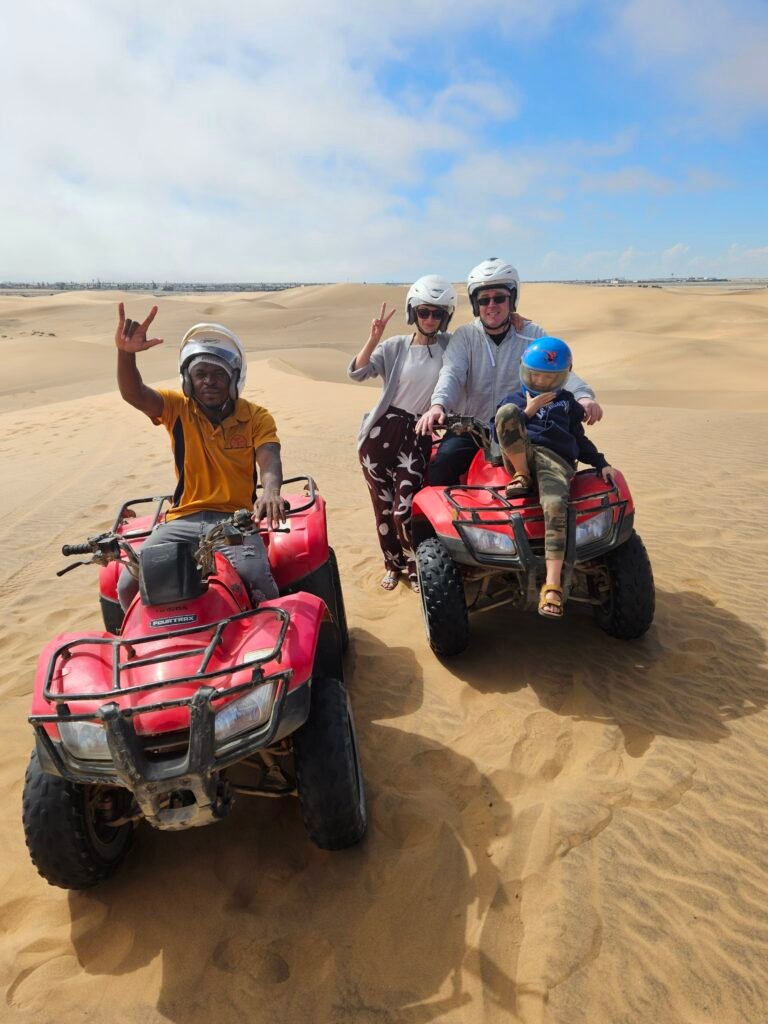
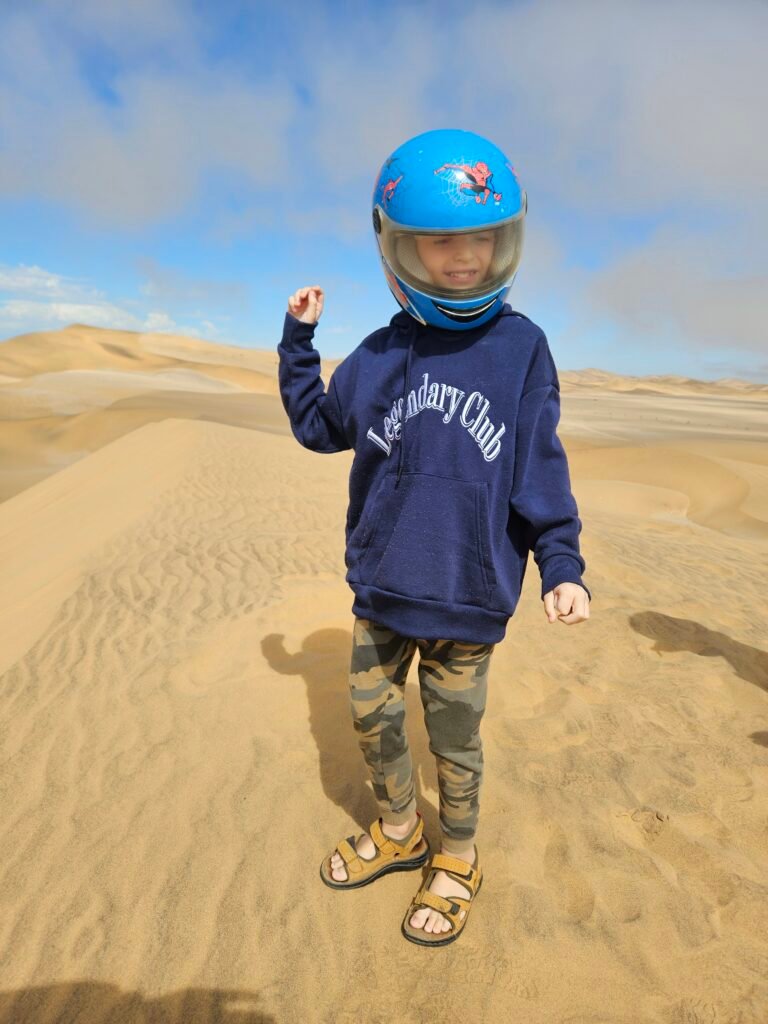
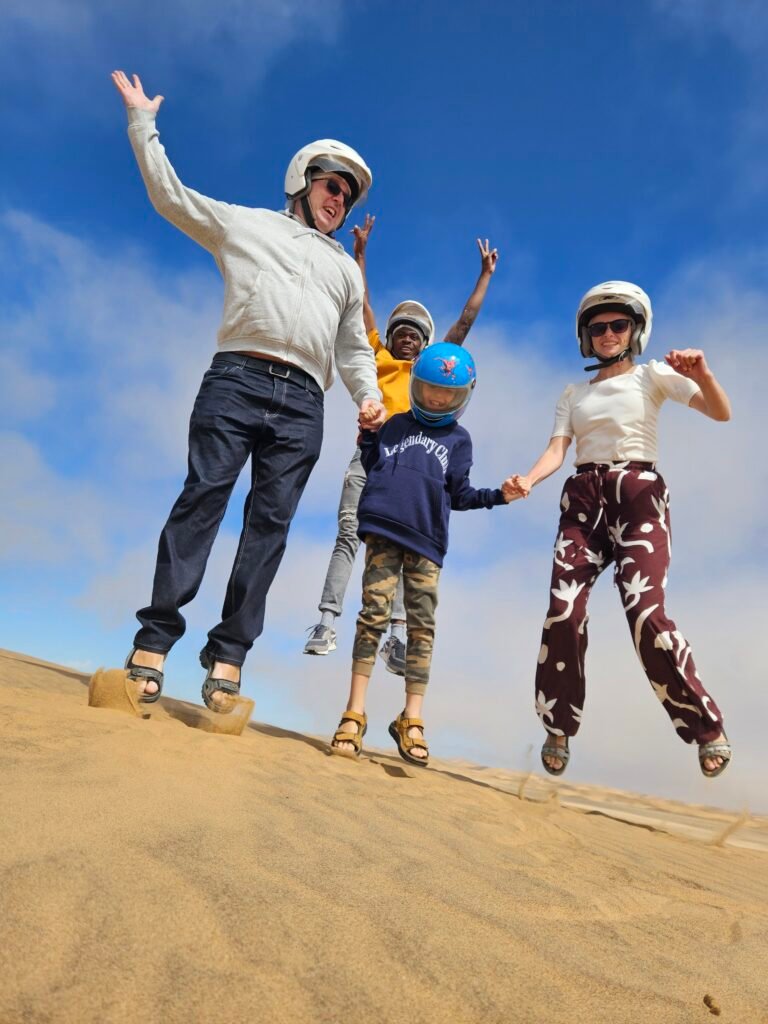
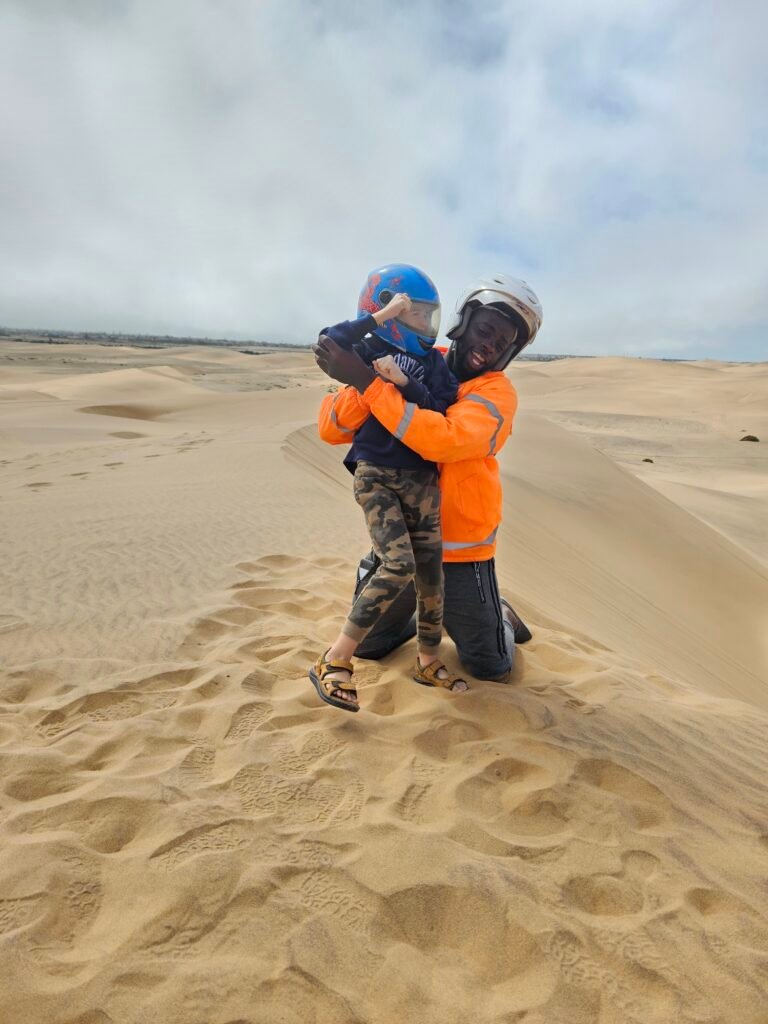
Our son was seven when we visited, and some of the activities were genuinely unforgettable for him. The quad biking in the desert around Swakopmund was probably one of the biggest hits.
Our Namibia itinerary: steal our weekend trips
Because we spent two months in Namibia, we had the luxury of not trying to cram everything into one trip.
We stayed in Windhoek as our base and used weekends to explore different parts of the country. This Namibia family itinerary is built around that same simple structure. So you can adapt it whether you have two long weekends or two months.
Here is the basic itinerary we followed:
Weekend 1: Swakopmund and Sandwich Harbour
- Windhoek to Swakopmund
- Quad biking in the desert
- Sandwich Harbour
- Dune bashing
- Driving through the massive dunes where the desert meets the Atlantic Ocean
This tour takes you on a 3 day journey from Windhoek to Sandwich Harbour and around the area.
Weekend 2: Sossusvlei and the Namib Desert
- Solitaire
- Dune 45
- Deadvlei
- Sesriem Canyon
This tour is a good option for exploring Sossusvlei if you prefer not to self drive.
Weekend 3: Himba and Bushmen experiences
- Visit a Himba community
- Learn about Himba traditions and daily life
- Visit Bushmen Paradise
- Learn about traditional Bushmen culture
Important: Bushmen Paradise involves a fairly steep climb up and down a mountain. There are no proper steps. Instead, you use a metal chain to help you climb. This is worth knowing before taking younger children.
Get Your Guide offers several tours for visiting the San people
Weekend 4: Spitzkoppe
- Explore Spitzkoppe
- See the enormous granite rock formations
- Visit a Bushmen community
- Learn about their traditions and way of life
You could combine some of these trips differently depending on how much driving you are comfortable with and how long you have. But if you’re coming to Namibia for a shorter holiday, I’d seriously consider building your itinerary around Swakopmund, Sossusvlei and the desert, then adding cultural experiences if you have time.
We booked all our tours with Quest Transfer, and they were great. They were able to customise some of the tours how we wanted. For example, they added the trip to the Himba village during our Sossusvlei tour.
Best things to do in Namibia with kids
1. Go quad biking in the desert around Swakopmund
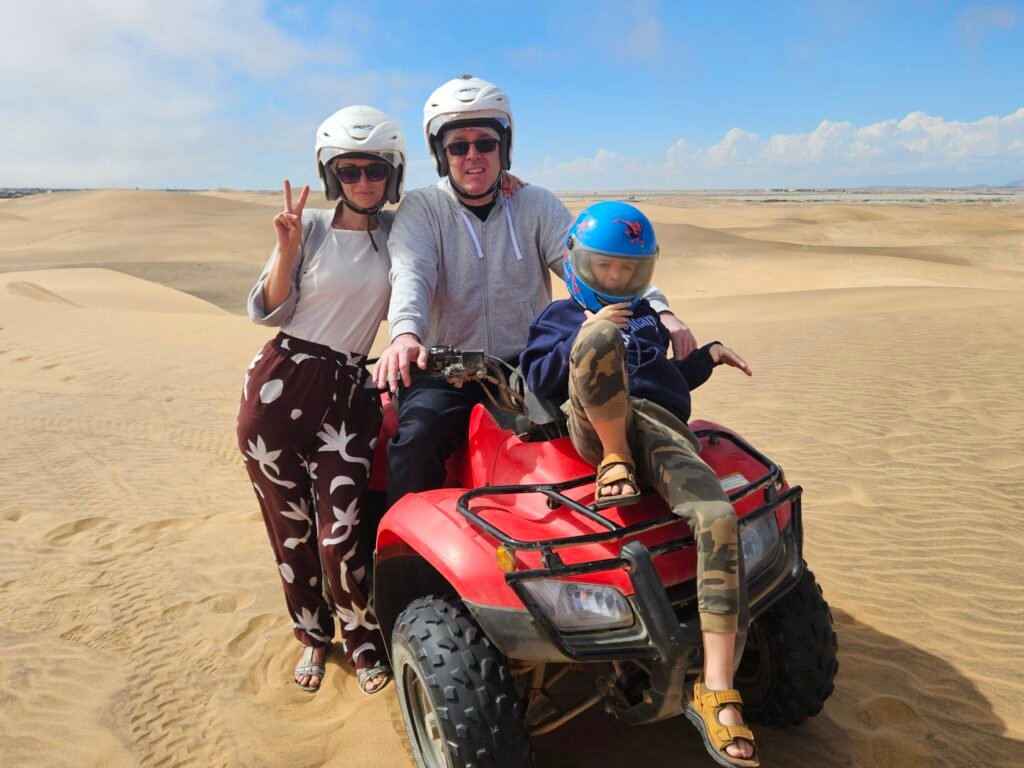
This was one of our son’s favourite activities in Namibia.
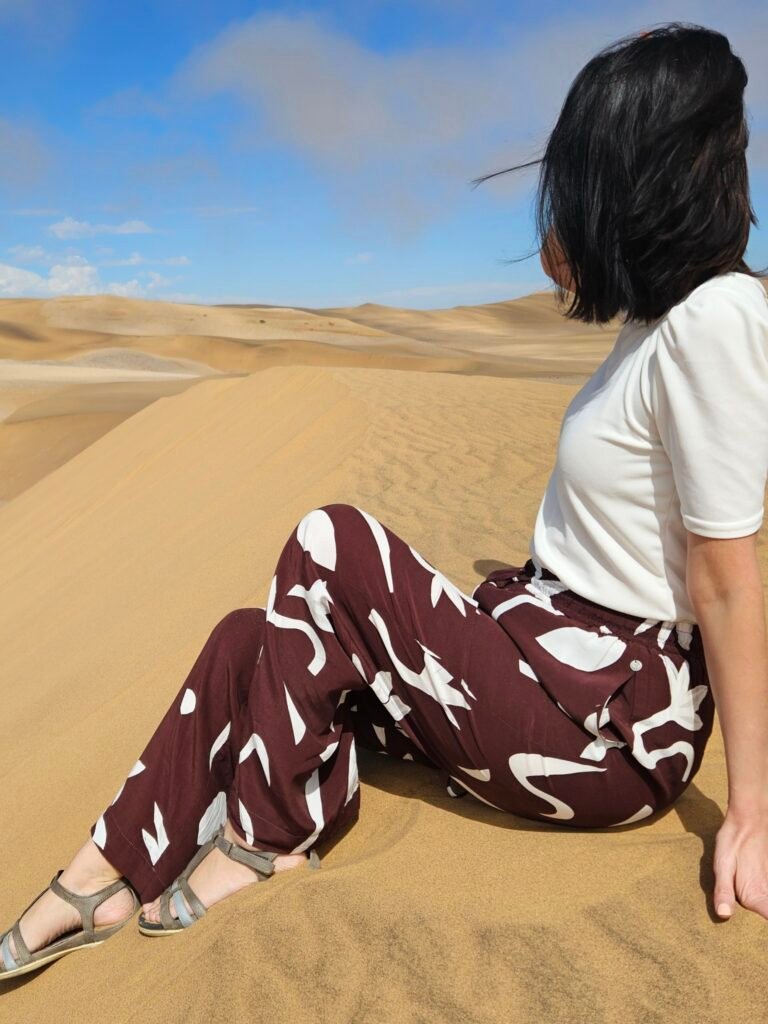
The desert around Swakopmund is enormous. And getting out onto the sand dunes on quad bikes is a completely different way to experience it.
At seven, our son absolutely loved it.
For kids who enjoy anything involving vehicles, speed and adventure, this is likely to be a highlight of a Namibia trip.
It also gives you a very different perspective on the Namib Desert. Instead of simply looking at the dunes from a viewpoint, you’re actually travelling across them.
Why families will enjoy it
It’s active, exciting and doesn’t require children to be particularly interested in history or geography to have a great time.
Of course, once you’re surrounded by enormous dunes, it’s also a pretty easy opportunity to start talking about how deserts form, how wind moves sand and why the landscape looks the way it does.
Recommended age
Our son was seven and loved it (he was on a bike with an adult). But check the minimum age requirements with the specific operator you book.
2. Visit Sandwich Harbour
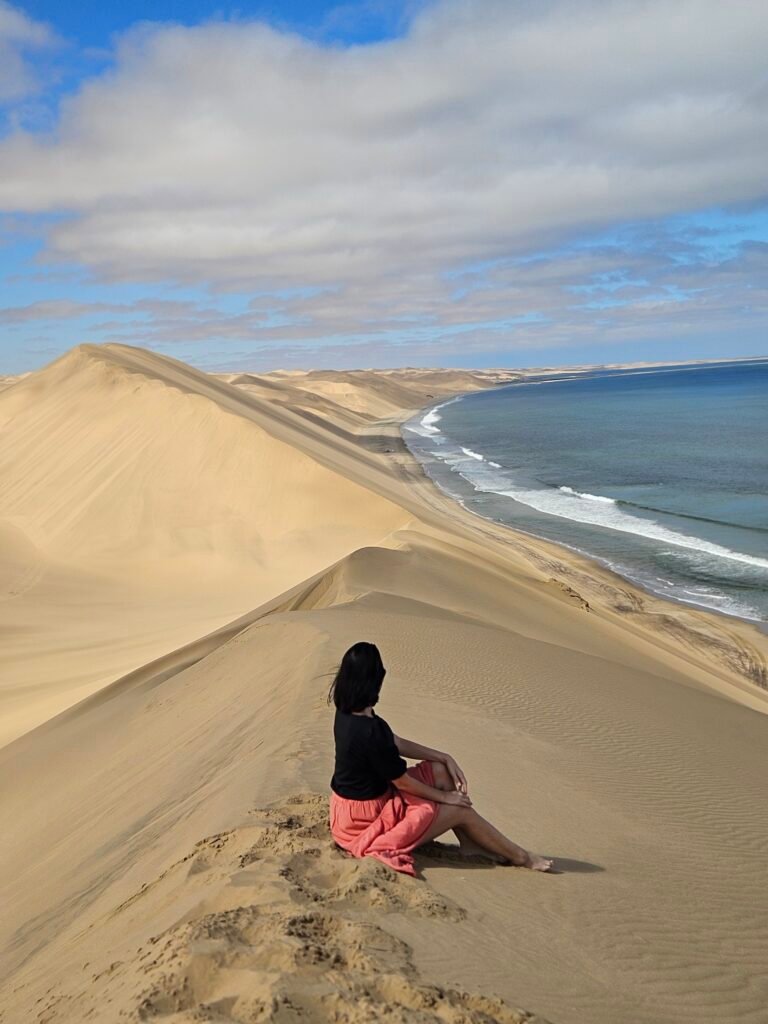
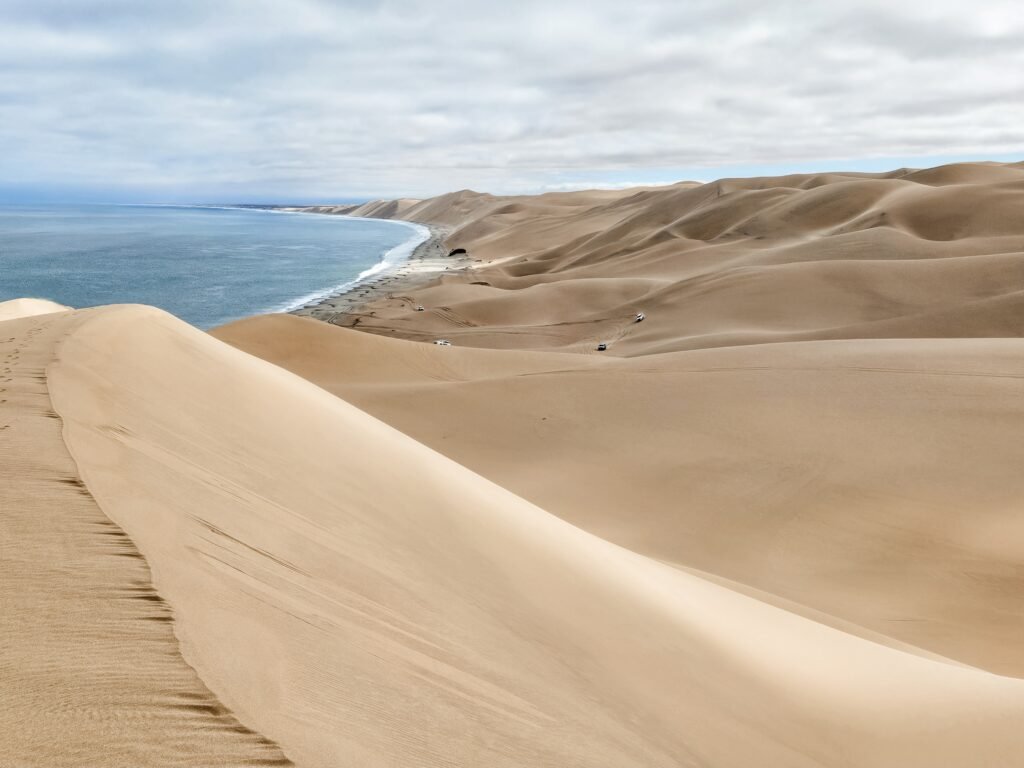
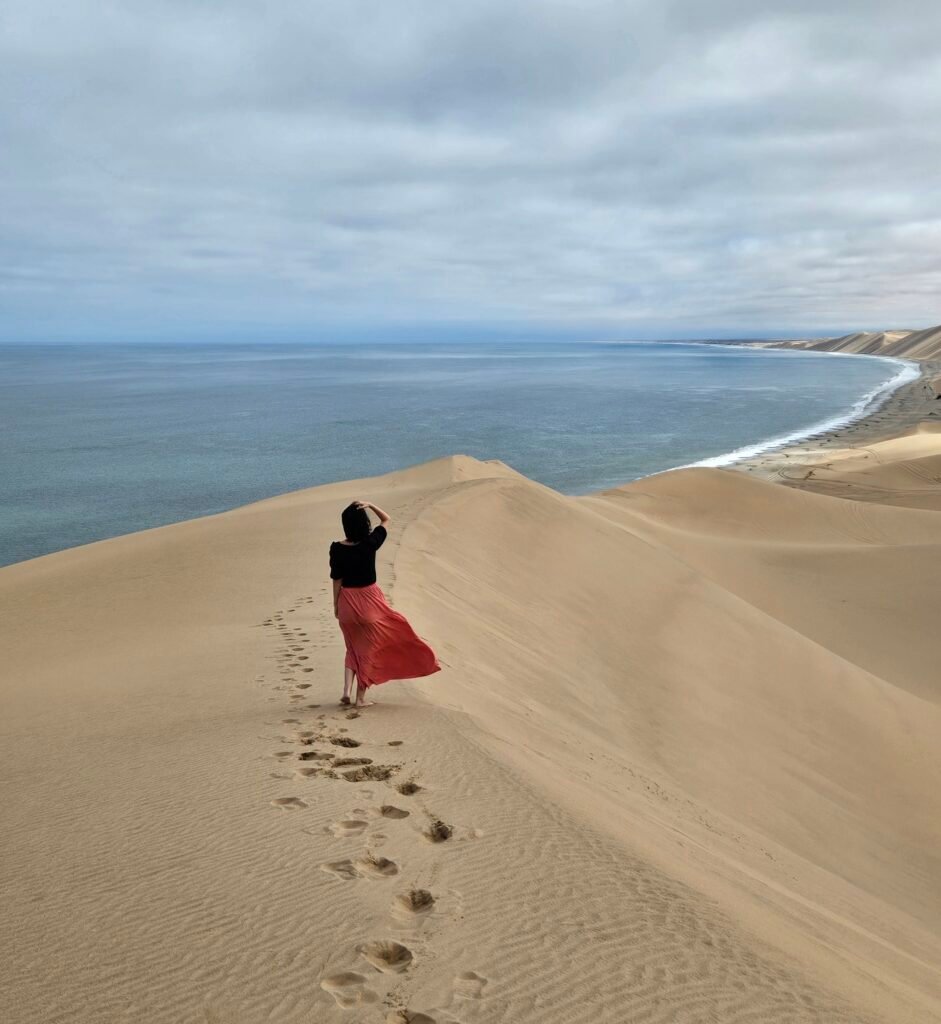
If you’ve seen photographs of Namibia, you’ve probably seen images of giant sand dunes dropping almost directly into the Atlantic Ocean.
That’s Sandwich Harbour, and it looks almost too dramatic to be real.
Sandwich Harbour is part of the Namib-Naukluft National Park, along the Atlantic coast south of Walvis Bay. What makes it so unusual is the way the Namib Desert meets the ocean. Huge golden dunes rise on one side, while the cold Atlantic stretches out on the other. There aren’t many places in the world where you get that combination on such a massive scale.
Getting there is half the fun. You travel along the beach and through the dunes in a 4×4, with some pretty serious dune driving along the way. At times the vehicle is climbing what looks like an almost vertical wall of sand before tipping over the other side. Our son was seven when we visited and absolutely loved it. For him, it was basically one enormous roller coaster made of sand.
Once you reach the higher dunes, the views are incredible. You can look back across miles of untouched desert and then turn around and see the Atlantic right beside you. It’s also a great place to talk to kids about how dunes move, how wind shapes the landscape and how the cold ocean helps create such an unusual coastal desert environment.
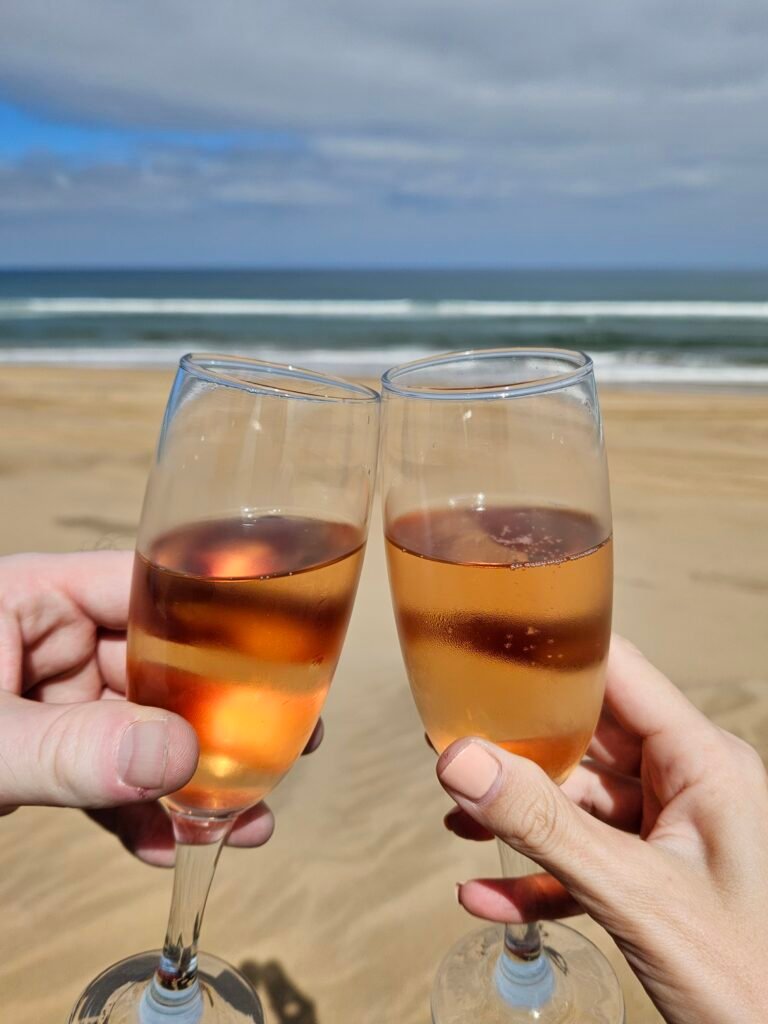
One of the nicest surprises was that our guide had prepared a picnic for us out in the dunes. It came with a lovely spread of food and even champagne. Sitting up on the sand, looking out over the desert and ocean while having lunch felt pretty special. Our son obviously wasn’t drinking the champagne, but he was very happy with the food and the fact that we were having a picnic in the middle of the desert.
Why families will enjoy it
This is definitely one for kids who like a bit of adventure. It’s not just about getting out of the car and looking at a beautiful view. The 4×4 drive, climbing the dunes and seeing the landscape change around you make the whole experience feel like an expedition.
For us, it was one of the highlights of our time in Namibia. It was also probably one of the most unusual landscapes our son had ever seen.
Practical tip
Do this with an experienced 4×4 operator rather than attempting to drive the dunes yourself. The sand can be extremely soft and the route is affected by tides, so local knowledge really matters. Bring sunscreen, water and a jacket. The Atlantic coast can be surprisingly cool, even when the desert inland is hot.
Recommended age
Our son was seven and had a fantastic time. But younger children who don’t enjoy bumpy or fast vehicle rides might find the dune driving a little intense (the ride may also cause motion sickness if you are prone to it).
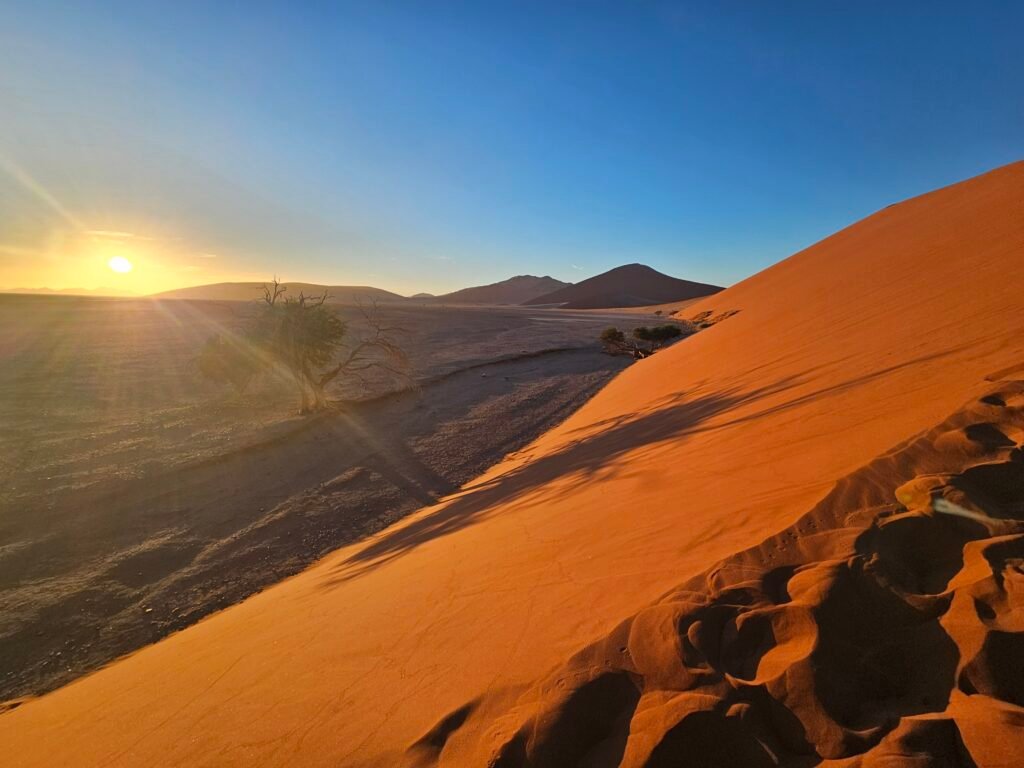
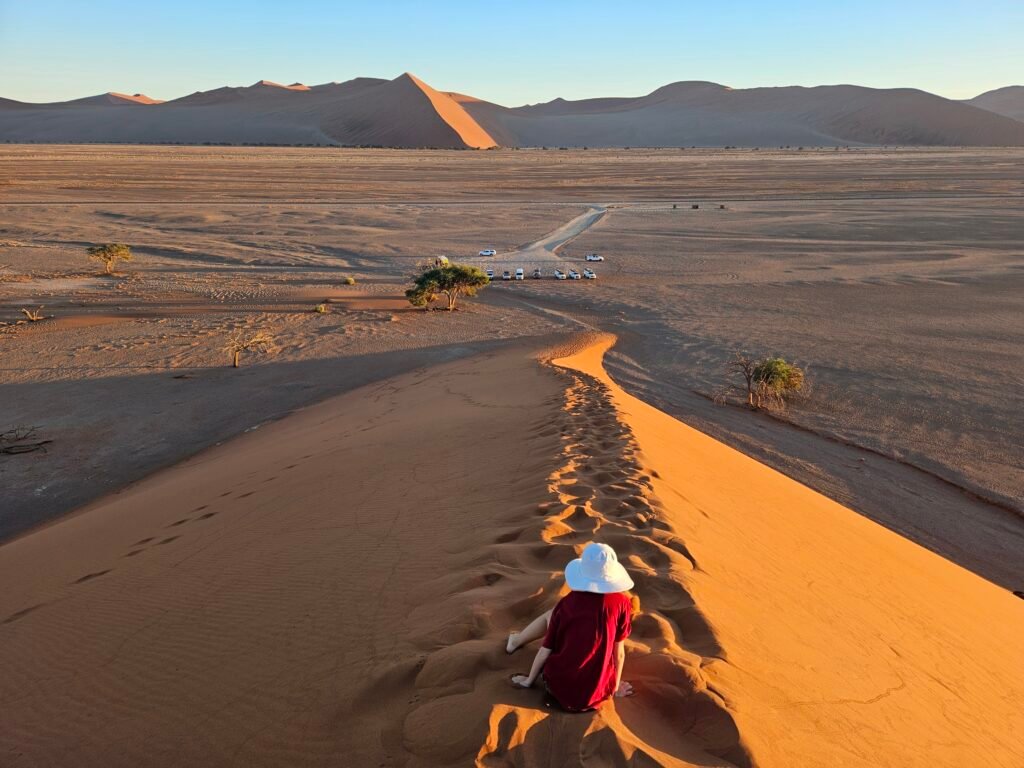
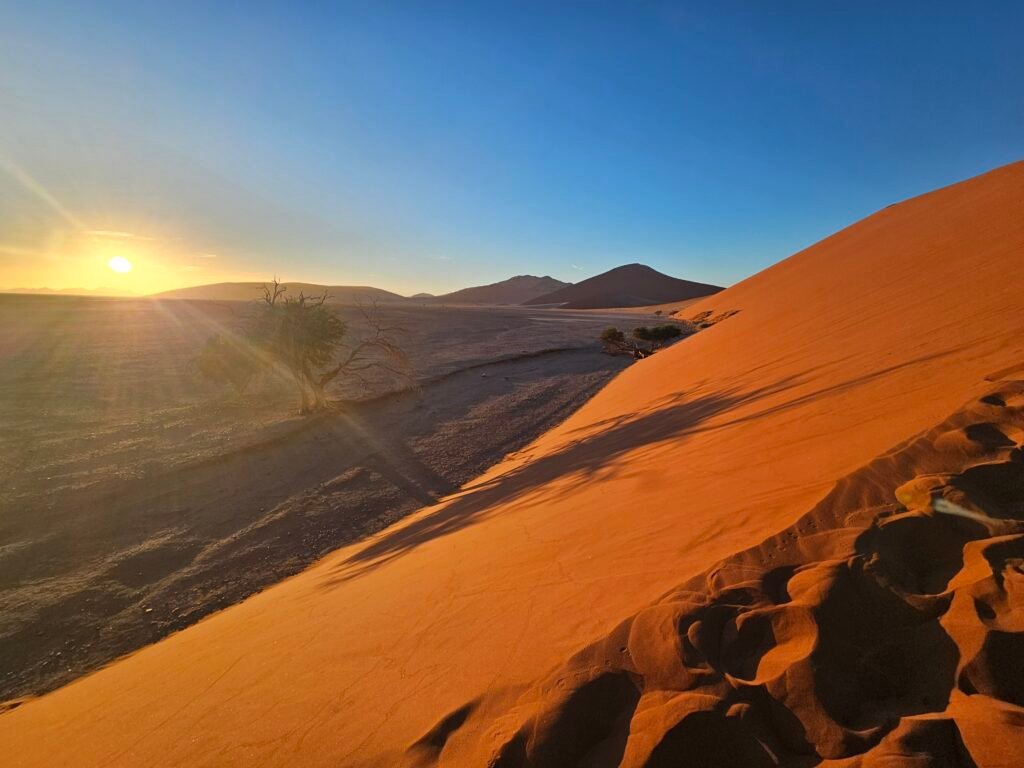
3. Explore Sossusvlei and climb Dune 45
If you only have time for one classic Namibia experience, Sossusvlei should probably be high on your list.
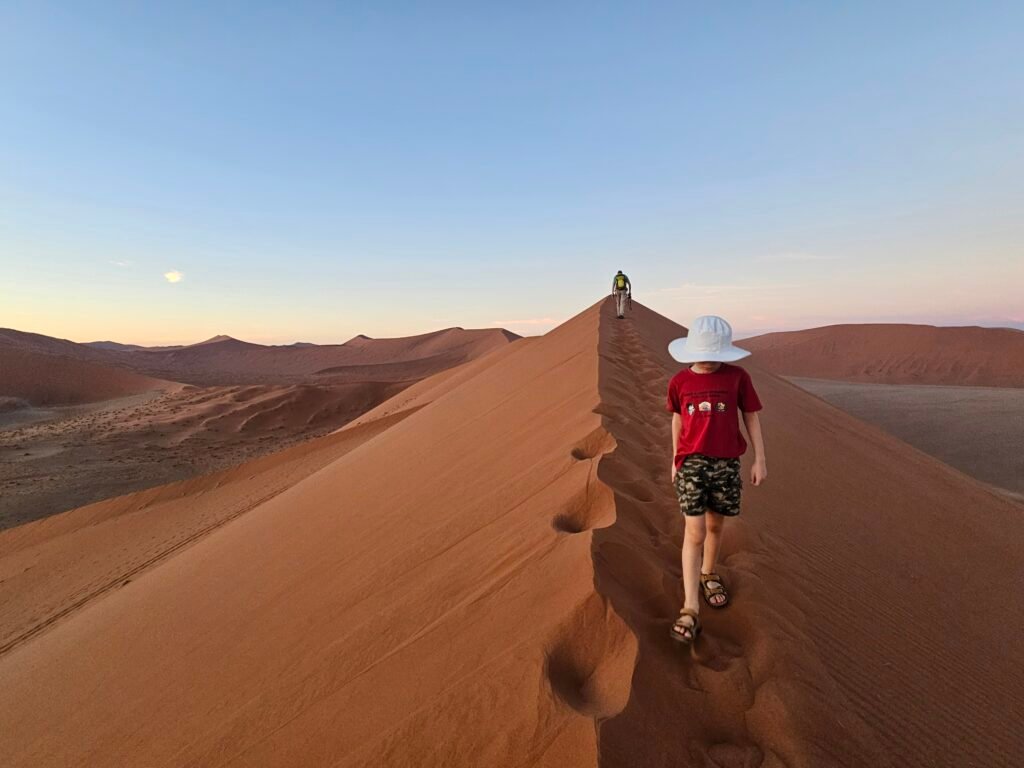
The landscape around Sossusvlei is famous for its enormous orange-red sand dunes.
We visited Dune 45, which is one of the best-known dunes in the area.
Climbing a giant sand dune with a seven-year-old is exactly as exhausting as it sounds. The sand moves under your feet, so every step feels like two steps. It was quite difficult to climb up on it, and we gave up half way. But our seven year old climbed up almost to the top without too much difficulty. The good thing is that you don’t have to go all the way. The views are spectacular even from the half way point.
Keep in mind that the tours to Dune 45 start really early (before 6 am). And it already starts getting pretty hot at that time.
Why families will enjoy it
Kids can actually interact with the landscape rather than just looking at it.
They can climb, run down the dunes and feel how different the sand is from a normal beach.
For worldschooling, it’s also a great place to discuss geology, erosion, weather and desert ecosystems.
Recommended age
Pretty much any age can visit Sossusvlei, but younger children may struggle with the heat and walking in deep sand.
Start early and take plenty of water.
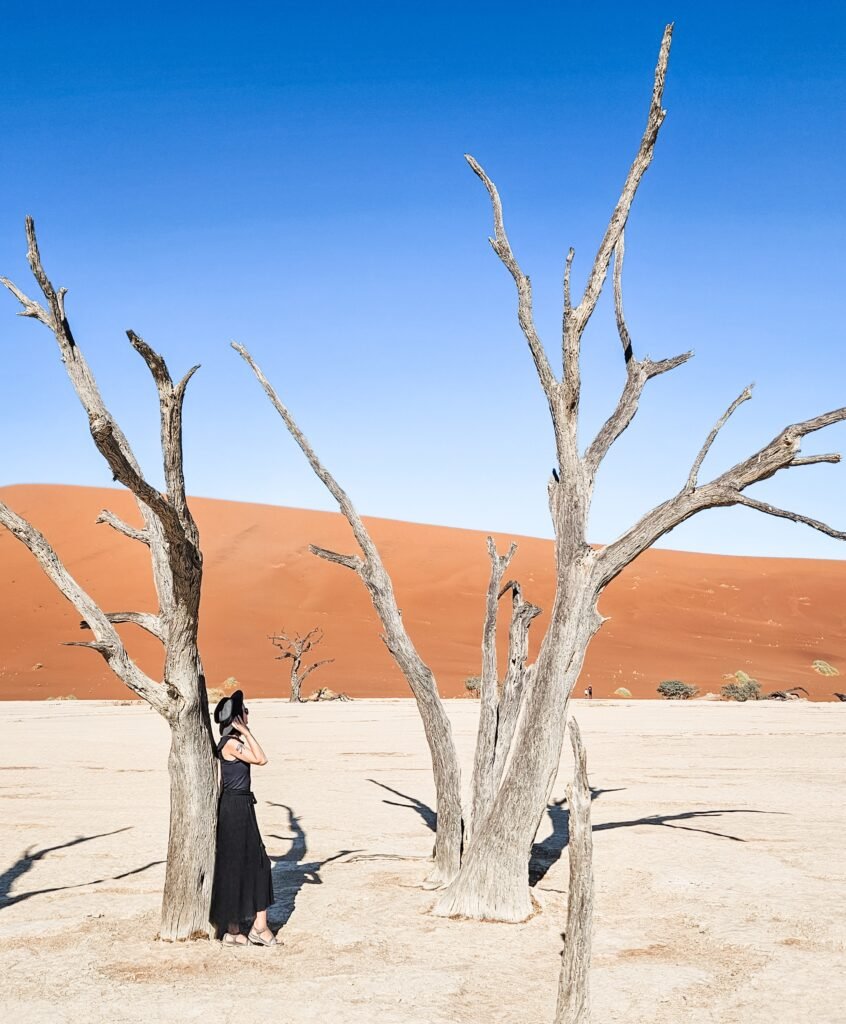
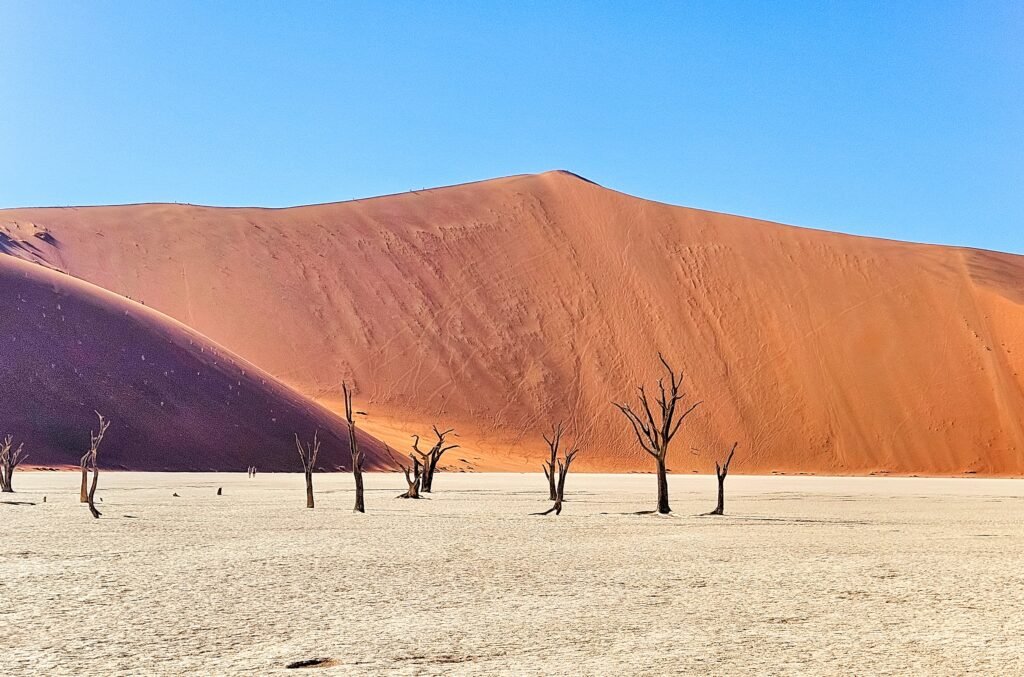
4. See the strange landscape of Deadvlei
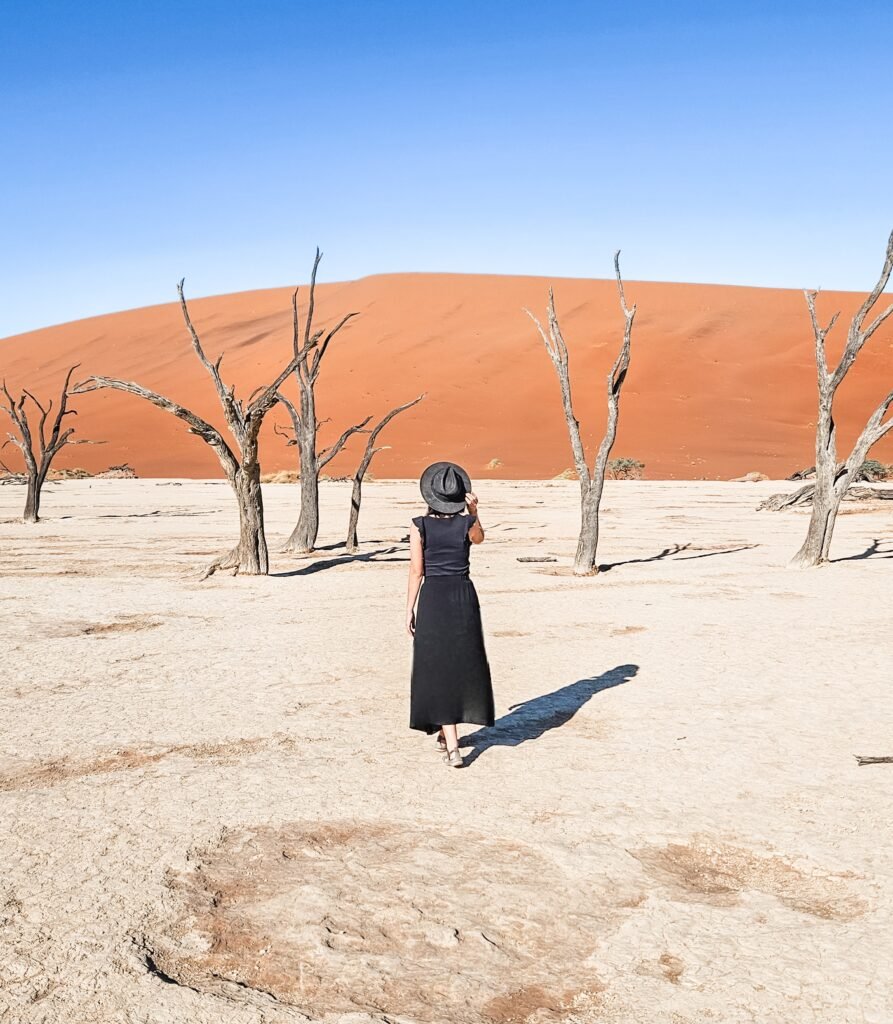
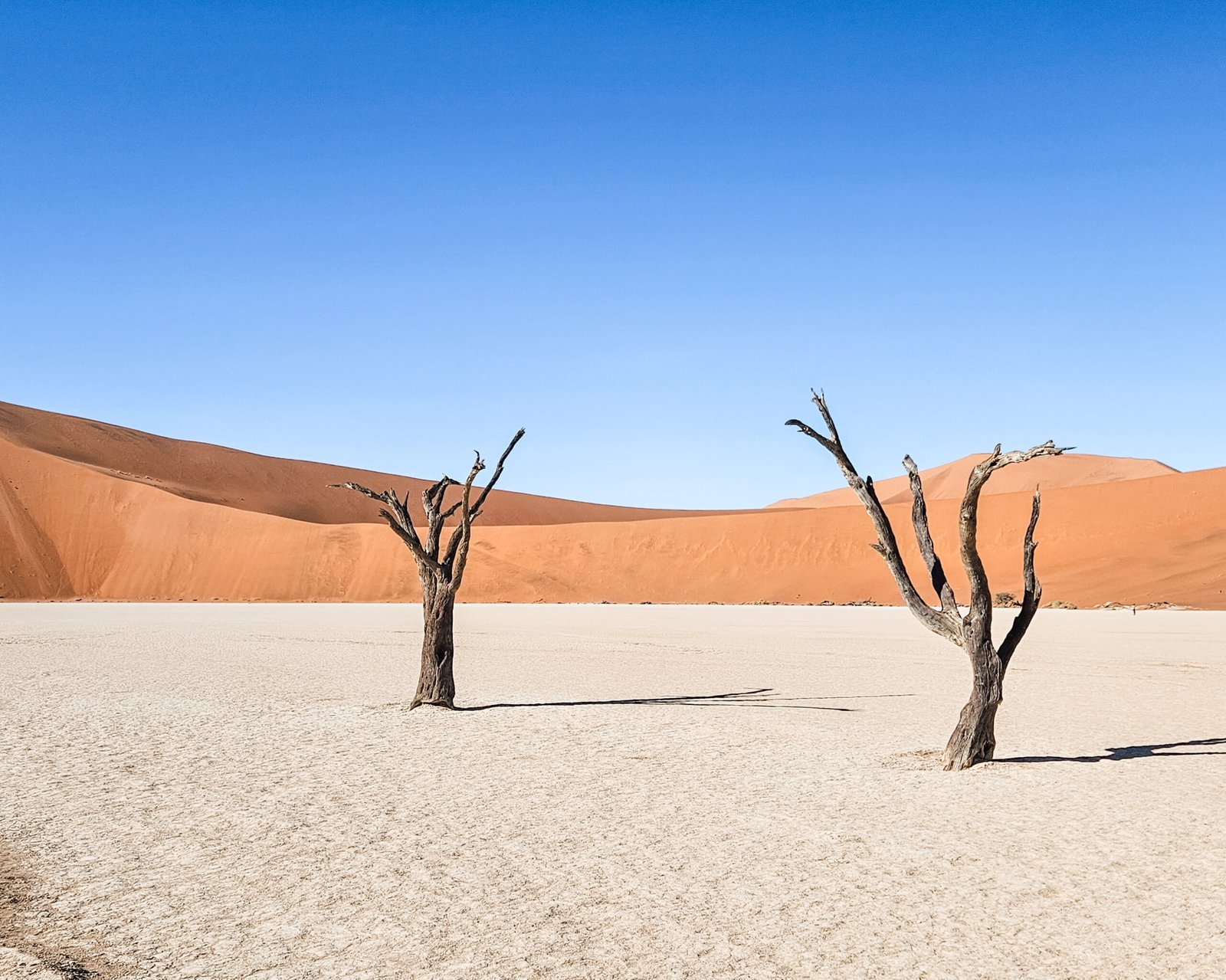
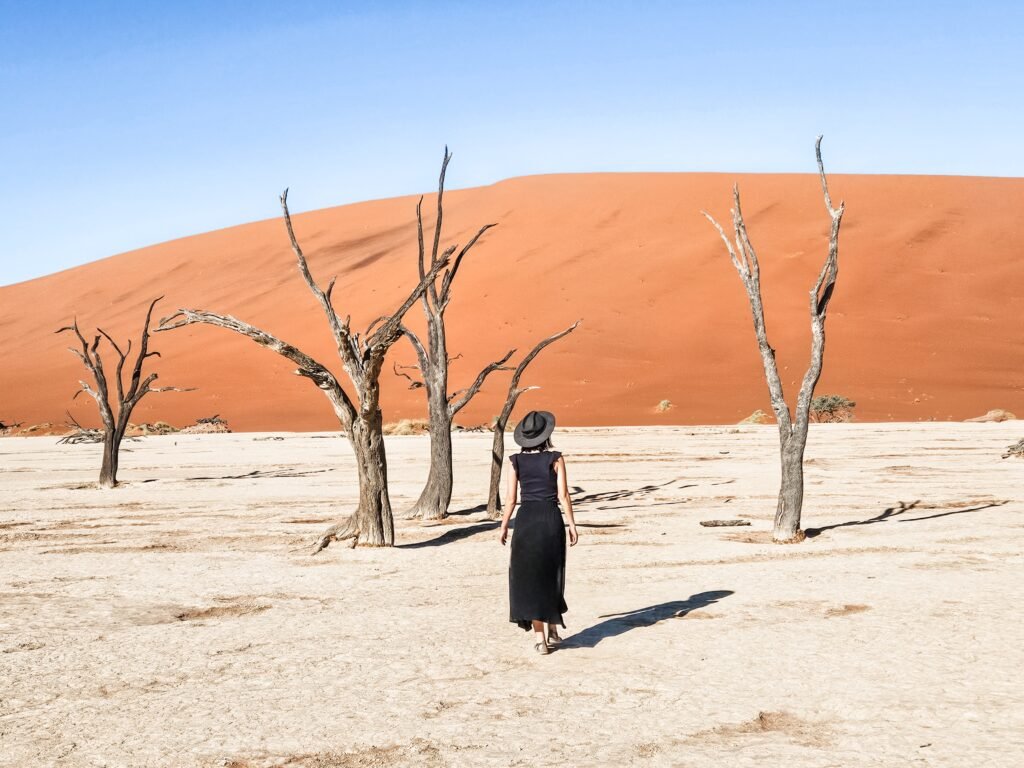
Deadvlei is one of those places that looks almost unreal in photographs, but seeing it in person is even stranger.
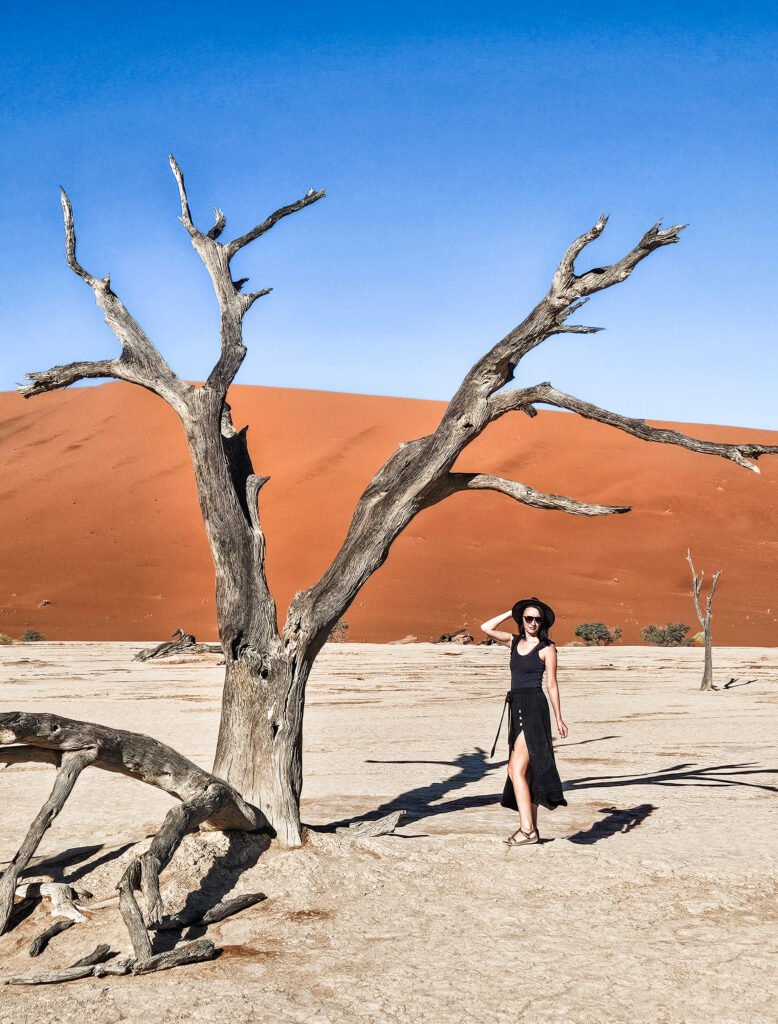
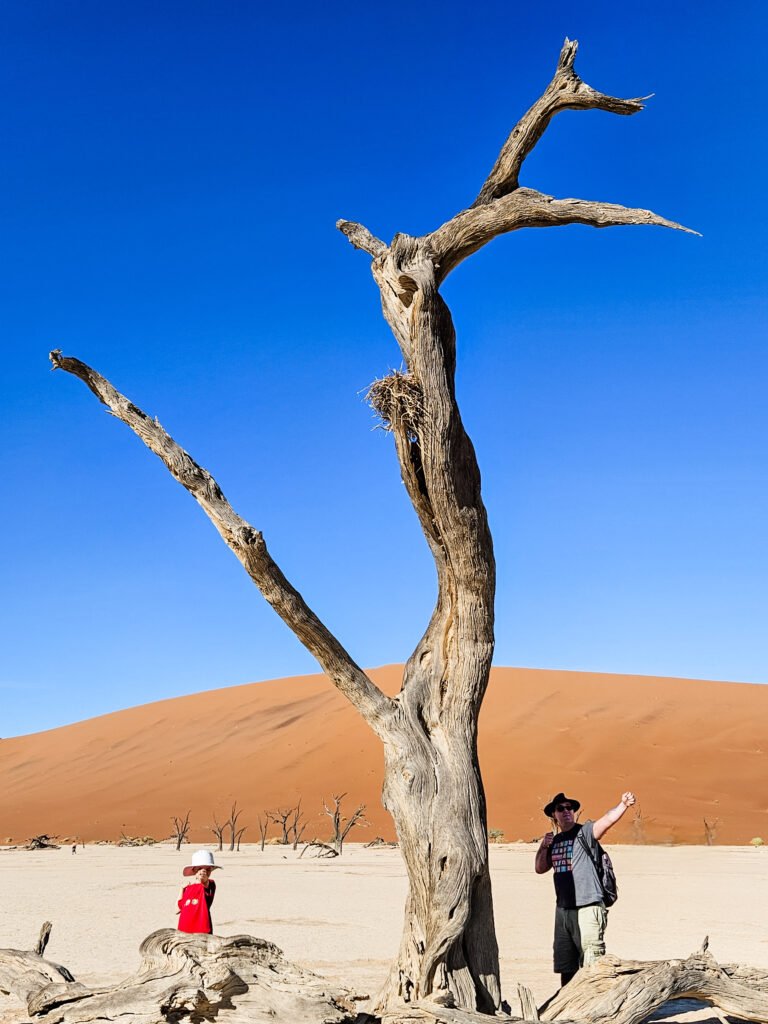
The name literally means “dead marsh”. The landscape is famous for its ancient, blackened camel thorn trees standing on a bright white clay pan. Enormous orange sand dunes surround the whole scene.
But the really interesting part is why the trees are there in the first place.
Thousands of years ago, the area was much wetter and the nearby Tsauchab River occasionally flooded the plain. This created enough water for camel thorn trees to grow. Eventually, the climate became much drier and the surrounding sand dunes shifted, blocking the river from reaching this particular part of the valley.
The trees could no longer get enough water and died.
What makes Deadvlei so unusual is that the trees didn’t rot away. The Namib Desert is so extremely dry that there isn’t enough moisture for the normal decomposition process to happen. As a result, some of these trees have been standing there for roughly 900 years. They’re dead, but they haven’t turned into the usual fallen, decomposing wood you would expect to see.
Over time, the trees have become blackened from exposure to the intense Namibian sun, creating that almost spooky landscape against the white clay and red dunes.
Why families will enjoy it
This was a particularly good place to visit with a child because there is a real mystery to solve.
Why are the trees dead? Why haven’t they fallen apart? Where did the water go? How can anything survive in a place this dry?
You can turn the whole visit into a simple lesson about climate change over geological time, water, desertification, rivers, plant survival and decomposition without needing to make it feel like school.
And for a seven-year-old, the landscape itself is fascinating. The contrast between the bright white ground, black trees and huge orange dunes looks almost like something from a fantasy film.
Practical tip
There is a walk from the parking area to Deadvlei. And you’ll be walking through sand, so comfortable shoes are useful. The heat can also be intense, particularly later in the day.
This is another place where an early start is your friend. Bring plenty of water, protect yourself from the sun and don’t underestimate how tiring walking through sand can be.
Recommended age
There isn’t really a minimum age for Deadvlei, but do keep in mind the above tips. For very young children the heat can be very tough. It was a bit too much by the end of it for our seven year old. And we didn’t stay there as much as we could have.
However, for worldschooling families, it’s one of those rare places where the scenery itself gives you a ready-made science and geography lesson.
5. Visit Sesriem Canyon
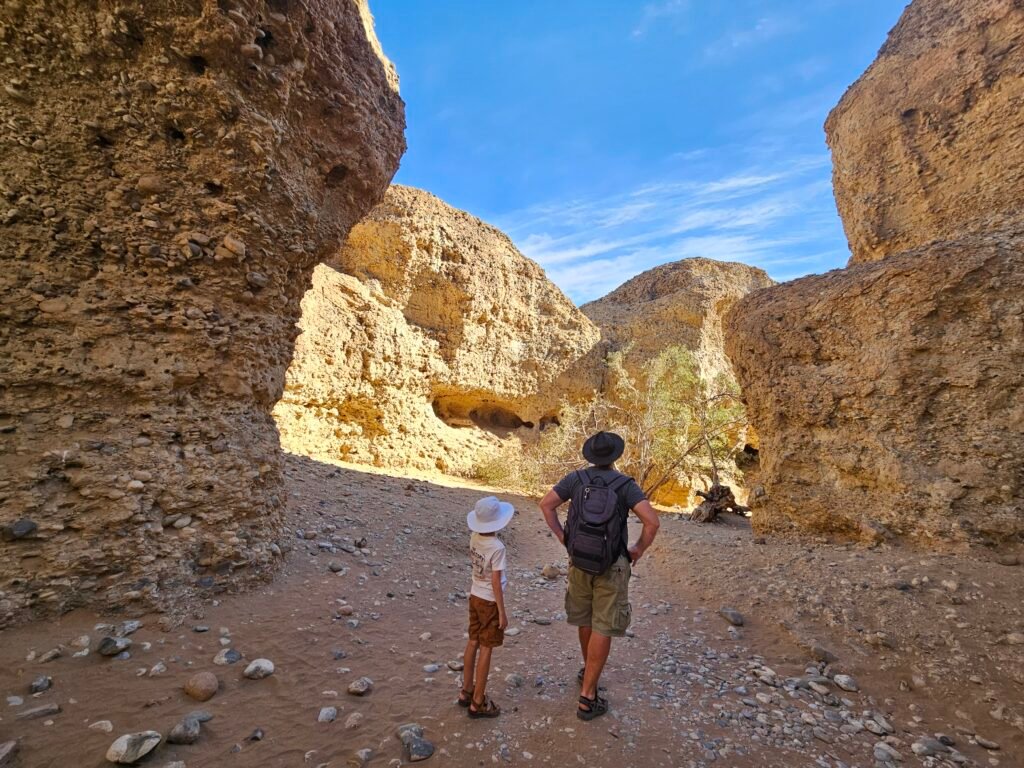
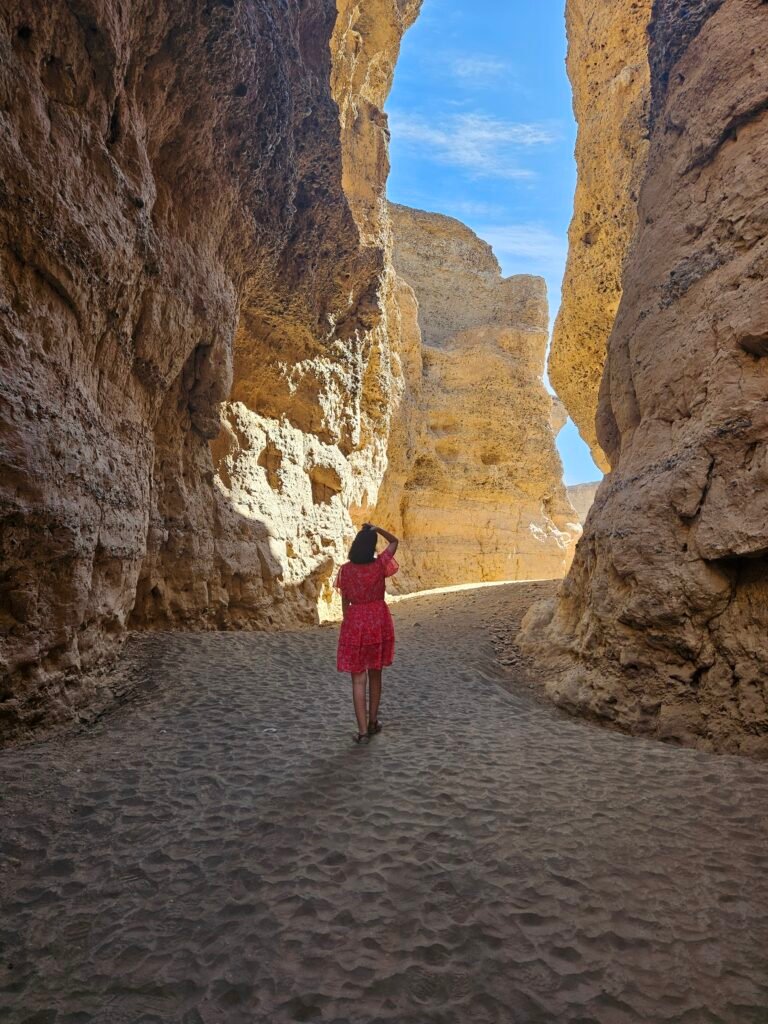
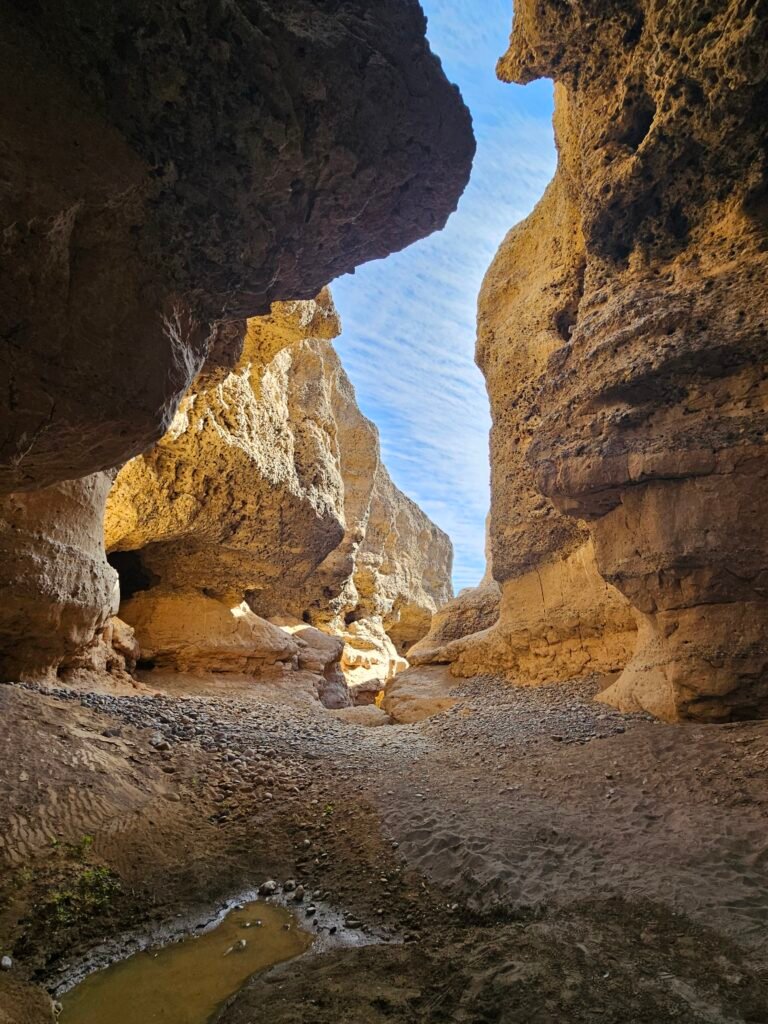
Sesriem Canyon is very different from the giant open landscapes around Sossusvlei. Instead of walking across enormous dunes, you can explore a narrow canyon carved into the rock.
The canyon was formed by the Tsauchab River. This has cut through layers of sediment and rock over millions of years. The river only flows after heavy rainfall, but the occasional flash floods have slowly deepened and widened the canyon. The name “Sesriem” comes from the early settlers who reportedly had to tie together six leather straps to reach water at the bottom of the canyon, hence “ses riem”, meaning “six straps” in Afrikaans.
Why families will enjoy it
Children can actually walk down into parts of the canyon and explore. It is also a great opportunity to explain erosion in a way that makes much more sense than looking at a diagram in a textbook.
6. Stop in Solitaire for the famous apple pie
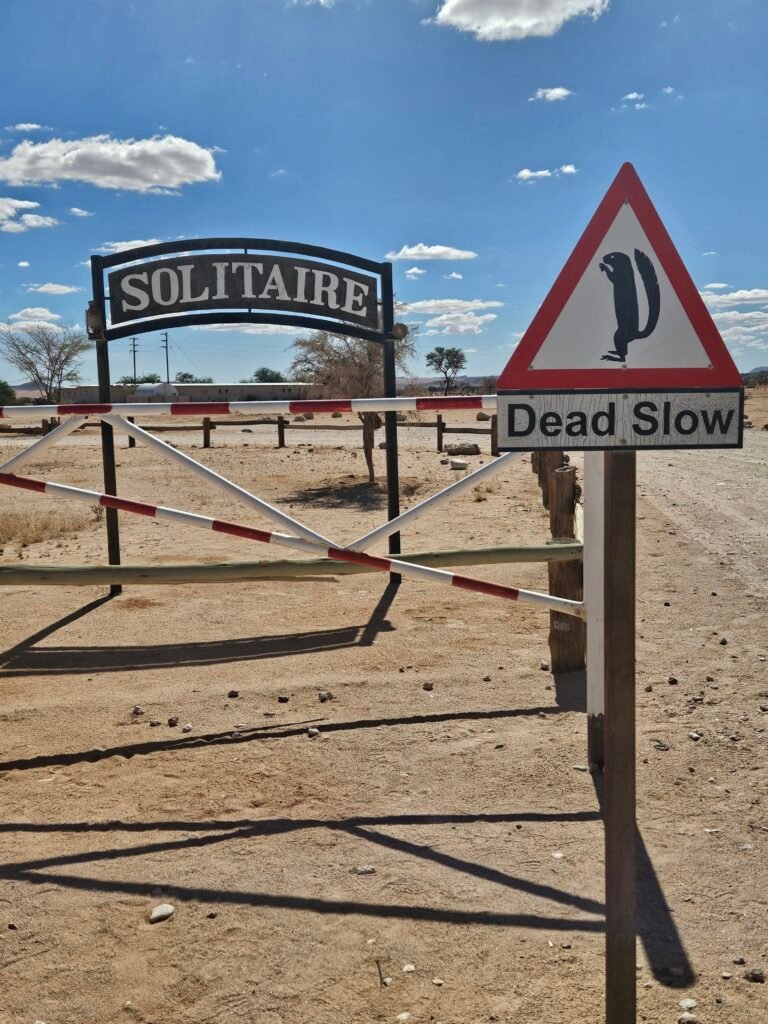
Solitaire is tiny. Really tiny. It’s essentially a desert outpost with a petrol station, a shop, accommodation, and the famous Moose McGregor’s Desert Bakery. But if you’re travelling towards Sossusvlei, it makes a very welcome stop. This is particularly true when you’ve been driving through the desert for hours.
The place became famous largely because of its bakery and its legendary apple pie. Percy “Moose” McGregor, a Scottish baker who made Solitaire his home, became known for his apple pie. This was based on an old family recipe and became a must-stop for travellers crossing the Namib Desert. Moose died in 2014, but the bakery and his famous pie have continued.
The pie is actually closer to a German-style apple strudel or crumble than the traditional American-style apple pie you might be imagining. It’s generally served as a generous slice, and the bakery also sells fresh bread, pastries, sandwiches and savoury meat pies.
Why families will enjoy it
After a long drive through the desert, stopping somewhere for coffee, a cold drink and a piece of warm apple pie is a pretty easy sell to a child.
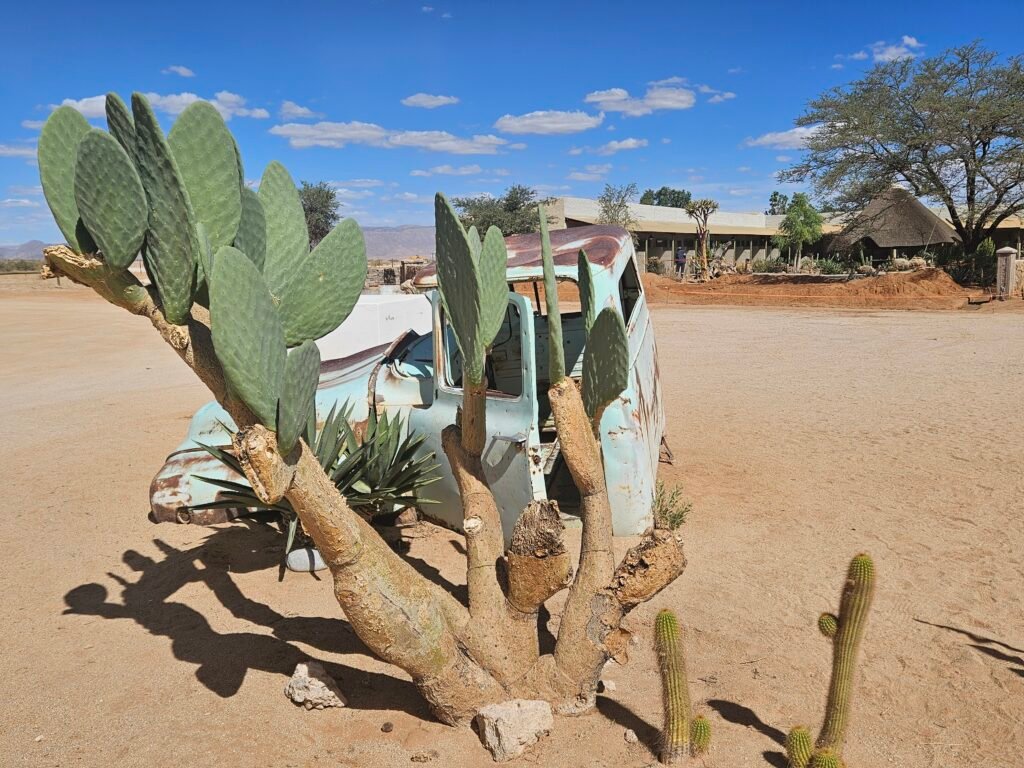
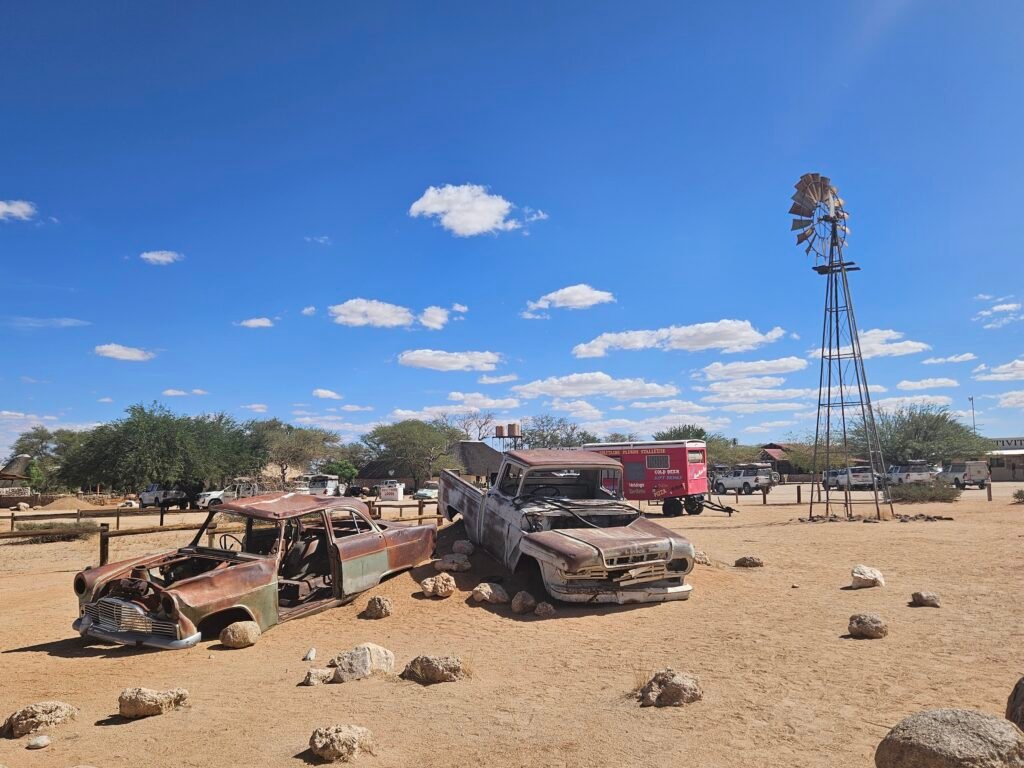
There are also old, rusting cars scattered around the property. These have become part of Solitaire’s character and make the stop a little more interesting for kids. It’s not somewhere I’d plan to spend hours. But it’s exactly the kind of quirky road-trip stop that breaks up a long drive.
And, of course, there’s the novelty of eating a famous apple pie in the middle of the Namib Desert. That’s hard to beat.
Practical tip
Solitaire is also an important fuel and supply stop. So it’s a good place to top up the tank and grab snacks before continuing towards Sossusvlei.
And yes, try the apple pie. Whether it’s actually the best apple pie in Namibia, Africa or the world is obviously impossible to prove, but it’s famous for a reason, and trying it has become part of the classic Namibia road-trip experience.
Recommended age
All ages. This is an easy stop for families and a particularly useful one when travelling with younger children.
7. Learn about Himba culture
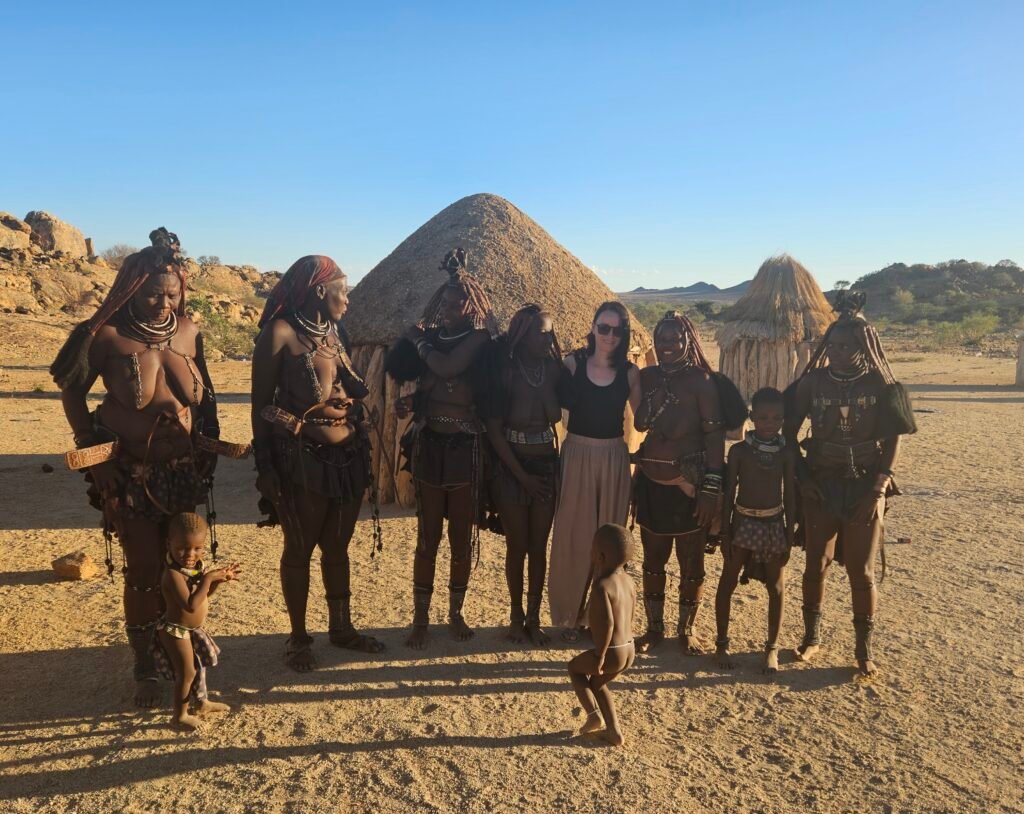
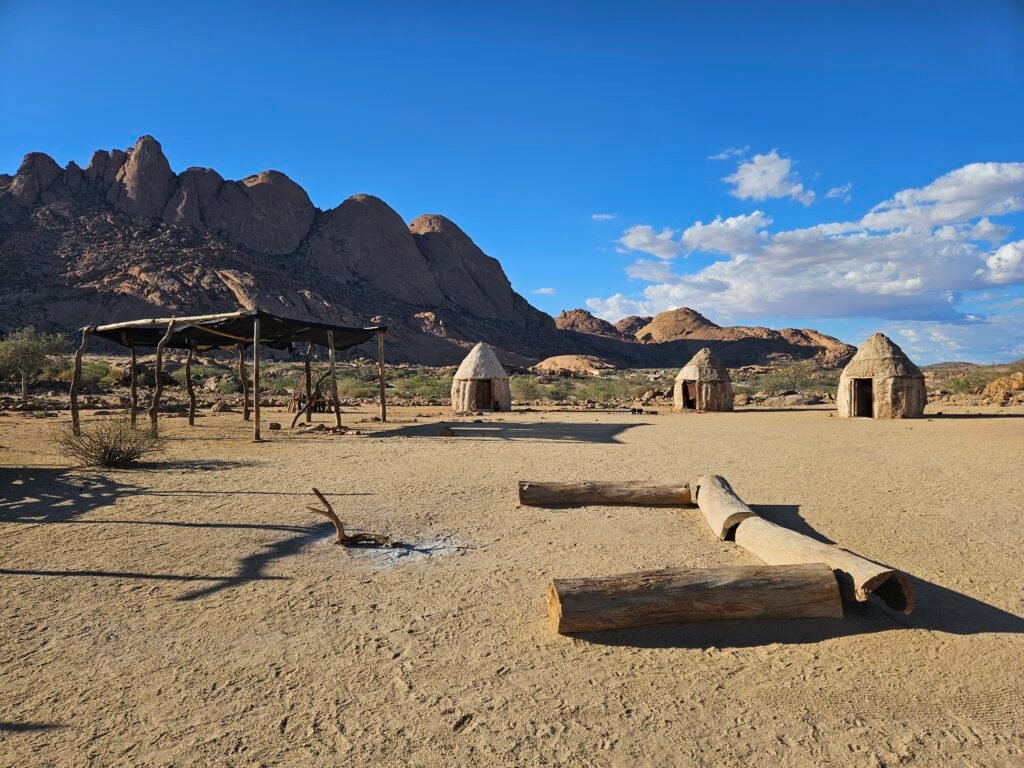
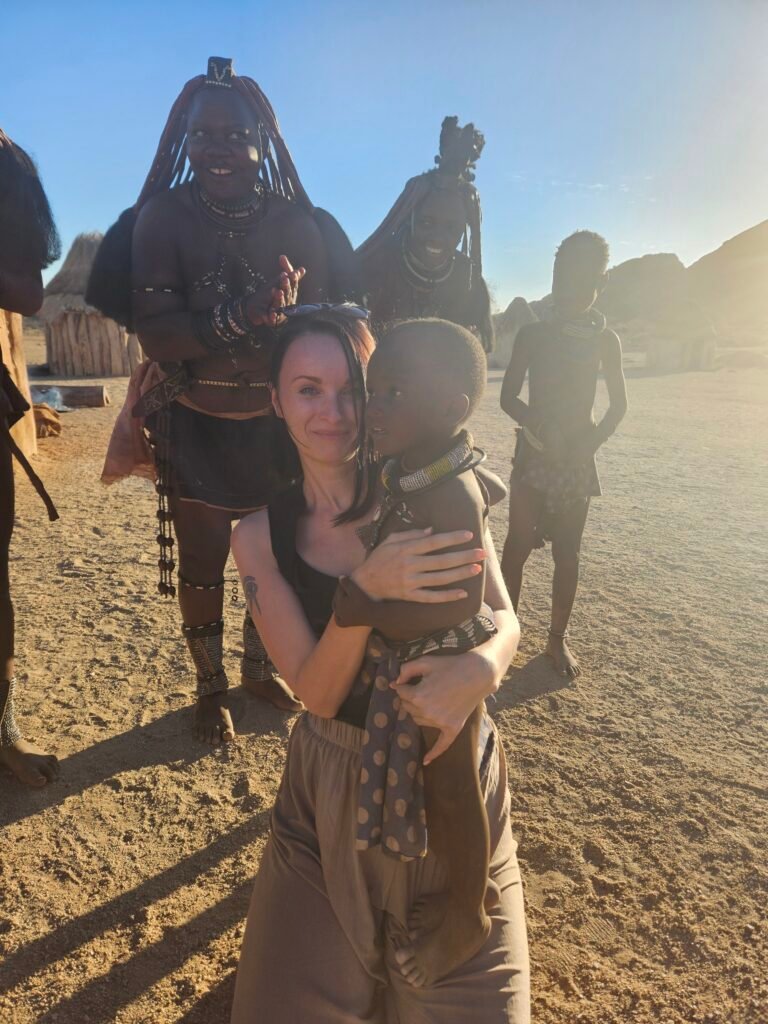
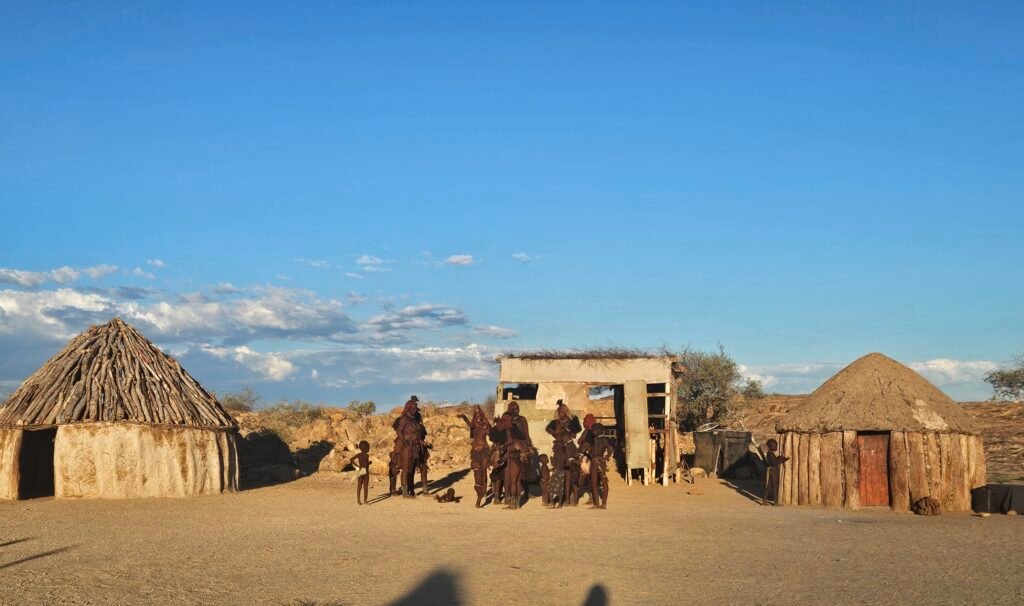
One of the most memorable parts of our time in Namibia was visiting a Himba community.
The Himba, or OvaHimba, are a semi-nomadic pastoralist people who live mainly in northwestern Namibia, particularly in the Kunene region. Some communities also live across the border in Angola. Traditionally, cattle and goats are central to their way of life, and their remote location has helped preserve many cultural traditions. At the same time, it’s important not to think of the Himba as a people who are somehow frozen in the past. Modern life, education, technology and tourism are all affecting Himba communities, and different families make different choices about how much they follow traditional ways of life.
That was actually one of the things we found most interesting. We weren’t just learning about an “ancient tribe”. We were meeting real people whose culture is changing and adapting, just like every other culture in the world.
The famous red clay
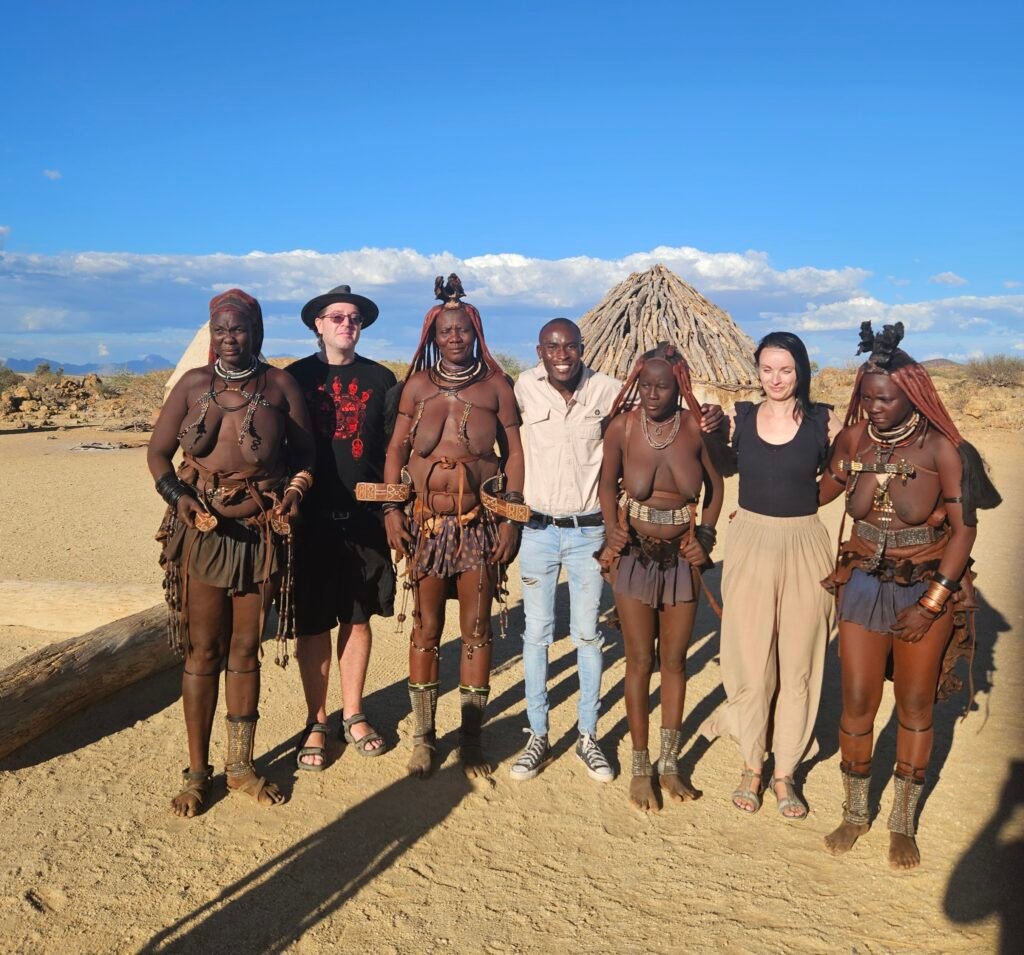
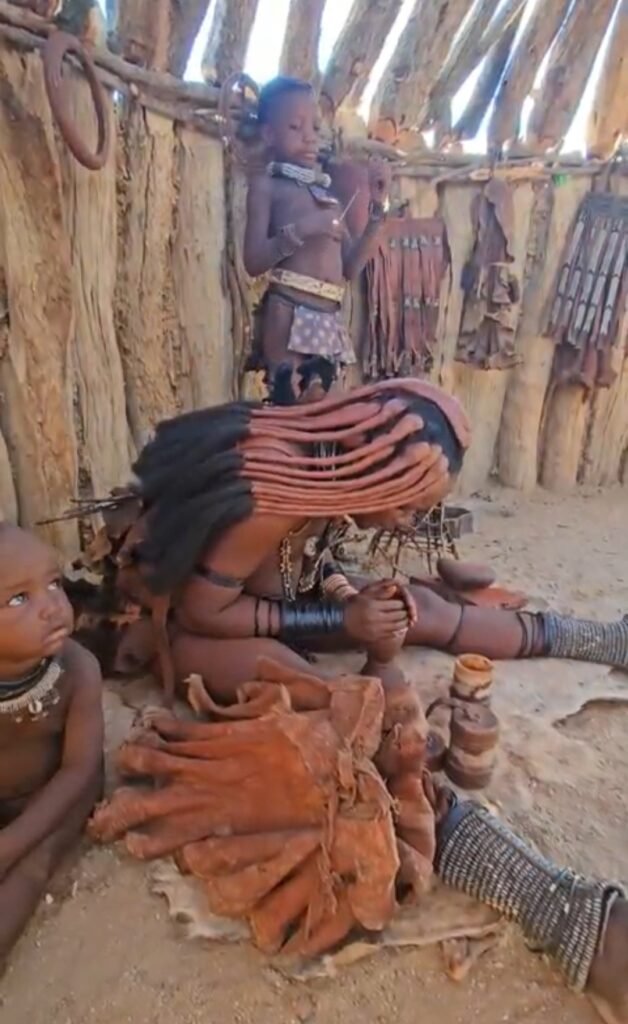
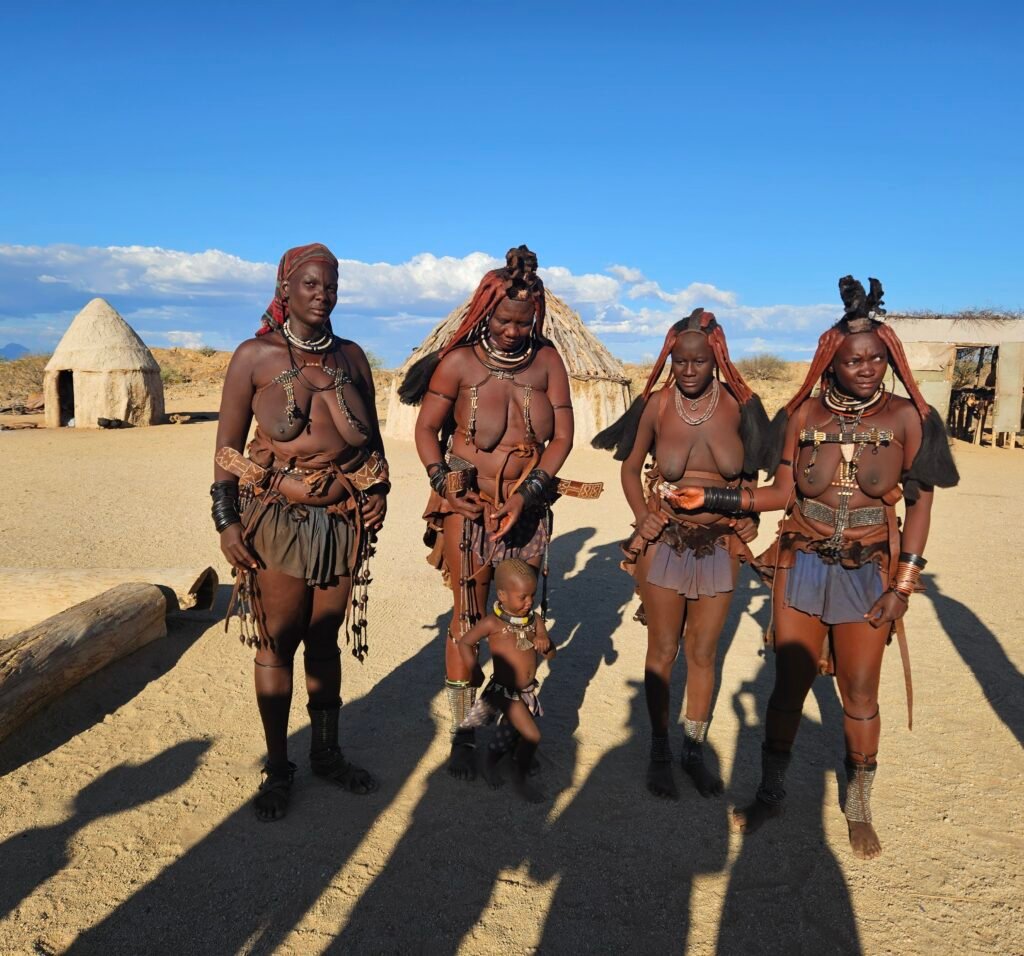
One of the first things you’ll notice about the Himba women is their distinctive reddish skin and hair.
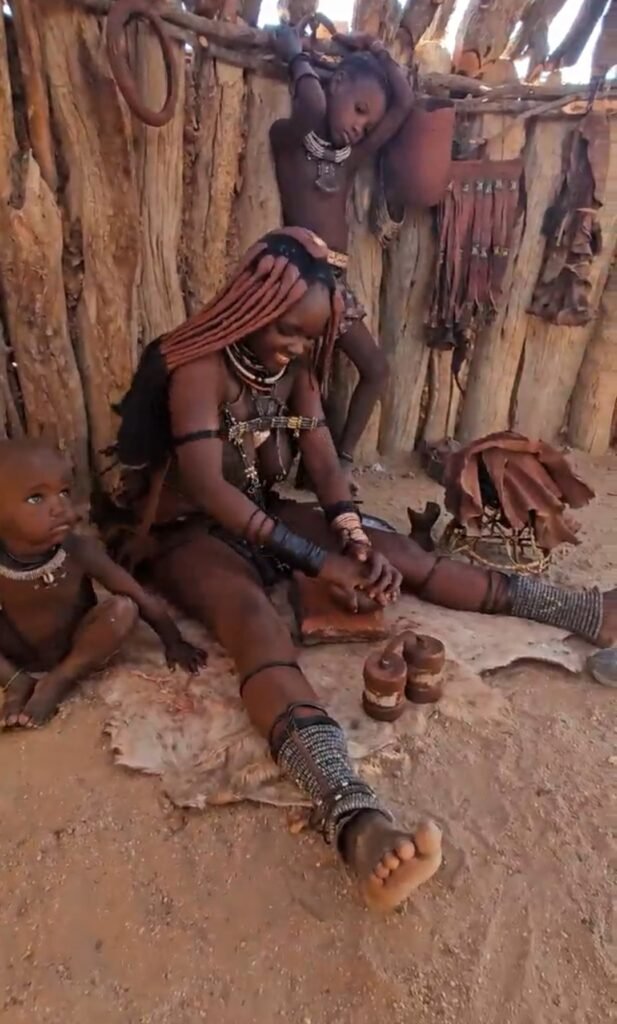
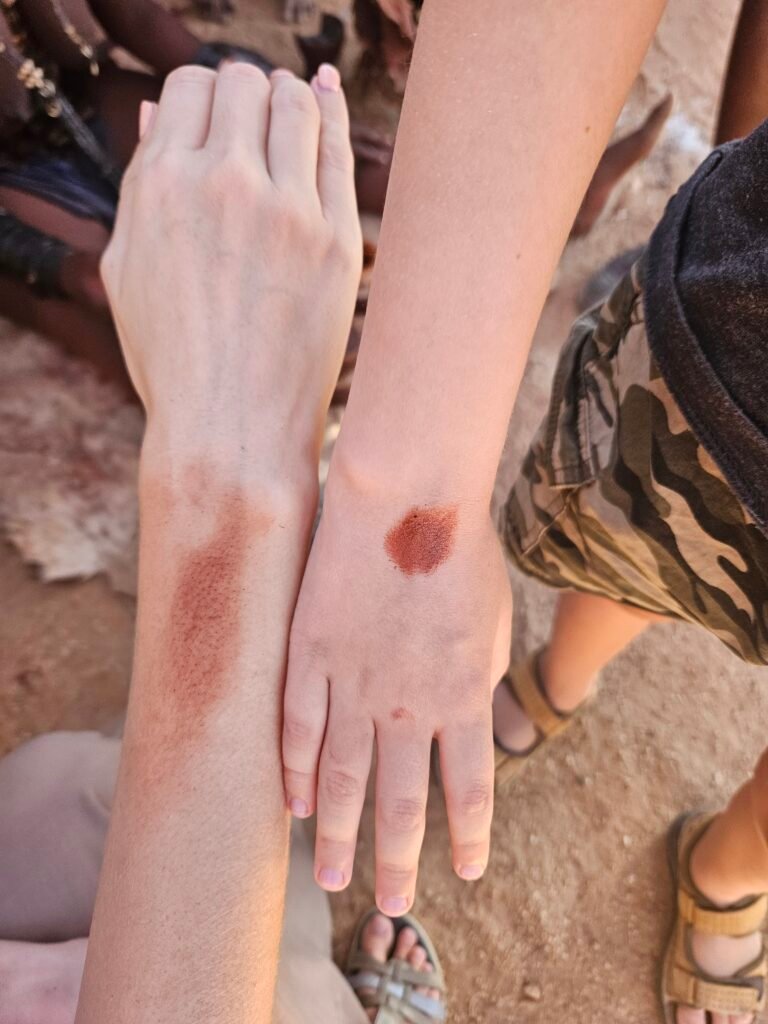
This comes from otjize, a mixture traditionally made with red ochre and animal fat, sometimes with aromatic plant material added. The ochre is a natural earth pigment. Applying it to the skin is both an important part of Himba aesthetics and a practical adaptation to the harsh, dry environment. It helps protect the skin from the sun and dry conditions, and the aromatic ingredients add fragrance.
The women also wear elaborate jewellery made from materials including metal, leather and beads. Jewellery, hairstyles and particular headdresses can communicate things about a person’s age, marital status and social position.
Our son was fascinated by all of this because it was so completely different from anything he had encountered before.
How do Himba women bathe without water?
This was probably one of the most memorable demonstrations during our visit.
The Himba traditionally conserve water very carefully. Women don’t take the kind of water baths or showers that we’re used to. Instead, we were shown how the women use smoke from aromatic plants as part of their bathing and cleansing routine.
They place aromatic material over hot coals, producing fragrant smoke, and use the smoke around their bodies. The practice is sometimes described as a “smoke bath”. The smoke is used for cleansing and fragrance, and it is particularly practical in an environment where water is scarce.
Seeing it demonstrated was much more memorable for our son than simply reading about it.
It also led to one of those great worldschooling conversations: What would you do if you lived somewhere where water was extremely difficult to get? Suddenly something that initially seems strange makes a lot more sense when you understand the environment people have adapted to. It also helped him appreciate more the things and the modern comforts that he has.
Jewellery, clothing and dancing
During our visit, we were able to see the traditional jewellery and clothing up close. And the women showed us some of the ways they prepare and use the red ochre.
There was also singing and dancing. This made the visit feel much more interactive than simply walking around looking at someone’s homes.
What about bringing gifts for the children?
We were keen to bring something for the children we met. And this is something I’d recommend thinking about before your visit.
However, I’d ask your guide or the community what would actually be useful first rather than simply turning up with bags of sweets, money or random toys. Our guide recommended that we buy some fruit, as that’s something that can be hard for the community to get. He also stopped at a supermarket on the way for us to buy the gifts.
There is an important ethical reason for this. In some areas, direct gifts to children have contributed to begging around tourist routes. And responsible travel guidance specifically recommends avoiding handing out sweets or money directly to children.
If a community has requested particular supplies, bringing those can be a lovely way to contribute. Otherwise, one of the best ways to support people is through the visit itself: use a local guide or community-run experience, buy jewellery or crafts directly from the people who made them. And pay the agreed fee for the cultural visit.
That way, the money is part of a genuine local economy rather than simply creating a situation where children learn that approaching tourists results in gifts.
Is visiting a Himba village ethical?
This is something I think is worth talking about, particularly when travelling with children.
At first glance, visiting an indigenous community as a tourist can feel uncomfortable. Are we learning about another culture, or are we simply treating people’s lives as an attraction?
I think how you visit makes a huge difference.
Namibia has a significant community-based tourism sector. And the country’s Ministry of Environment and Tourism specifically promotes community-based tourism as a way of reducing poverty, supporting rural development and spreading the financial benefits of tourism. Community tourism can provide income through guiding, crafts, accommodation and cultural experiences, as well as employment and other community benefits.
The Himba themselves are also increasingly involved in tourism. In some communities, cultural visits provide an opportunity to earn additional income by sharing aspects of their traditions with visitors. They can also earn income by selling locally made jewellery and crafts. Namibia’s tourism authority describes this as part of the complicated balance between preserving traditional culture and participating in the modern economy.
That doesn’t mean every Himba village tour is automatically ethical.
I’d look for a visit that:
- Uses a local Himba guide or a reputable local operator
- Keeps groups relatively small
- Explains beforehand what you can photograph
- Gives people the choice about whether they want to participate
- Pays the community or local people fairly
- Encourages buying locally made crafts rather than imported souvenirs
- Doesn’t treat people as props for photographs
- Doesn’t encourage tourists to hand out money or sweets to children
And always ask before taking photographs. Just because you’re allowed to take a photo in some situations doesn’t mean everyone you meet wants to be photographed.
Why this was such a good worldschooling experience
For us, this was much more than a sightseeing excursion.
Our son was seven, which was a great age for this kind of experience. He could ask questions, notice differences and start thinking about why people live the way they do.
We could talk about water scarcity, climate, livestock, traditional housing, food, clothing, family structures, art, religion, economics and how cultures change over time.
Most importantly, he was learning that different doesn’t mean strange or wrong.
A textbook can tell a child that people in Namibia have different traditions. Meeting people, listening to them explain those traditions and seeing them demonstrated makes that knowledge much more real.
It also opened up conversations about tourism itself. Why do people visit other communities? Who benefits from tourism? What makes a respectful visitor? Is it okay to take photographs? Why might someone choose to preserve a traditional way of life while also using modern technology or sending their children to school?
Those are fairly big questions for a seven-year-old, but travelling gives you opportunities to have these conversations naturally.
If you want more ideas for turning everyday moments like this into learning opportunities, we’ve rounded up the worldschooling apps and websites we actually use on the road.
8. Visit Bushmen Paradise
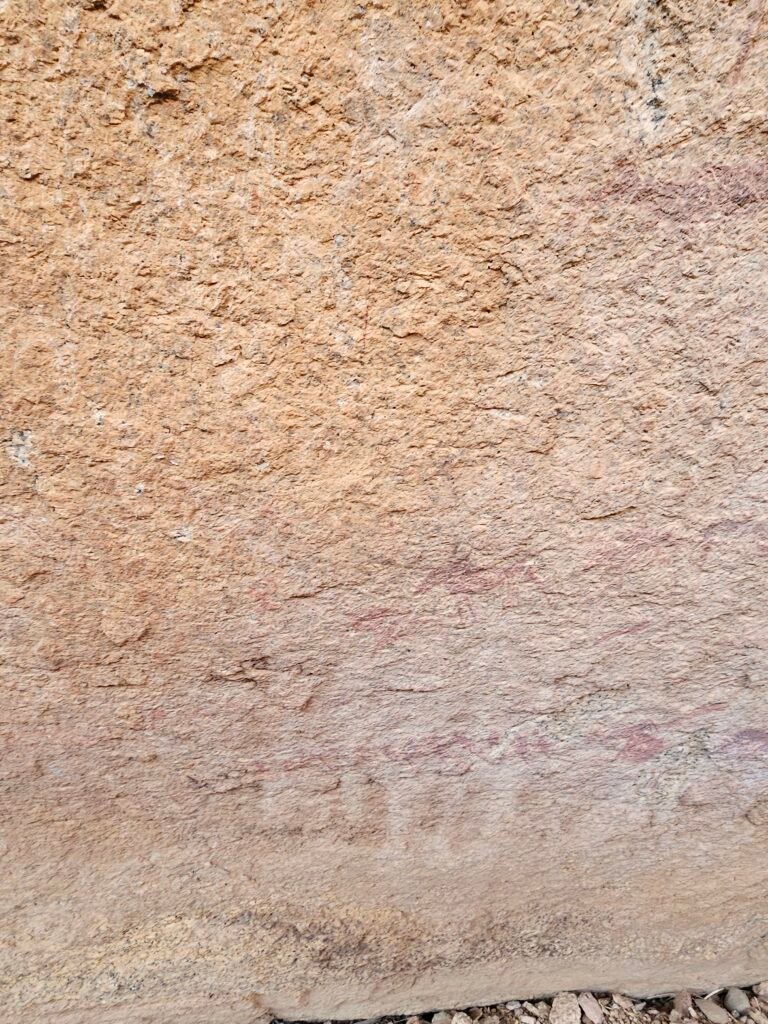
Bushmen Paradise, near Spitzkoppe, is worth visiting for more than just the views. The site contains prehistoric rock paintings made by San hunter-gatherers. The paintings are believed to date from roughly 4,400 BC to around 100 AD. The cave was once considered one of the finest collections of rock art in Namibia and was declared a national monument in 1954.
The paintings include figures of people and animals, including animals such as giraffes and rhinoceroses. Unfortunately, some of the artwork has been badly damaged by vandalism over the years. This is a good reminder of how fragile these sites are and why it’s important not to touch the paintings or use anything on the rock to make them more visible for photographs.
The climb
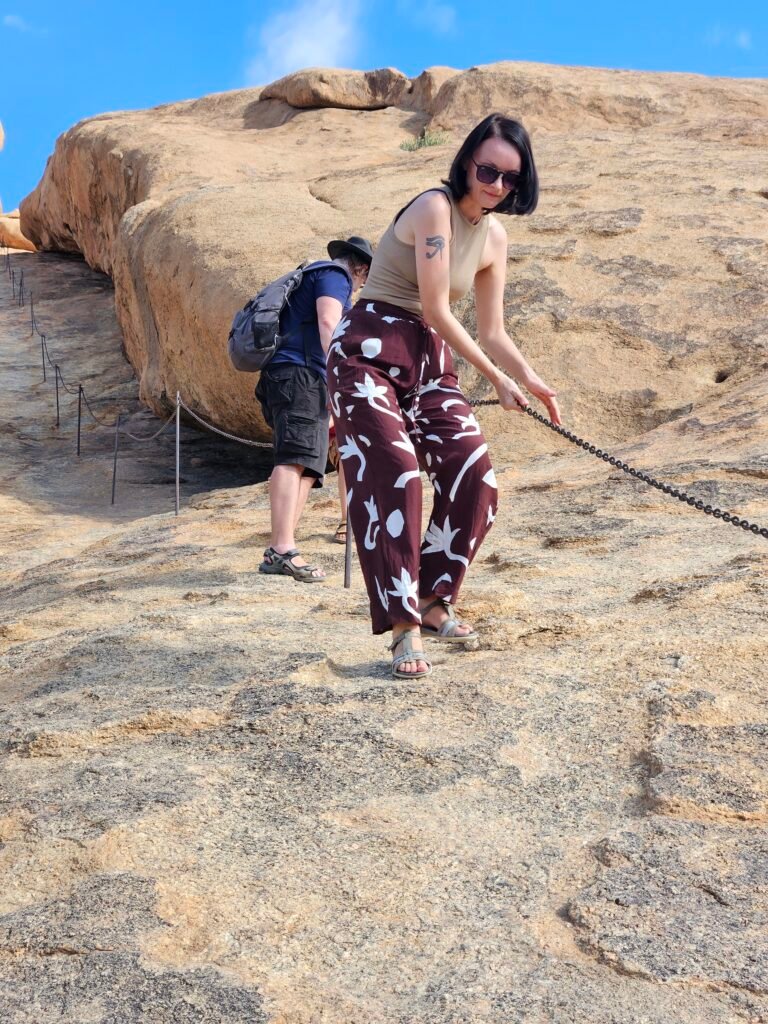
There is one important thing to know before you go with children: getting to the main cave is not an easy walk.
There are no proper steps. You have to climb up and down some fairly steep, rocky sections, using a metal chain as a handhold. Our son was seven when we visited and managed it. But I’d definitely take the climb seriously if travelling with younger children or anyone who isn’t comfortable scrambling over rocks.
Once you’re up there, though, standing in the shelter and seeing paintings that are potentially thousands of years old makes the effort worthwhile.
Why families will enjoy it
For a worldschooling family, this is a fantastic opportunity to connect history and archaeology to a real place. Instead of looking at prehistoric art in a book, you’re standing where people lived and created these images thousands of years ago.
It’s also worth combining with the cultural experience in the Spitzkoppe area, where we visited a Bushmen community and learned about some of their traditions. Together, the two experiences gave our son a much better sense that these aren’t just people from a history book. They are part of living cultures with deep connections to this landscape.
9. Explore Spitzkoppe and spend a night under the stars
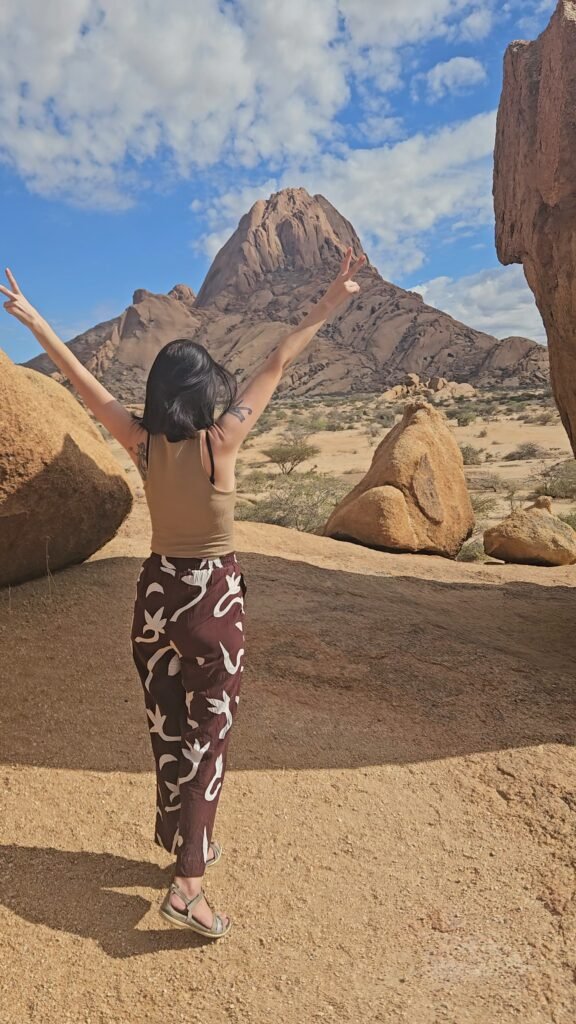
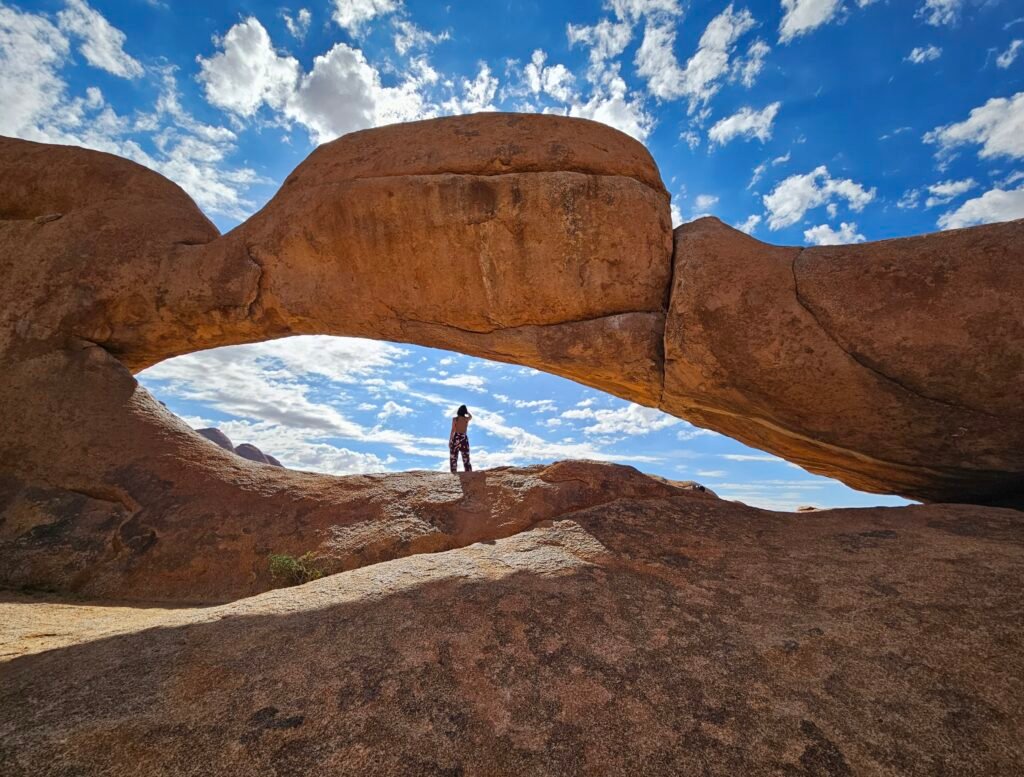
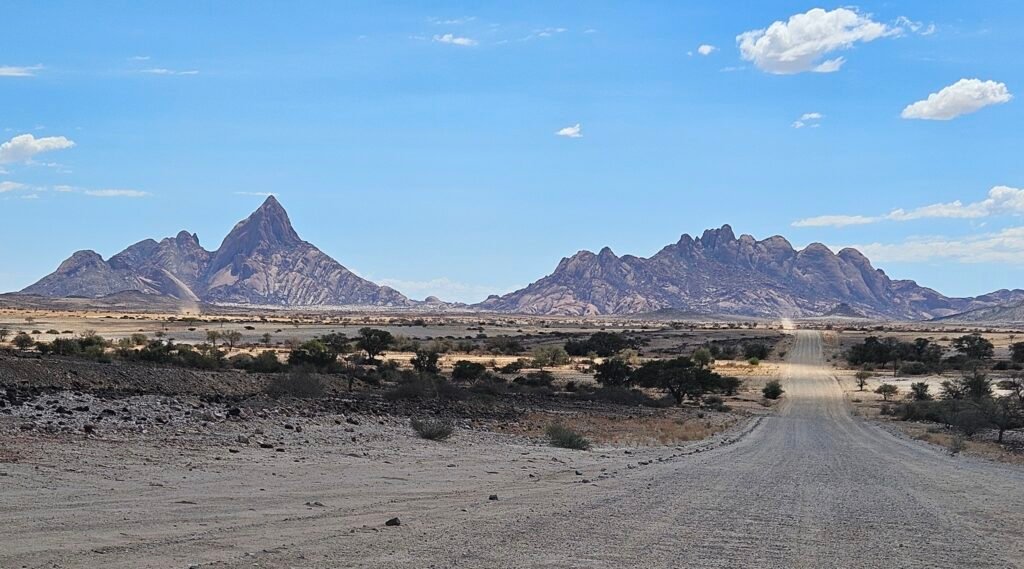
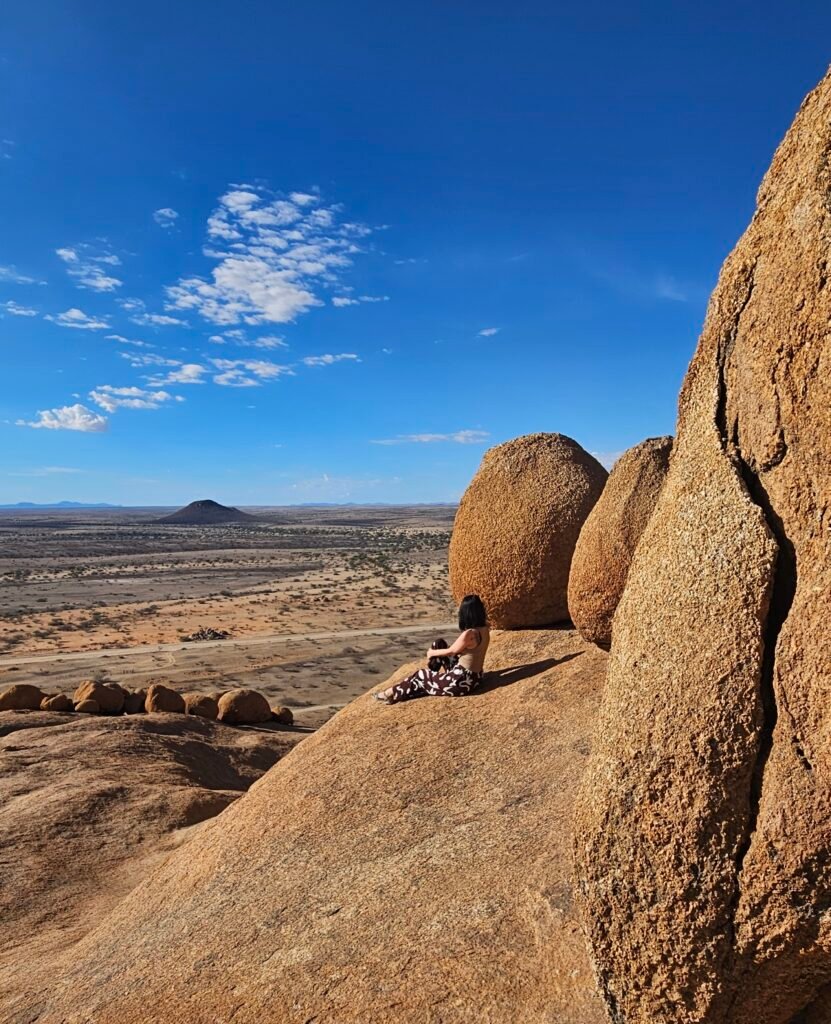
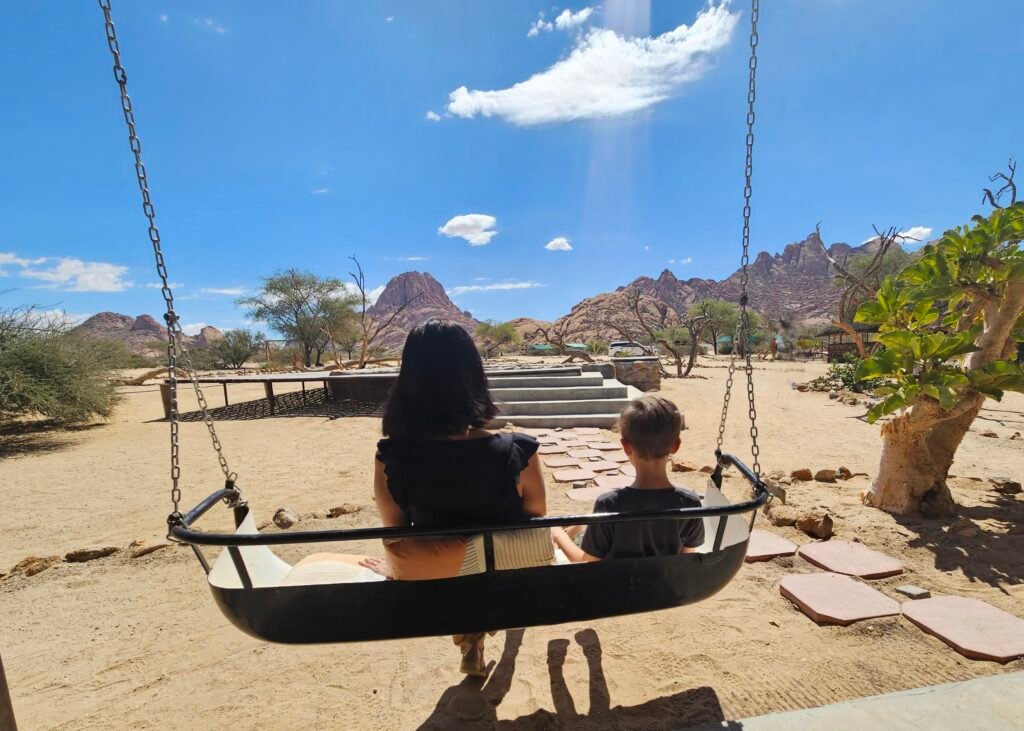
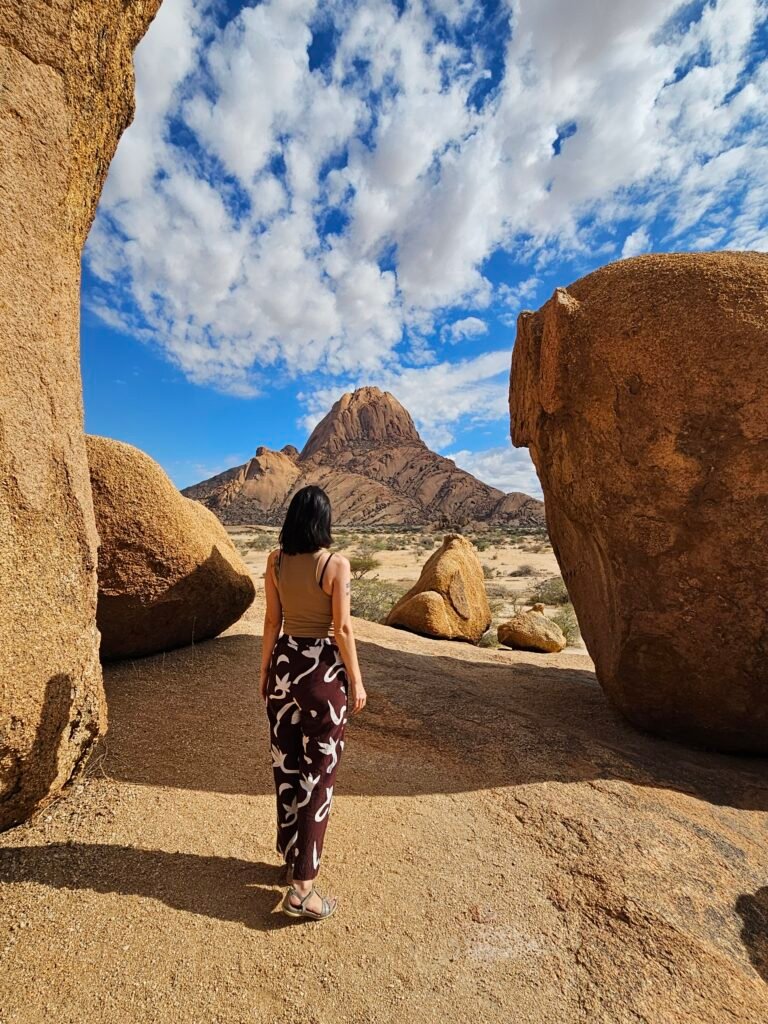
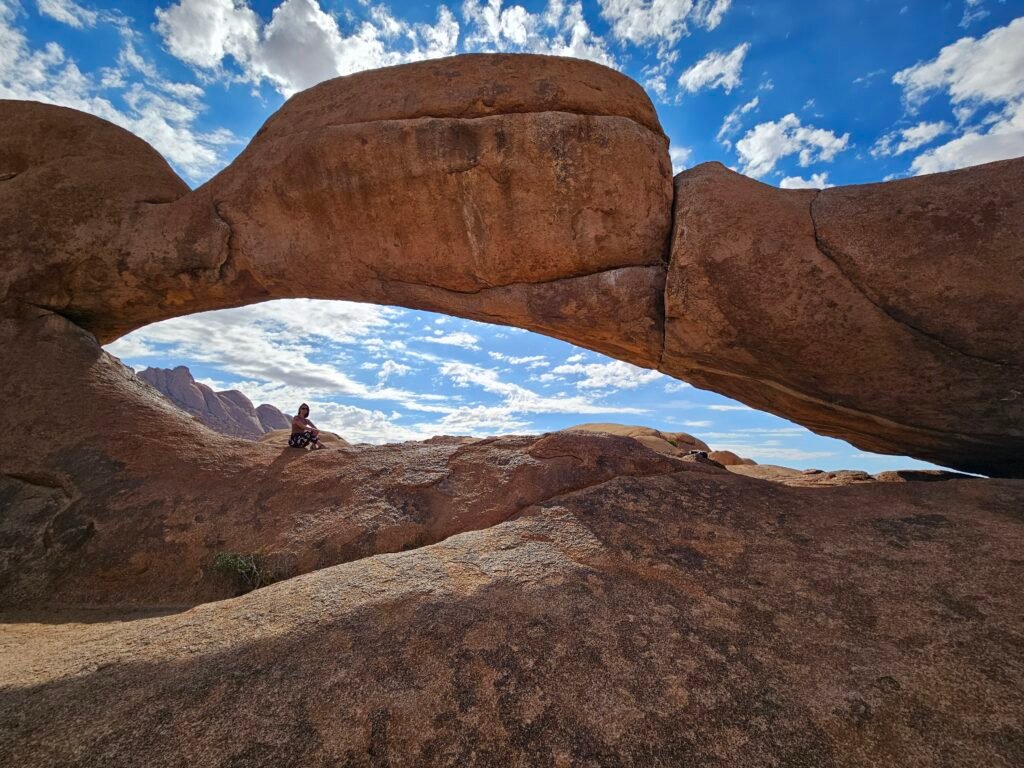
Spitzkoppe was one of our favourite stops in Namibia. The landscape is completely different from the dunes around Sossusvlei. Huge granite peaks rise out of the flat desert, with enormous boulders scattered around the landscape. The main peak rises about 670 metres above the surrounding plains. And the whole area has earned the nickname “Namibia’s Matterhorn”.
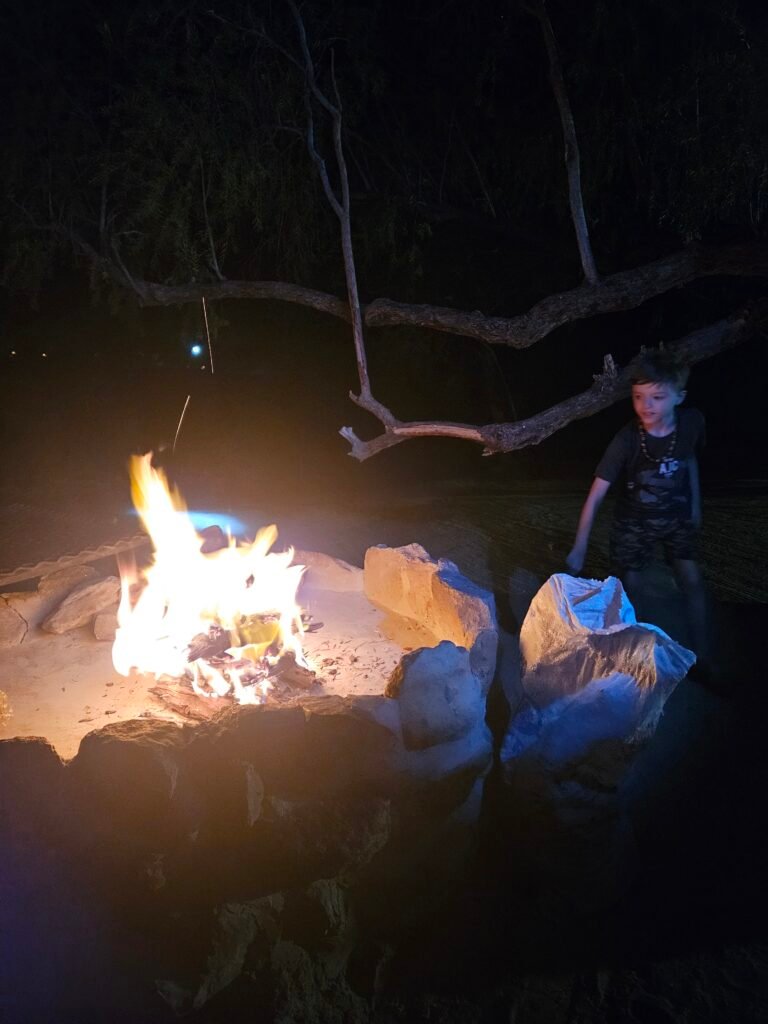
We decided to spend a night camping at Spitzkoppe, and I’m really glad we did. There is something pretty special about sitting by the fire at night and sleeping out in the middle of the desert. It’s just you, the rocks, the sand and an enormous sky.
And the stars were incredible.
Spitzkoppe is known for its exceptionally dark skies, with very little light pollution around the mountains, making it an excellent place for stargazing. Once the sun went down, the sky seemed to go on forever. For our son, it was another one of those experiences that is difficult to recreate in a classroom. You can talk about constellations, planets and light pollution. But it’s much more memorable when you’re lying outside your tent looking straight up at the night sky.
During the day, there is plenty to explore around the granite formations. And the landscape itself is a great opportunity to talk about geology. The granite formations were exposed over millions of years as the softer surrounding rock eroded away.
Spitzkoppe is also an important archaeological and cultural area. San communities lived around these rocks long before modern Namibia existed, using natural shelters and leaving rock art behind. That connection between the landscape, ancient history and living cultures is what made the area particularly interesting for us.
Why families will enjoy it
Spitzkoppe gives children plenty of space to explore rather than simply looking at a landscape from behind a fence.
Our favourite part was honestly just being there. Camping among the rocks, watching the sunset and then lying under the stars made it feel like a proper adventure.
If you’re travelling with kids, I’d definitely consider staying overnight rather than treating Spitzkoppe as a quick stop between destinations.
Recommended age
All ages, although some of the rock scrambling and hikes are better suited to children who are confident on uneven terrain.
10. Meet the San people and learn traditional hunting skills
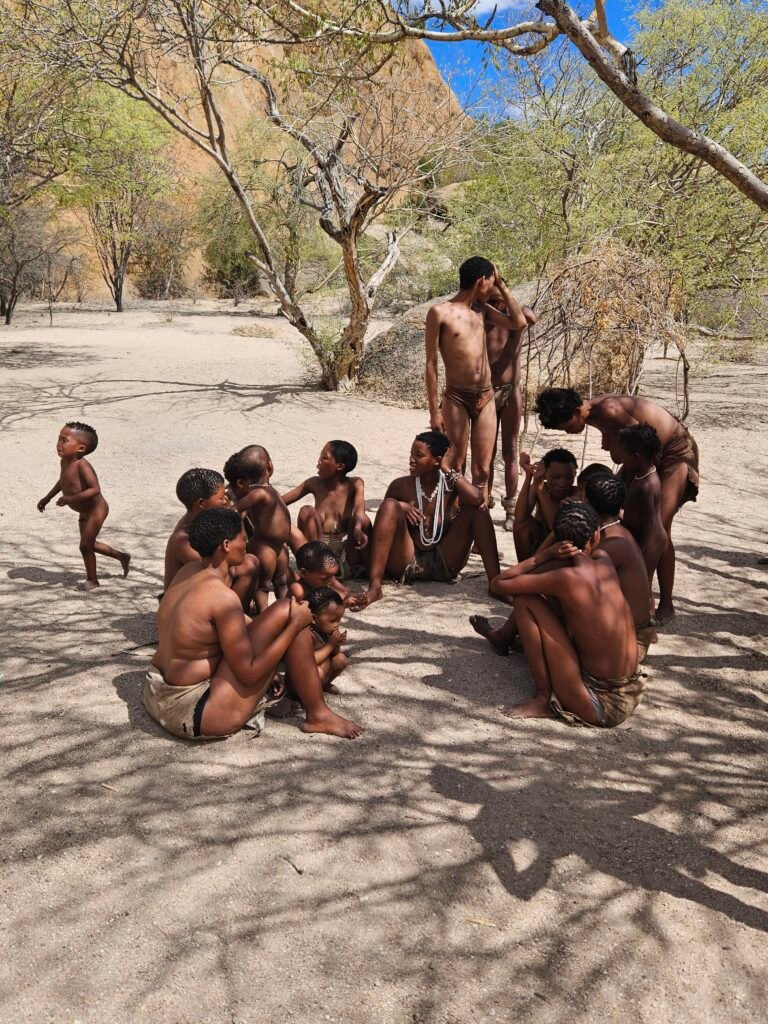
Another experience we really enjoyed was visiting a San community in the Spitzkoppe area.
The San are not one single tribe or ethnic group. Instead, they are a collection of Indigenous peoples across southern Africa, with different languages, cultures and traditions. They are often described as some of the world’s oldest surviving hunter-gatherer populations, although that phrase needs a little context. Modern San communities are not simply “people from prehistoric times”. They are living cultures with histories that stretch back extremely far. Genetic and archaeological research shows remarkable continuity between some present-day San populations and hunter-gatherer populations living in southern Africa thousands of years ago. Recent research, for example, found genetic continuity between present-day San groups and people living in southern Africa around 9,000 years ago.
Traditionally, many San communities lived by hunting wild animals and gathering plants, with an extraordinarily detailed knowledge of the environment around them. Hunting required an understanding of animal tracks, behaviour and the landscape. Gathering, meanwhile, involved knowing which plants could be eaten, which could be used medicinally and where to find them.
For our son, this was one of the most hands-on experiences we had in Namibia.
Seeing traditional hunting techniques
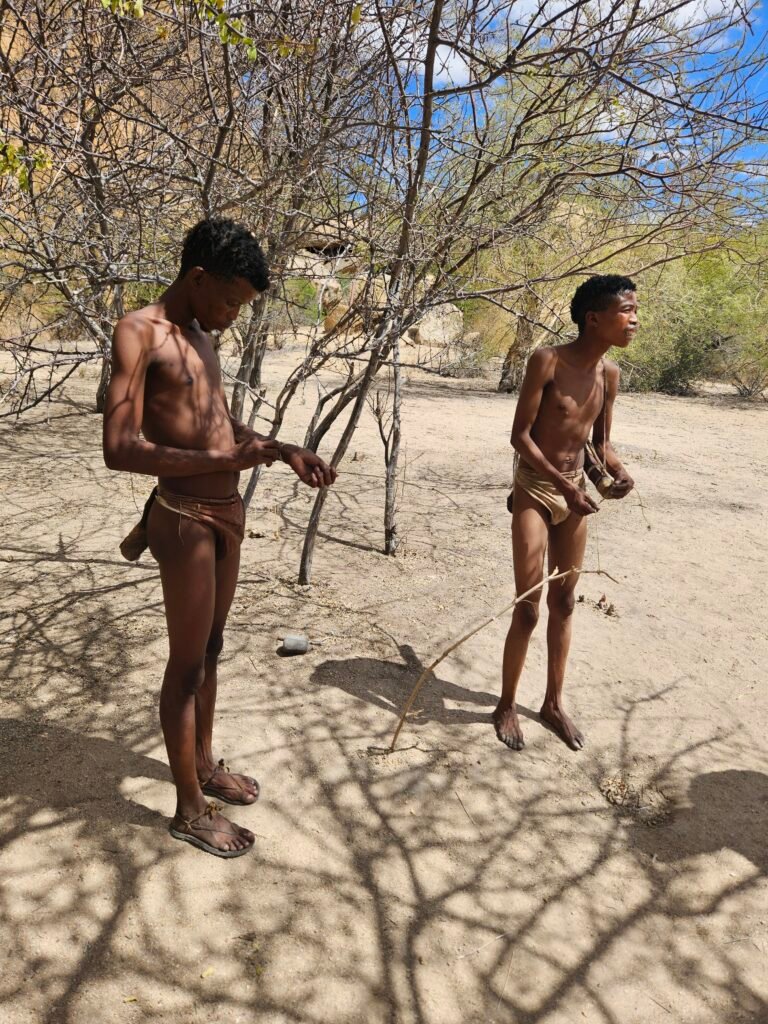
The community we visited demonstrated some of the traditional skills that San people used for survival.
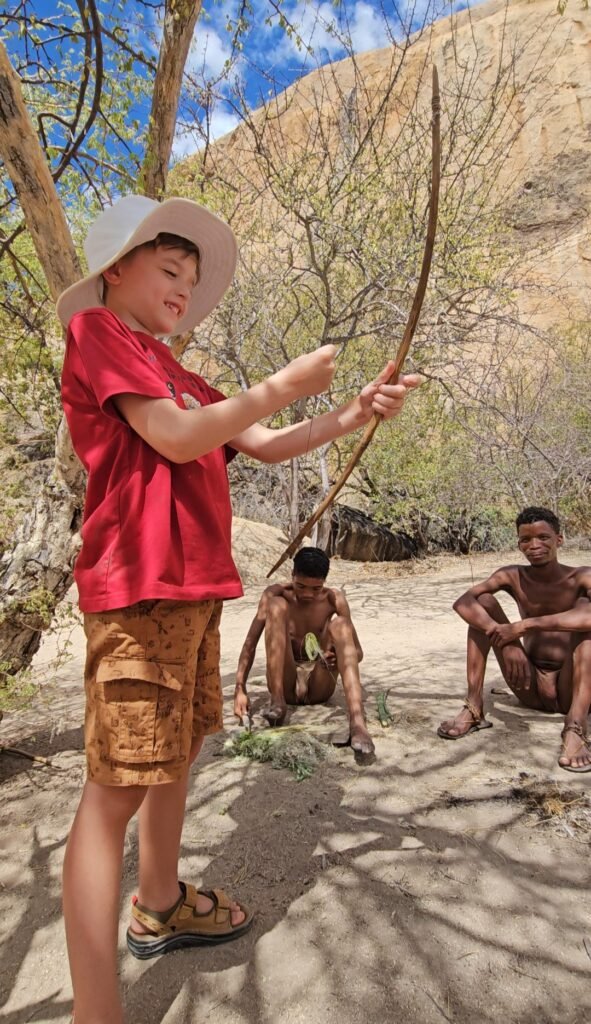
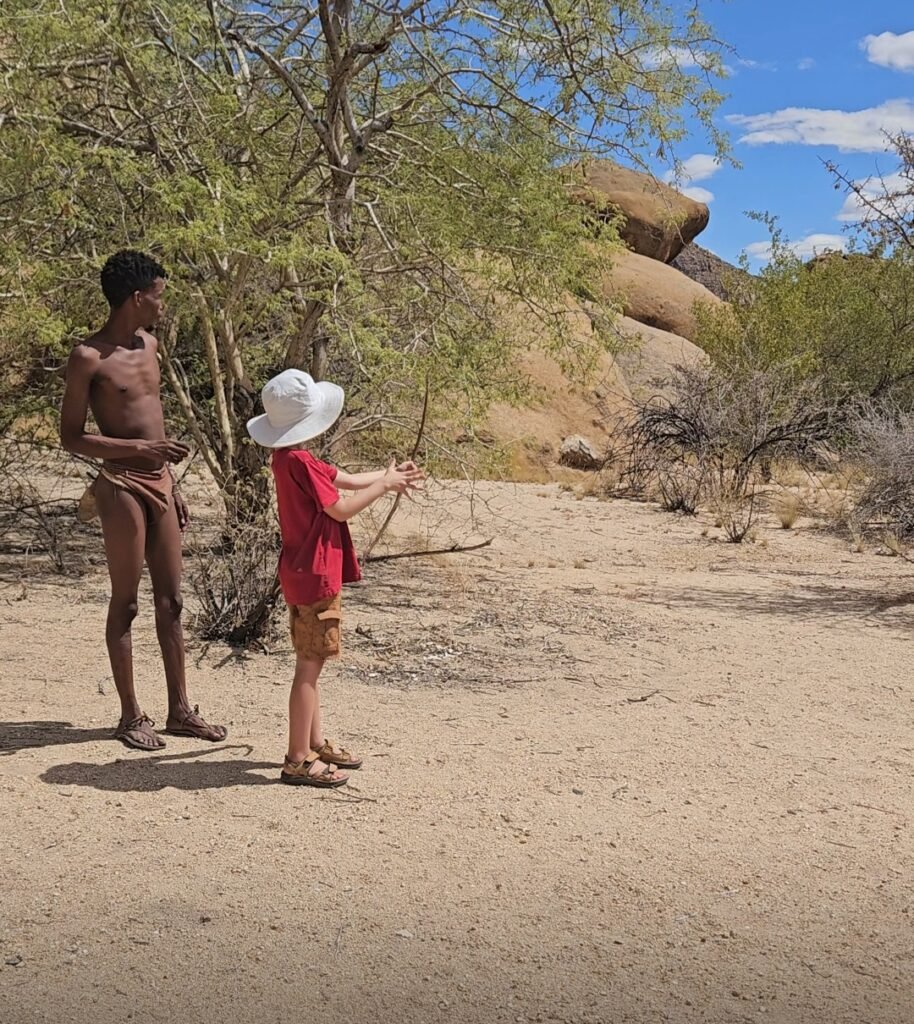
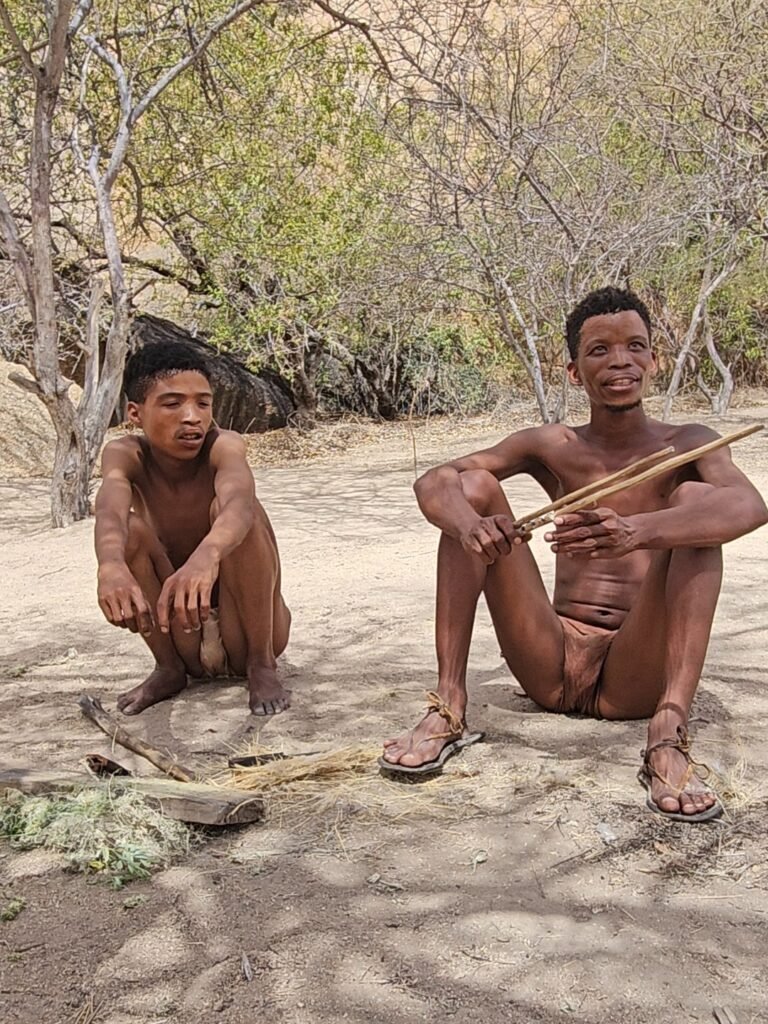
They showed us how they made fire, demonstrated traditional hunting techniques and explained how they identified and used different plants. They also showed us how medicines could be made from plants found in the surrounding environment.
One of the highlights for our son was learning about the bow and arrows used for hunting. He even got to become a San “warrior” for a little while and try shooting a bow that they had made. He was very proud of himself.
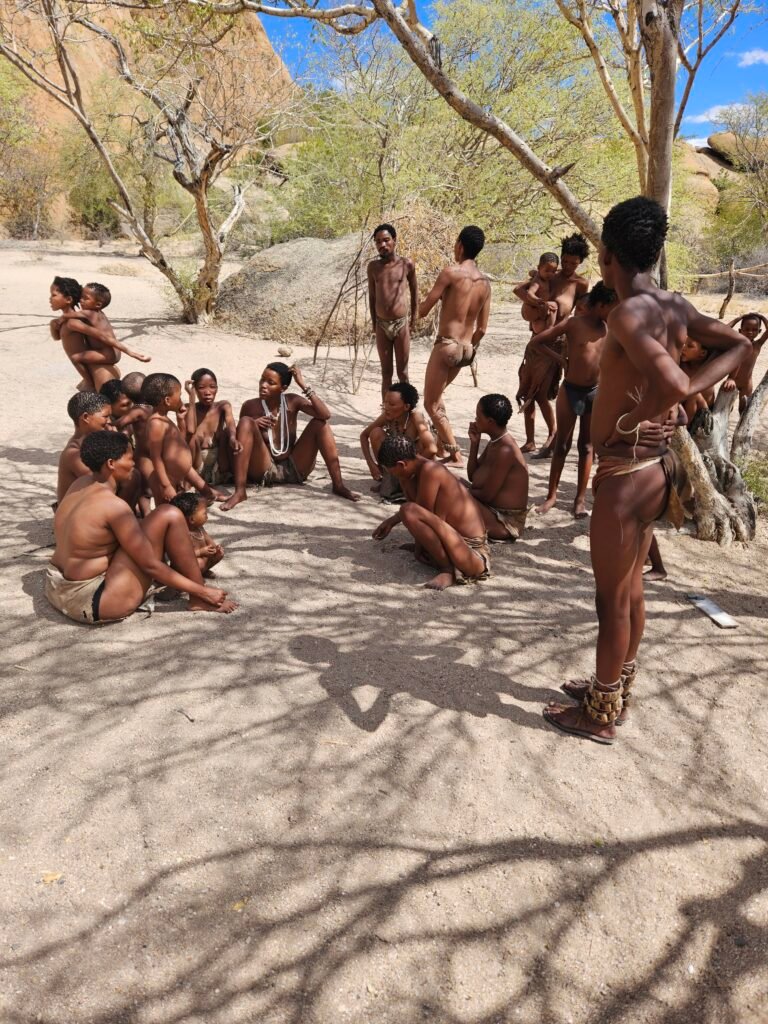
There were also traditional songs and dancing, which made the experience much more interactive. Rather than simply being told about San culture, he got to see the skills, music and knowledge being demonstrated in front of him.
Why this is such an amazing worldschooling experience
This was one of those experiences where several different subjects came together without us having to force a lesson onto it.
There was history, because we were learning about a culture with a very long history in southern Africa. There was science, because we learned about fire, plants, medicine, animal behaviour and tracking. There was geography and environmental studies, because traditional hunter-gatherer life depends so heavily on understanding the environment and knowing how to find food and water. And there was physical education, because our son actually got to practise some of the skills rather than simply hearing about them.
Perhaps most importantly, it gave him a different perspective on what humans actually need to survive. It also gave us a chance to talk about how much of that knowledge has been lost or threatened as traditional ways of life have changed.
Experiences like this are exactly why we love worldschooling. If you’re just getting started, our ultimate guide to worldschooling resources is a good place to begin.
The ethical side of San cultural experiences
As with visiting the Himba, I think it’s worth thinking about the ethics of cultural tourism.
The San communities offering these experiences are not simply reenacting history. They are living communities participating in the modern economy, and tourism can provide an important source of income.
A good cultural experience should give the community a direct financial benefit while allowing them to decide which parts of their culture and knowledge they want to share.
I’d look for locally run or community-supported experiences, listen to your guide about photography and participation. And avoid treating people as a performance or photo opportunity.
For us, the experience felt much more meaningful because our son was genuinely interested and involved. He wasn’t just watching someone demonstrate how to make a fire. He was asking questions, trying the bow, listening to the songs and beginning to understand how people could live very differently depending on their environment.
And that is probably the biggest educational value of experiences like this.
Namibia for worldschooling
Namibia was one of the countries where we didn’t need to deliberately create lessons.
The country basically provided them for us.
A few of the things our son could learn about during our travels included:
Geography
Namibia is an excellent geography lesson in itself.
We could trace our route across the country, look at the Namib Desert, the Atlantic coastline and the different landscapes between Windhoek, Swakopmund, Sossusvlei and Spitzkoppe.
Geology
The dunes, granite formations and canyon at Sesriem all provide examples of geological processes.
Indigenous cultures
Meeting Himba and Bushmen communities gave our son an opportunity to learn about cultures and traditions that are very different from his own.
Environmental science
Namibia’s desert environment naturally leads to questions about how plants, animals and people survive with limited water.
History
Travelling through Namibia also opens up discussions about colonialism, independence and the country’s more recent history.
This is one of the things we love about worldschooling. A trip doesn’t need to be turned into a worksheet to be educational.
Where to stay with kids in Namibia
We spent two months based in Windhoek, which worked really well for us.
Having a base meant that we weren’t constantly changing accommodation. And because we were travelling as a worldschooling family, it gave us somewhere to settle into a routine during the week. In windhoek we rented a house on Airbnb in a quiet area in Windhoek West, and it worked well for us because the house had outside space. We could easily take a taxi if we needed to go to the city centre. However, the more popular area to stay is Independence avenue, CBD or Klein Windhoek.
When choosing accommodation with children, I’d prioritise:
- A comfortable family room or apartment
- A swimming pool, particularly during warmer months
- Somewhere with space for children to move around
- Easy access to food
- Parking if you’re driving
- Air conditioning
Where to stay if you’re road-tripping Namibia
Namibia has some amazing places to stay, from comfortable lodges to simple campsites surrounded by incredible scenery.
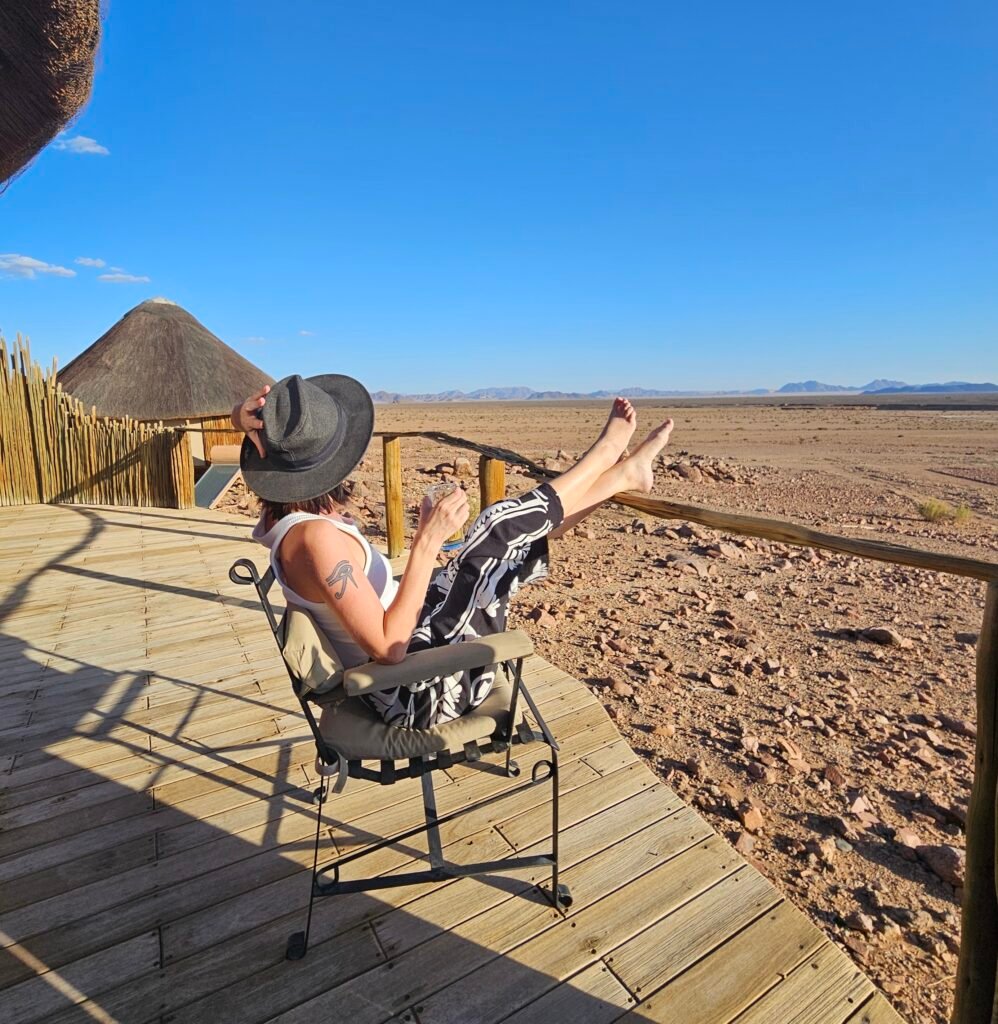
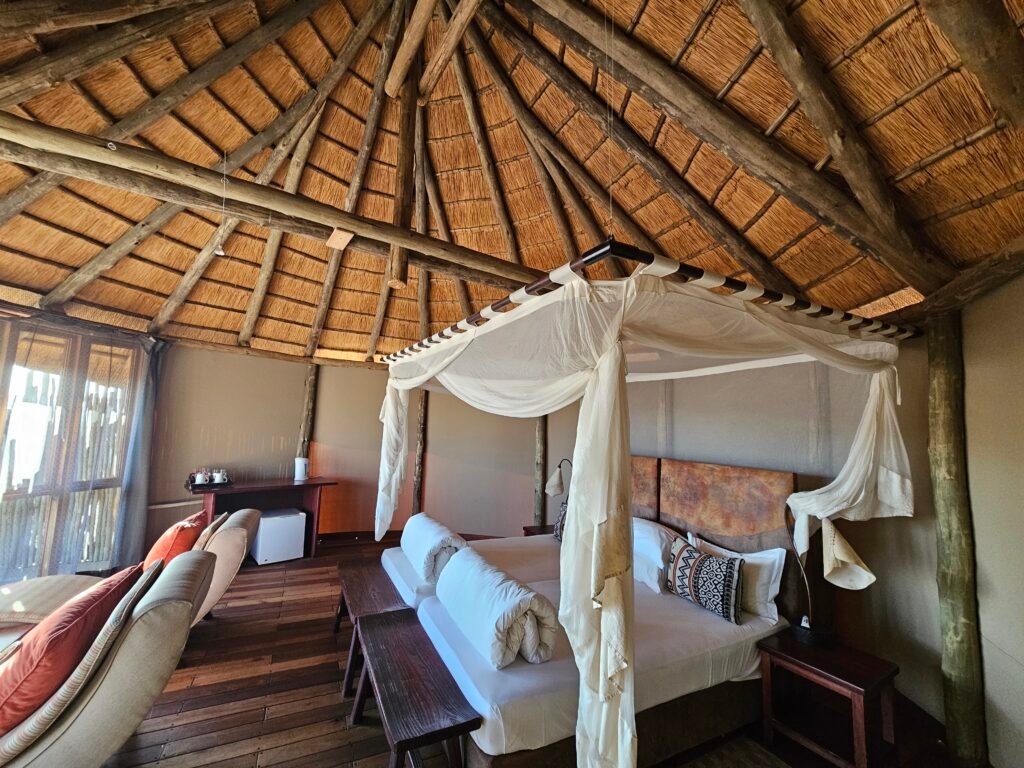
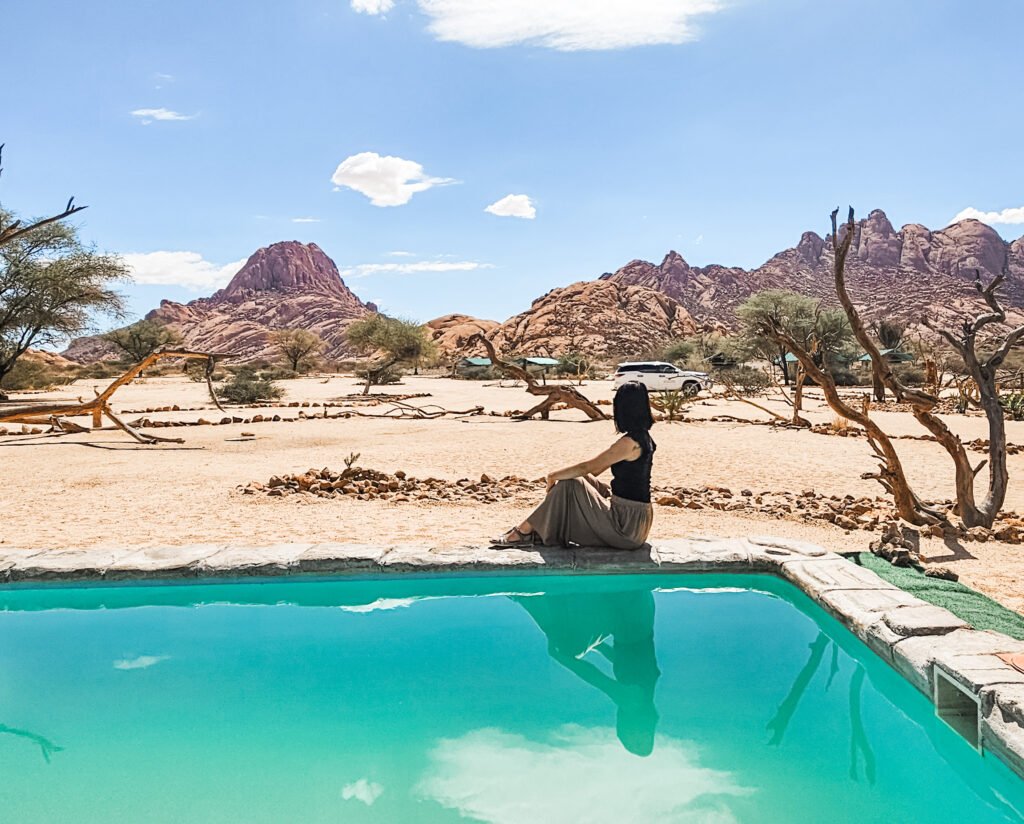
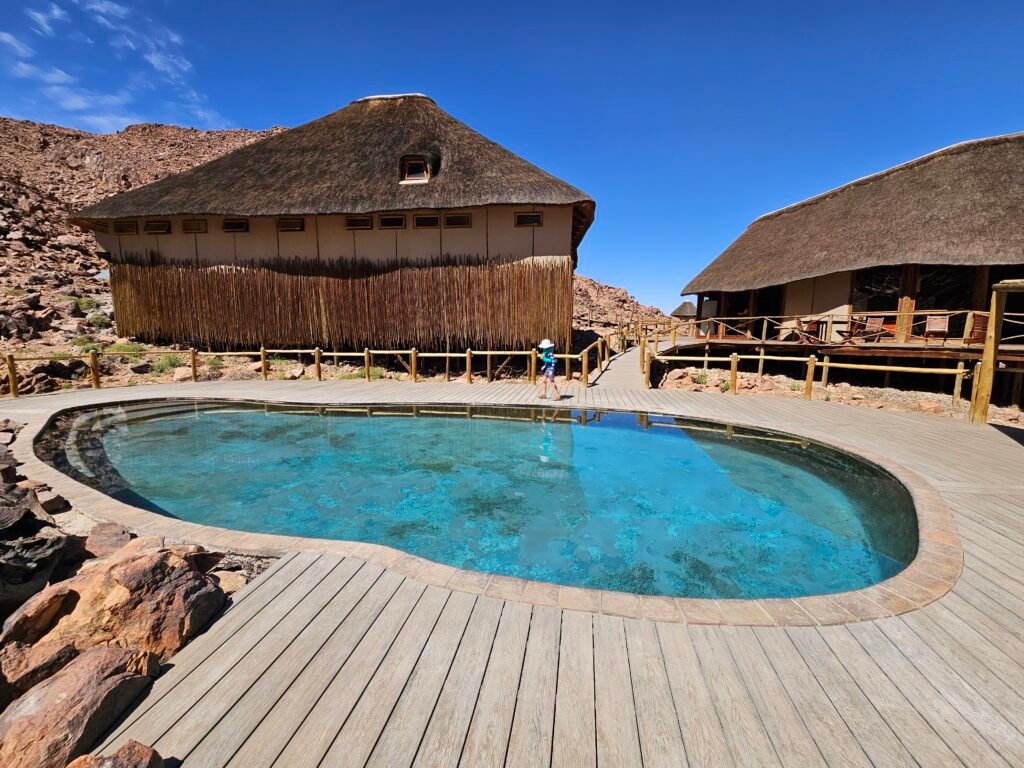
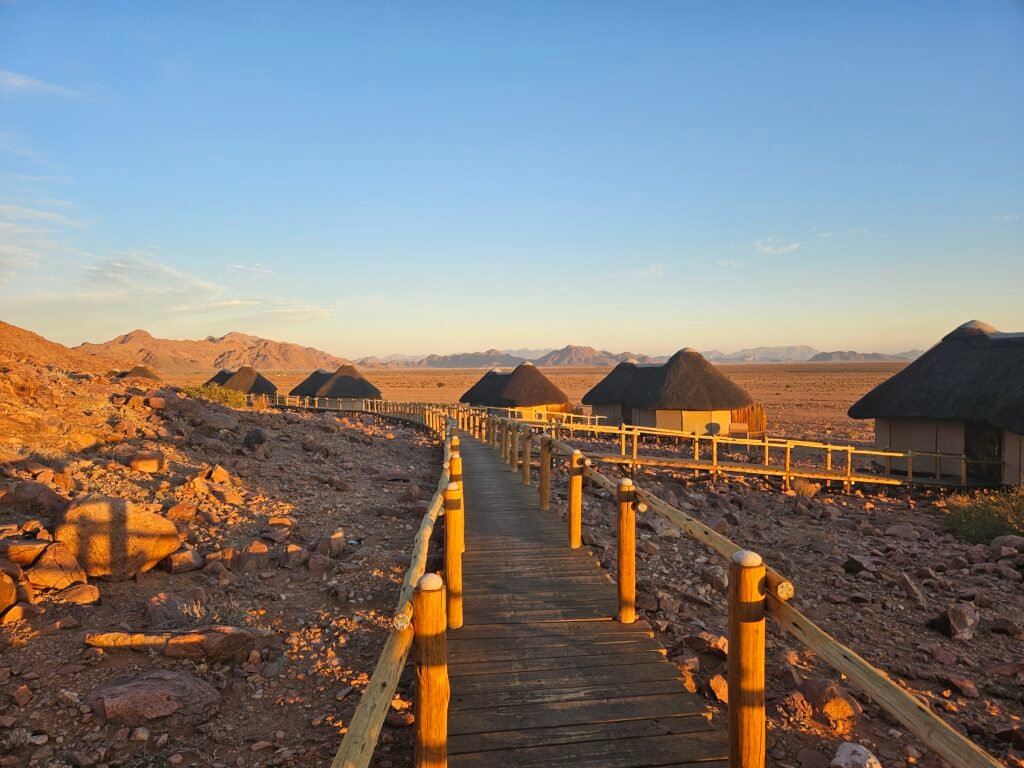
We booked one night at Sossus Dune Lodge, but it was so beautiful that we ended up staying for two. The setting in the middle of the desert is incredible, the food was genuinely amazing, and the stars at night were something else. With so little light pollution, stepping outside after dark felt like having a front-row seat to the universe.
For something more adventurous, Spitzkoppe Tented Camp and Campsites is a great option. We spent a night camping here, surrounded by the huge granite formations, and sleeping under the stars was unforgettable. Spitzkoppe is also one of the best areas in Namibia for stargazing, so if you’re road-tripping and enjoy camping, this is one I’d definitely put on your list. The site has showers, and a restaurant that serves good breakfast.
Both of the places have a swimming pool which can be a blessing after a hot day in the desert.
Getting around Namibia with kids
Namibia is a big country.
Distances that look manageable on a map can translate into many hours of driving.
This is probably the biggest thing I’d tell families planning a Namibia road trip.
Don’t underestimate the distances.
For our particular situation, using Windhoek as a base and travelling on weekends meant we could manage our schedule around our son’s needs.
For a traditional holiday, however, I’d plan your route carefully and avoid trying to see the entire country in one trip.
A rental car gives you much more freedom. But you need to be comfortable with long drives and, depending on your route, different road conditions.
Practical tips for travelling to Namibia with kids
Plan around the driving
Namibia is not a destination where you can simply look at two locations on a map and assume they’re close.
Build your itinerary around realistic driving times.
Your children will thank you.
Start desert activities early
The desert gets hot, and there isn’t much shade.
Early mornings are generally much more pleasant for activities such as dune climbing.
Bring plenty of water
This sounds obvious, but in Namibia it is worth taking seriously.
Always carry more water than you think you’ll need when heading into remote areas.
Pack layers
Namibia can have surprisingly big temperature changes.
A hot desert afternoon and a chilly morning are not contradictory.
For the exact layers, shoes and kit we packed, see the family travel gear we actually use, after 70+ countries.
Don’t overpack your itinerary
This is especially important with children.
There is a temptation to look at a map and think, “We’re already here. So we might as well add one more place.”
In Namibia, that can quickly turn into several extra hours in the car.
Leave some breathing room.
Expect limited services in remote areas
Outside the main towns, don’t expect shops, restaurants and petrol stations around every corner.
Plan ahead.
Is Namibia safe for families?
We felt comfortable travelling around Namibia with our son, but as with any destination, you need to use common sense.
Windhoek is actually one of the safest cities in Africa. The biggest practical issues for family travellers are often related to the environment rather than the kind of risks people traditionally associate with travelling.
Remote areas are genuinely remote.
Heat, dehydration, long distances and vehicle problems can become serious if you’re unprepared.
Don’t wander off into remote areas without enough water, and take local advice seriously.
When visiting communities, be respectful and follow the guidance of your guide.
And when doing activities such as quad biking or the climb at Bushmen Paradise, make sure the activity is appropriate for your child’s age and confidence level.
What food should you try in Namibia?
Namibian food has a mixture of African, German and South African influences. So you’ll find everything from German-style breads and pastries to traditional meat dishes and plenty of familiar food for children.
But one thing you should definitely try while you’re there is game meat.
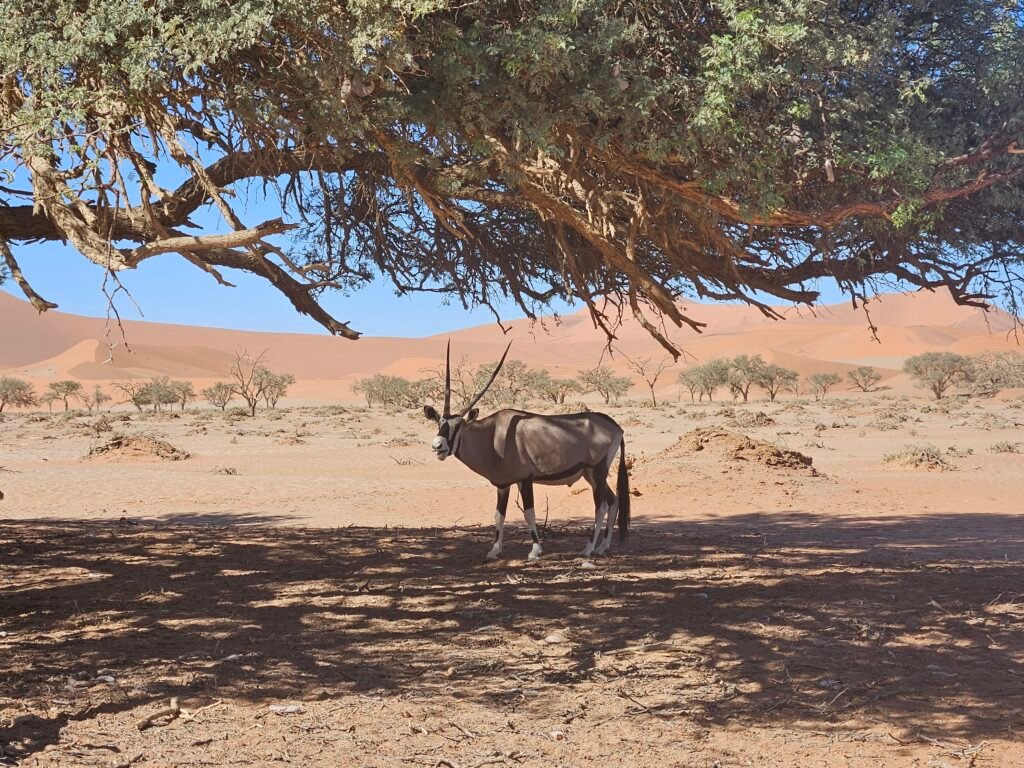
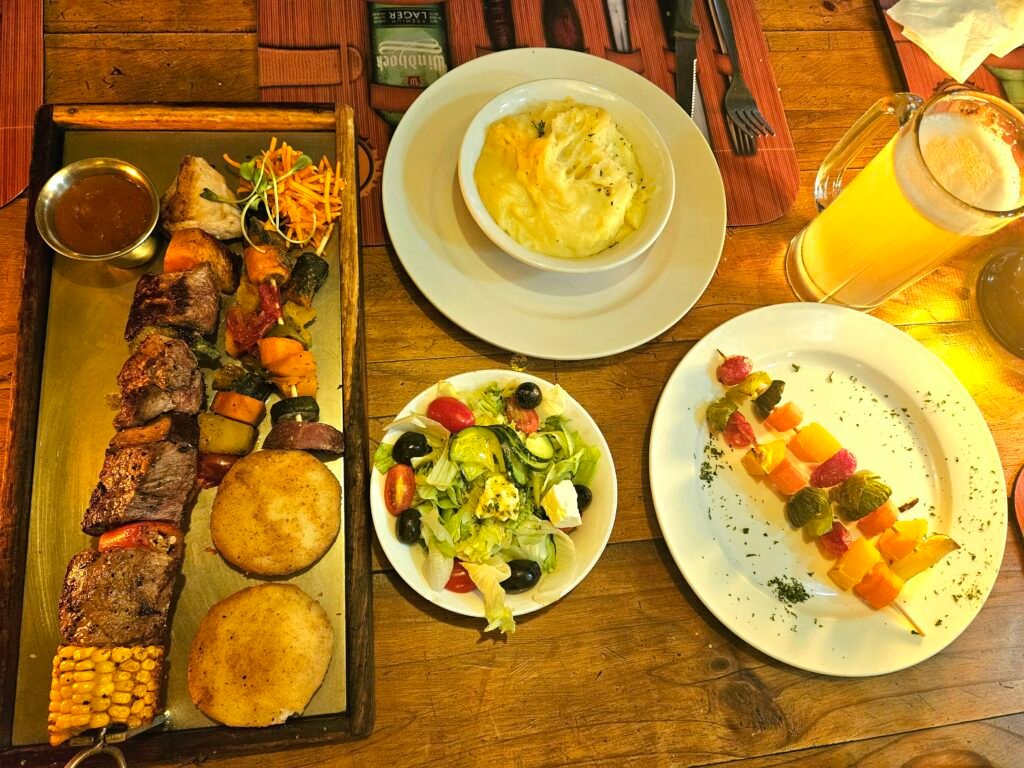
Game is widely available in Namibia, and you’ll find meats that you probably don’t see very often at home, including oryx (gemsbok), springbok, kudu, and even giraffe, along with several other types of game. If you’re travelling with children, it can actually be a fun way to introduce them to the idea that different countries have very different food traditions.
Try game meat at Joe’s Beerhouse
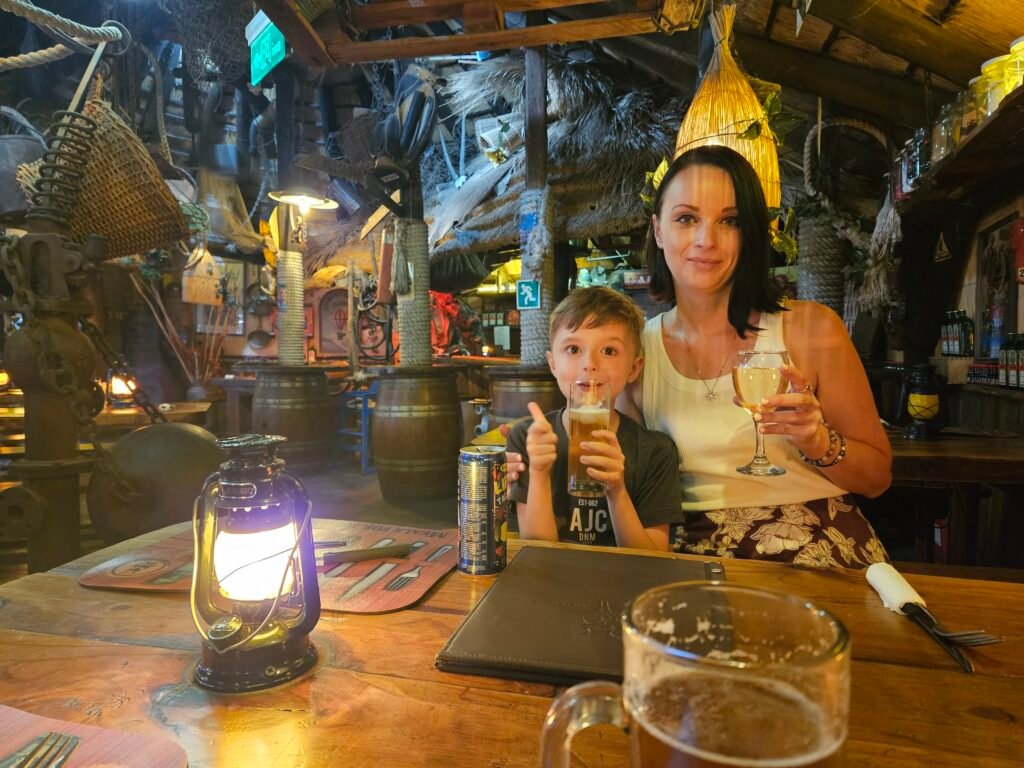
If you’re staying in Windhoek, we’d definitely recommend Joe’s Beerhouse.
It’s a well-known Windhoek institution, but it’s not just somewhere tourists go for the novelty. We thought the food was genuinely very good. And it’s a great place to try several different types of Namibian game meat.
The menu has a wide selection of game, and you can try things such as oryx, springbok, kudu and other local meats. It’s a good option if you’re curious about game but don’t want to order an entire meal of something you’ve never tried before.
For our family, it was also one of those meals that became part of the travel experience itself. Instead of just eating something familiar in another country, our son could try foods that actually came from the environment and food culture around him.
And if you’re wondering what game meat tastes like, the different varieties aren’t all wildly different from beef or other red meats. Oryx and springbok, for example, are generally quite lean. So they’re often served in a way that lets the meat itself shine.
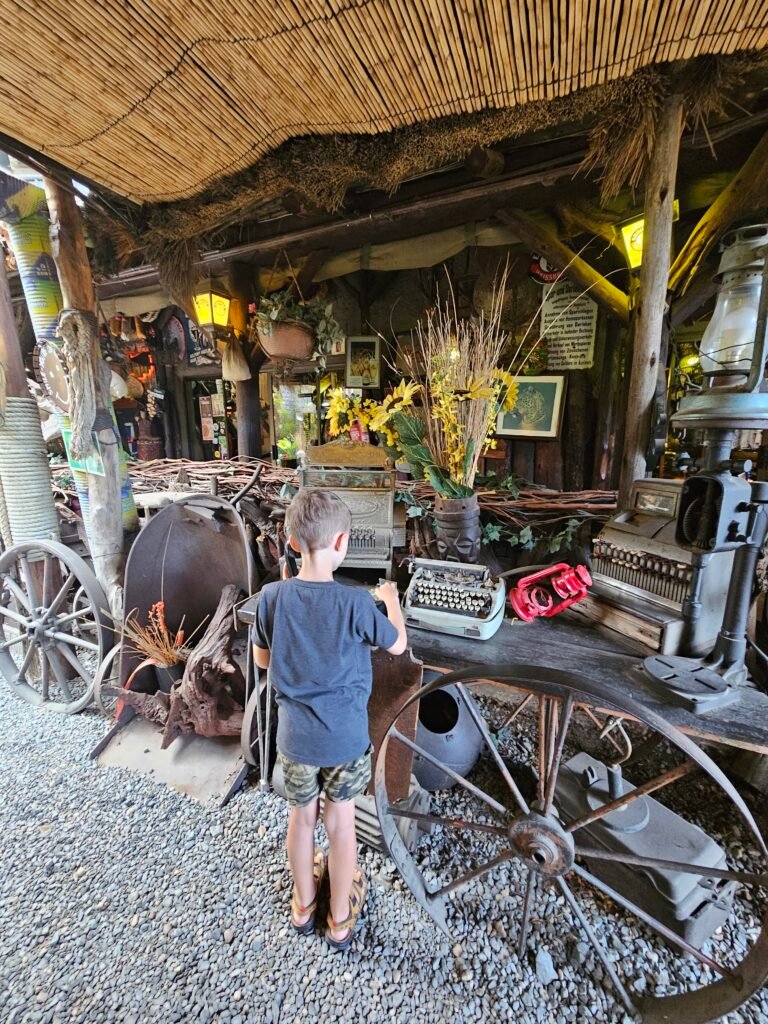
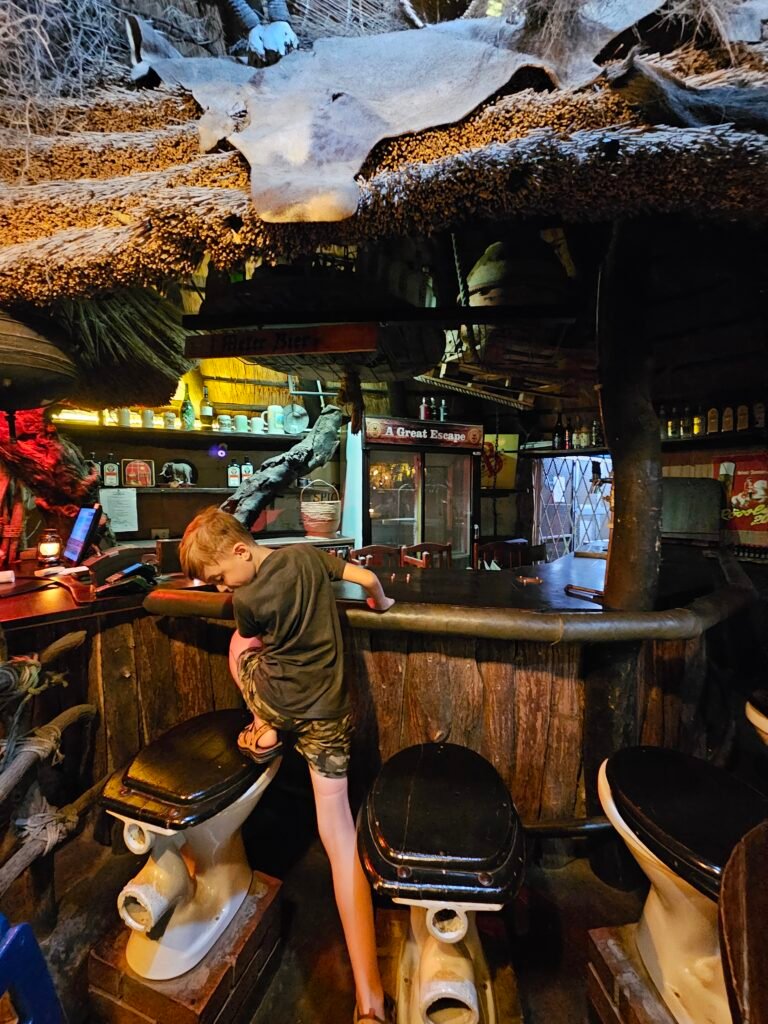
Joe’s is also a fun place to visit with children because of its unusual, almost museum-like decor, with all sorts of African and Namibian memorabilia around the restaurant. It’s much more interesting than a standard family restaurant. And there’s plenty to look at while you’re waiting for your food.
Other Namibian foods worth trying
You’ll also come across plenty of German-influenced food, particularly in places such as Windhoek and Swakopmund. Think sausages, schnitzel, breads, pastries and other hearty dishes.
And then there are the famous apple pies at Solitaire, which deserve their own stop on any road trip towards Sossusvlei.
For families, the good news is that you don’t need to worry too much about finding food that children will eat. There are plenty of familiar options alongside the more unusual local dishes.
One practical tip, though: when you’re heading into remote parts of Namibia, don’t rely on finding a restaurant whenever you get hungry. Bring snacks and water with you, particularly when travelling with children. Some of the drives are long and there may be very little between destinations.
How long do you need in Namibia?
If you’re doing a normal holiday rather than staying for two months like we did, I’d suggest giving Namibia at least two weeks if you want to experience some of its major highlights without spending the entire trip in the car.
Two weeks gives you much more breathing room than trying to squeeze everything into seven days.
If you have three weeks or more, you can slow things down and add more destinations.
And if you have the flexibility to do what we did and stay for longer, Namibia works surprisingly well as a base for slower travel.
We spent our weekdays in Windhoek and used weekends for adventures, which gave us the best of both worlds.
Our favourite Namibia experiences with our son
If we had to narrow our Namibia adventures down, these would be the experiences that stand out most from our time there:
Quad biking in the desert: Our seven-year-old absolutely loved this. It was one of those activities where he was completely engaged from beginning to end.
Sandwich Harbour: The sight of enormous dunes meeting the Atlantic Ocean was one of the most memorable landscapes we saw.
Deadvlei: The strange combination of dead trees, white ground and giant dunes makes this place genuinely fascinating.
Meeting the Himba and the San people: A completely different kind of experience, and an important part of our son’s cultural learning.
Bushmen Paradise: Interesting culturally, but remember that the climb is steep and involves using a metal chain rather than stairs.
Spitzkoppe: A great combination of dramatic scenery, exploration and cultural learning.
Our recommended 2-week Namibia itinerary
We were lucky enough to spend two months in Namibia. This meant we could use Windhoek as our base and explore the country at a much slower pace. But we know most families won’t have that much time.
If you only have two weeks in Namibia, here’s the Namibia family itinerary I’d recommend.
I’d still try to include the places and experiences we loved most. But I’d allow a little more time for the longer drives rather than trying to cram everything into a few exhausting days.
Days 1-2: Windhoek
Start in Windhoek and give yourselves a day or two to settle in after arriving.
This is a good time to pick up supplies, get used to the country and recover from your flight before heading out on the road.
I’d also make time for a meal at Joe’s Beerhouse, particularly if you want to try some of Namibia’s game meats such as oryx, springbok and kudu.
Days 3-4: Swakopmund and Sandwich Harbour
Windhoek → Swakopmund
Spend a couple of nights around Swakopmund.
One day, do a desert quad-biking trip. Our seven-year-old absolutely loved this, and it was one of his favourite activities in Namibia.
Then take a Sandwich Harbour tour, where you’ll drive through the enormous dunes and see the place where the Namib Desert meets the Atlantic Ocean.
The combination of desert and ocean is spectacular, and the dune driving makes the journey itself part of the adventure.
Days 5-7: Sossusvlei and the Namib Desert
Swakopmund → Solitaire → Sossusvlei
Head towards the Sossusvlei area, stopping at Solitaire along the way.
This is where you’ll want to try the famous apple pie at the Desert Bakery. And it’s also a useful place to refuel and stock up before continuing into the desert.
Spend at least two nights around Sossusvlei so you aren’t rushing through everything.
Visit:
- Dune 45
- Deadvlei
- Sesriem Canyon
- Sossusvlei itself
I’d aim to get to the dunes early in the morning. The heat can become intense later in the day. And climbing sand dunes with children is hard enough without doing it in the hottest part of the afternoon.
Days 8-9: Return towards Spitzkoppe
Sossusvlei → Spitzkoppe
This is another longer driving day, so don’t try to fill it with lots of activities.
Once you reach Spitzkoppe, slow down.
This is one place where I’d really recommend staying overnight if you can. We camped there and sleeping under the stars was one of the most memorable parts of our Namibia trip.
Spitzkoppe has exceptionally dark skies and is considered one of the best places in Namibia for stargazing. After the sun goes down, the landscape completely changes.
During the day, explore the granite formations and surrounding area.
Day 10: Bushmen Paradise
Use your time around Spitzkoppe to visit Bushmen Paradise and see the ancient San rock paintings.
The paintings are thousands of years old, and the site gives children a fascinating connection to prehistoric human history.
Just remember that getting there involves a steep climb with no steps, using a metal chain for support. Our son was seven and managed it, but this isn’t an easy walk and I’d take your child’s age and confidence into account.
Day 11: Visit a San community
Spend some time with a San community and learn about traditional hunting and survival skills.
During our visit, we saw demonstrations of traditional fire-making, hunting techniques and the use of plants for medicine. There were also songs and dancing. And our son got to try shooting a bow that had been made by the community.
For a worldschooling family, I’d definitely keep this experience in the itinerary. It’s one of those activities where history, science, culture and environmental studies all come together naturally.
Days 12-13: Himba cultural experience
Depending on your exact route and which community you visit, use the next couple of days to experience Himba culture.
This was another highlight for us. We learned about traditional Himba life, saw the red ochre used by the women, learned about their smoke-bathing tradition and saw traditional jewellery and clothing. We also watched singing and dancing.
I’d definitely recommend arranging this through a reputable local operator or community-based tourism project so that the people you’re visiting actually benefit from the experience.
Day 14: Return to Windhoek
Head back towards Windhoek for your final night and prepare for your flight home.
If your flight is late in the day, you may have some time to explore a little more of the city. But after two weeks of driving and exploring, you may also be perfectly happy doing absolutely nothing.
And honestly, that’s okay too.
Here are some examples of multiple day tours that can be available.
We booked all our tours with Quest Transfer, and they were great.
A note about this itinerary
This is a fairly ambitious two weeks.
Namibia is enormous, and you’ll spend a lot of time in the vehicle. We had two months. So we could spread these experiences out over several weekends and never felt like we were constantly rushing.
If you only have two weeks, I’d resist the temptation to add another five destinations just because they’re on the map.
You could easily spend more time around Sossusvlei, Swakopmund or Spitzkoppe and enjoy the trip more.
I’d also consider doing the longer sections with an organised tour, as we did, rather than trying to drive everything yourself. If you prefer self-drive, Namibia is extremely well suited to it, but you’ll need to plan your driving distances carefully.
The point of this itinerary isn’t to see every corner of Namibia.
It’s to give you a taste of the landscapes, adventure and cultures that made the country so memorable for us, without turning your two-week family holiday into one very long driving marathon.
Final thoughts: Is Namibia worth visiting with kids?
Absolutely, but Namibia isn’t the right destination for every family.
If your idea of a family holiday is a resort, short transfers and lots of organised children’s activities, I’d probably look elsewhere.
But if your family enjoys adventure, road trips, wildlife, deserts, unusual landscapes and learning through real experiences, Namibia is fantastic.
For us, having our seven-year-old along actually made the trip more interesting. We weren’t just looking at beautiful landscapes. We were constantly stopping to answer questions, explaining what we were seeing and letting him experience things for himself.
And some of the best memories weren’t necessarily the famous sights.
They were the moments when he was racing across a desert on a quad bike, climbing over rocks, asking questions about how people live in completely different environments, or simply staring at a landscape that looked nothing like anywhere he’d been before.
Spending two months in Namibia also reminded us why we love travelling slowly with our son. We didn’t need to tick off every attraction in the country. We had a base, settled into a routine, and then used our weekends to go exploring.
For a worldschooling family, that worked incredibly well.
Namibia is big, sometimes challenging, and definitely requires some planning. But if you’re willing to embrace the long drives and the wide-open spaces, it can be an amazing place to travel with children.
More family travel guides
If you enjoyed this Namibia itinerary, you might also like some of our other family travel and worldschooling guides:
- Antigua Guatemala with Kids: The Best Family and Worldschooling Guide
- Things to Do in Da Nang With Kids: A Family Guide to Da Nang, Vietnam
- Best Things to Do in Kraków with Kids
- Prague with Kids: Fun Things to Do in Prague as a Family
- 21 Best Things to Do in Copenhagen with Kids
- Chișinău with Kids: The Best Things to Do in Moldova with Your Family