

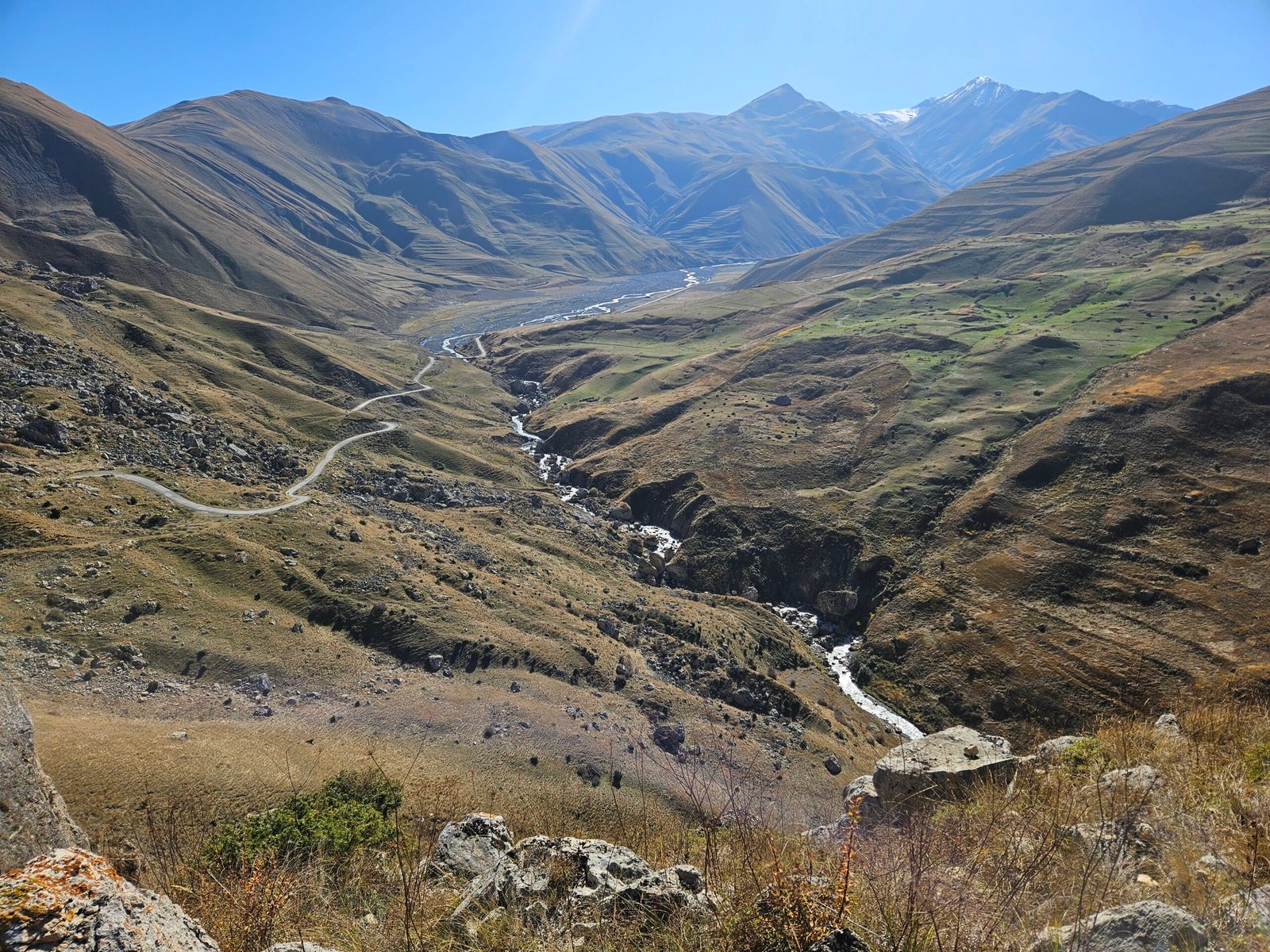
Azerbaijan With Kids: Our 5-Day Family Trip From Baku to Khinalig
Azerbaijan is easy and fun to travel with kids, because there is so much variety packed into a relatively small area. As currently we have a home base in Georgia, Baku is only a quick flight away, and made for a great short trip for us.
We travelled around Azerbaijan with our eight-year-old son and spent five days exploring the country. We based ourselves around Baku and used private-driver tours to get out into the countryside. That made it possible to see quite a lot without having to deal with complicated public transport connections, especially for places such as Khinalig and the more remote mountain areas.
And there is a lot to see.
In just a few days, we went from Baku’s medieval Old City and the Caspian Sea to a futuristic building designed by Zaha Hadid, ancient rock carvings, natural gas fires, bubbling mud volcanoes, a spectacular palace in Sheki and the high Caucasus mountain village of Khinalig.
The landscape changes dramatically as you leave Baku. One minute you are surrounded by modern buildings and the Caspian waterfront, and not long afterwards you can be driving through almost completely barren landscapes before reaching mountains and remote villages.
That contrast was one of the things I liked most about Azerbaijan.
This is our family travel guide to Azerbaijan, based on the places we actually visited, with current practical information added for anyone planning the same trip now.
Is Azerbaijan good for family travel?
Azerbaijan is a fantastic option for families, particularly if you like travel that combines history, unusual landscapes and road trips. We found it safe, friendly and relatively affordable compared with many European destinations, and people were welcoming towards our son wherever we went.
It also works well if you prefer a trip that feels a little different from the usual family holiday. There are plenty of comfortable places to stay and eat, getting around is straightforward with a driver, and you can see a lot without spending a fortune. For families who enjoy exploring rather than spending the whole holiday at a resort, Azerbaijan is a very good choice.
Planning a trip to Azerbaijan?
🛏️ Booking hotels: Booking.com – Baku Old Town family hotels
1. Royal Antique Boutique Hotel (Budget)
Good-value boutique option in the Old City, with a very convenient location and strong guest reviews.
2. Sultan Inn Boutique Hotel (Mid-Range) 👍 Top Pick
Right beside the Maiden Tower in the heart of the Old City. Family rooms are available, and the location score on Booking.com is currently 9.8/10.
3. Four Seasons Hotel Baku (Luxury)
A beautiful 5-star option overlooking the Caspian Sea and Old City, with an indoor pool, family rooms and a 9.9/10 location score on Booking.com.
🎟️ Booking tours: Viator and GetYourGuide
1. Baku City & Old Town Guided Tour
A good option if you want a guide to take you around the main sights without having to organise everything yourself.
2. Gobustan, Mud Volcanoes, Ateshgah & Yanardag Tour 🏆 Top Pick
This is the combination I’d look for if you have limited time in Baku. It covers several of the places we visited outside the city in one day.
3. Sheki & the Caucasus Private Two Day Trip
A long day from Baku, but a good option if you want to see Sheki without arranging the logistics yourself. If you have the time, we’d recommend staying overnight in Sheki rather than rushing back to Baku.
4. Khinalig & Quba Mountain Tour
For dramatic mountain scenery and a chance to visit one of Azerbaijan’s most remote historic villages. This is another long day, so a private tour or driver makes much more sense for families than trying to piece the journey together by public transport.
🚗 Renting a car: Discover Cars
Useful if you want to explore independently beyond Baku. Current Baku Airport listings include major rental companies and cars from around $50+ per day, although prices vary considerably by dates, car type and insurance.
📱 eSIM: Nomad eSIM for Azerbaijan
Nomad offers Azerbaijan eSIM plans from US$6, with options including 3 GB, 5 GB and 10 GB plans valid for 30 days. It’s an easy way to get connected without buying a physical SIM when you arrive.
🏥 Travel Insurance: SafetyWing Nomad Insurance
Flexible travel medical insurance designed for long-term travellers and families, with coverage in 180+ countries, including Azerbaijan. You can buy it before or during your travels
Baku with kids
Baku is the obvious base for exploring Azerbaijan and, for a family, it is also an interesting introduction to the country because the city looks very different depending on where you are.
There is the old walled city, grand European-style buildings from the oil boom, the Caspian waterfront and very modern architecture such as the Heydar Aliyev Centre. The official Azerbaijan tourism site describes Baku as the “City of Winds”, and the city is known for the strong winds that come off the Caspian.
For us, Baku was a good place to start before heading out into the countryside. If you’d like to learn more about Baku’s fascinating history, we recommend this tour that shows you the highlights of the city.
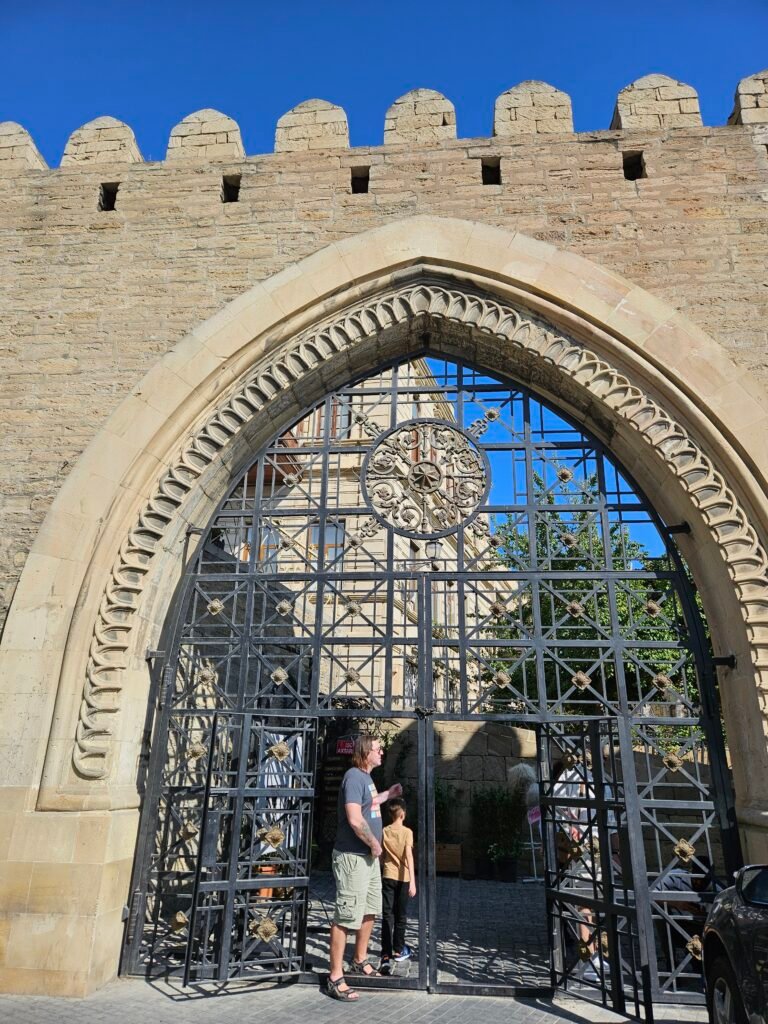
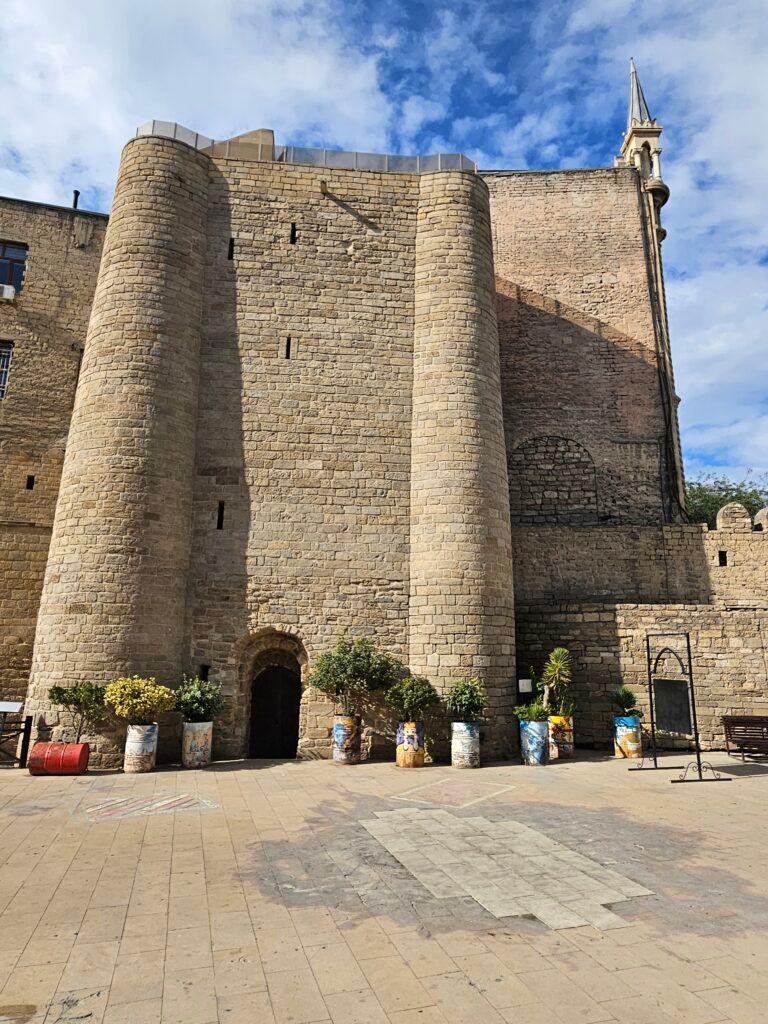
The Old City, Icherisheher
Baku’s Old City, known as Icherisheher, is the historic heart of the capital and a UNESCO World Heritage Site.
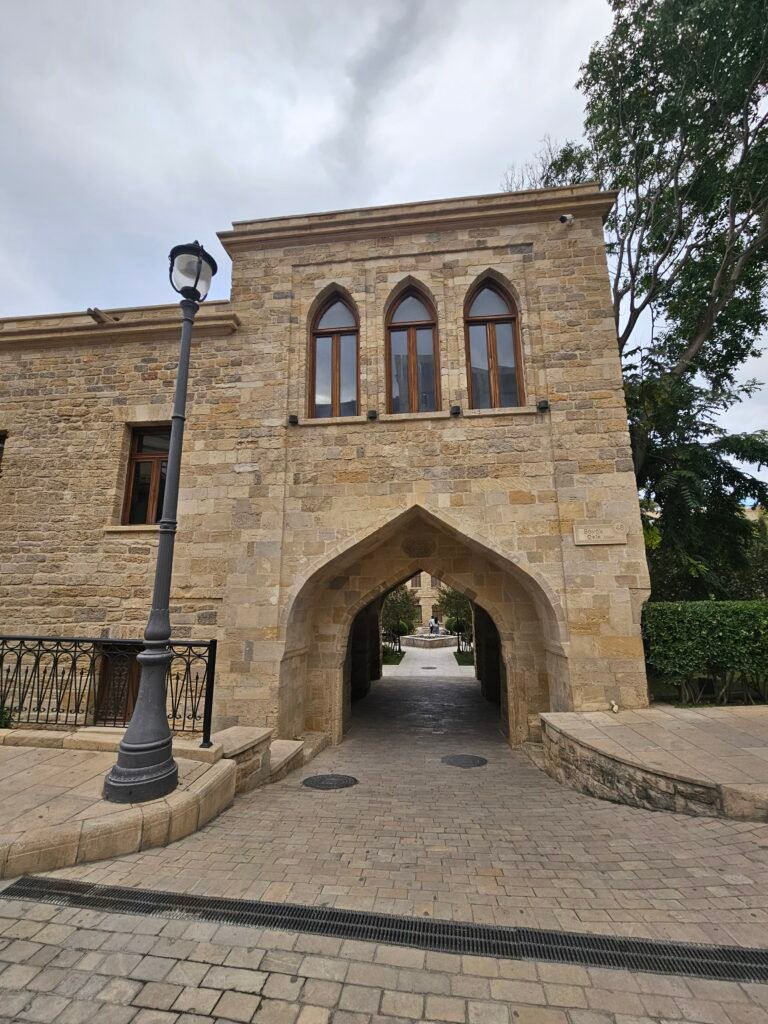
It is enclosed by historic walls and contains some of Baku’s most important sights, including the Maiden Tower and Shirvanshahs’ Palace. This was one of the areas we visited, and it is the part of Baku where I would allow yourself time simply to wander.
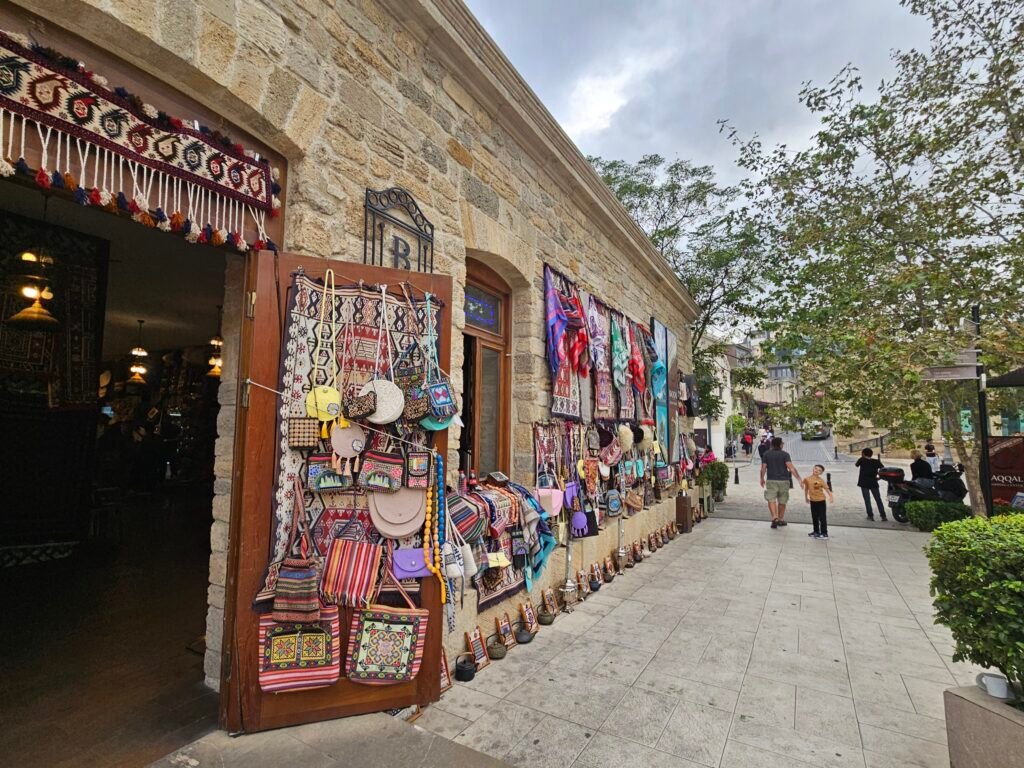
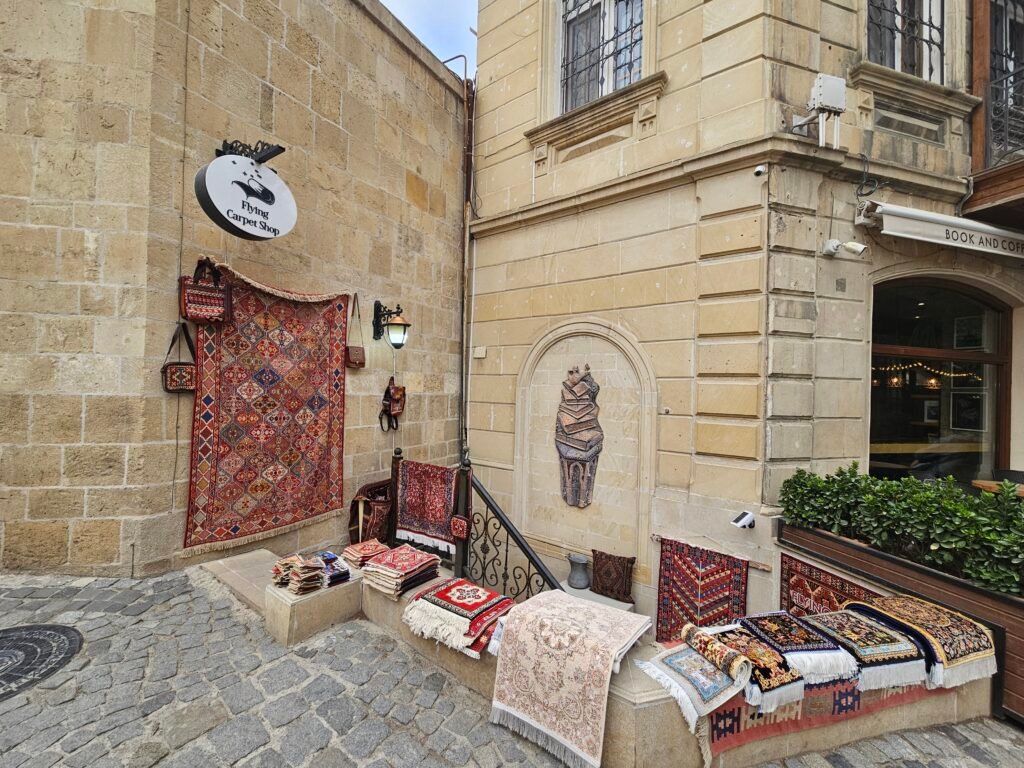
The narrow lanes, old stone buildings and little courtyards make the Old City interesting in itself. There are also cafés, restaurants, small shops and museums scattered through the area.
The Old City is also an easy place to combine several attractions in one visit.
Maiden Tower
🕐 Opening Hours: Every day, 10 AM – 7 PM
💰 Entry Fees: 19 AZN adults | 9 AZN children (5–17)
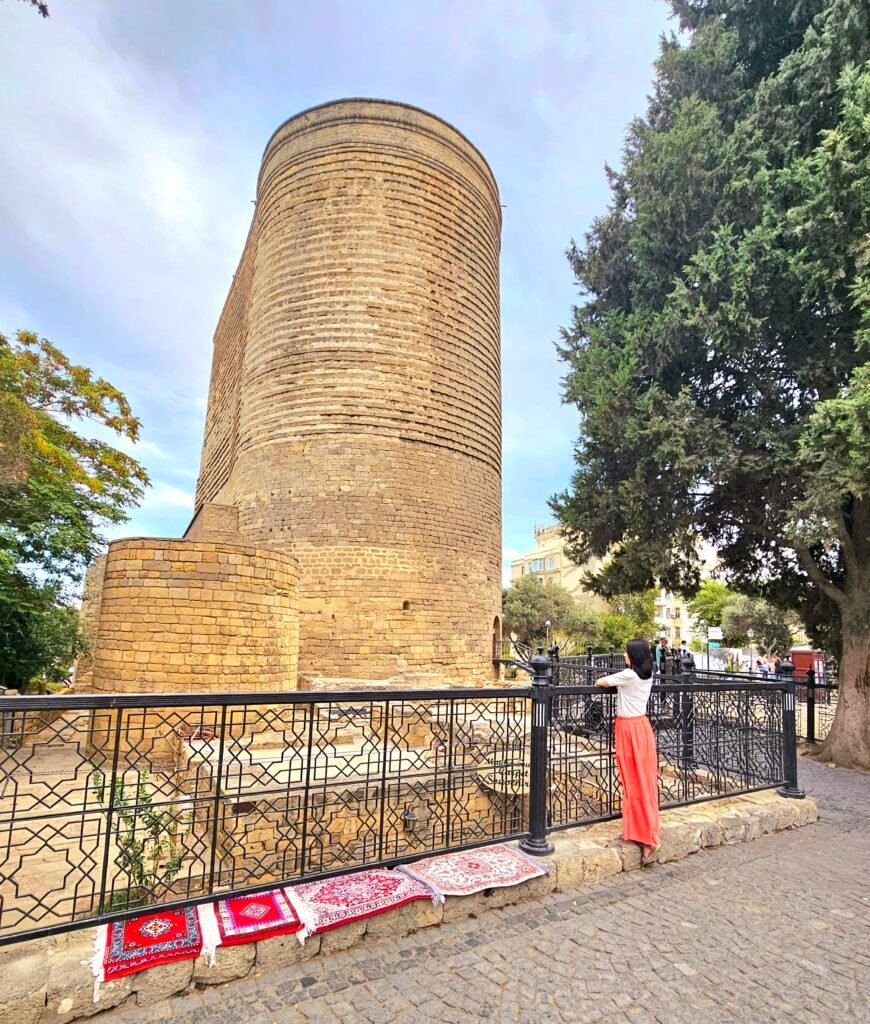
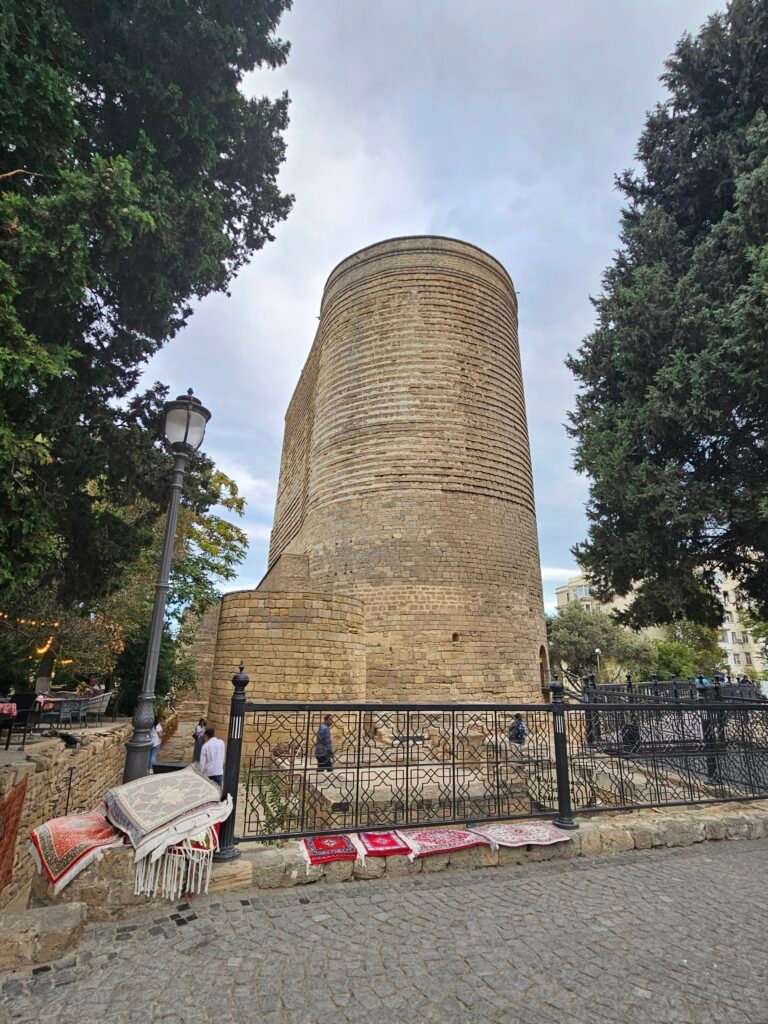
The Maiden Tower is probably the most recognisable historical monument in Baku’s Old City.
We visited it as part of exploring the Old City, and it is an easy one to combine with the other sights in the area.
One of the interesting things about the tower is that nobody is completely sure what it was originally built for. Some theories suggest it may have been a defensive tower or part of Baku’s old fortifications, while others believe it had a religious or astronomical purpose. There are also legends connecting the tower with a princess, although these are stories rather than established history.
The uncertainty actually makes it more interesting to explore with kids. Instead of having one definitive explanation, you can look at the building and ask what clues might tell us what it was used for.
The official tourism information also notes that both the tower’s date and original purpose remain the subject of different theories. (Azerbaijan Travel)
If you are visiting the Old City, I would include it rather than making a separate trip.
Shirvanshahs’ Palace
🕐 Opening Hours: Every day, 10 AM – 7 PM
💰 Entry Fees: 24 AZN adults | 12 AZN children (5–17)
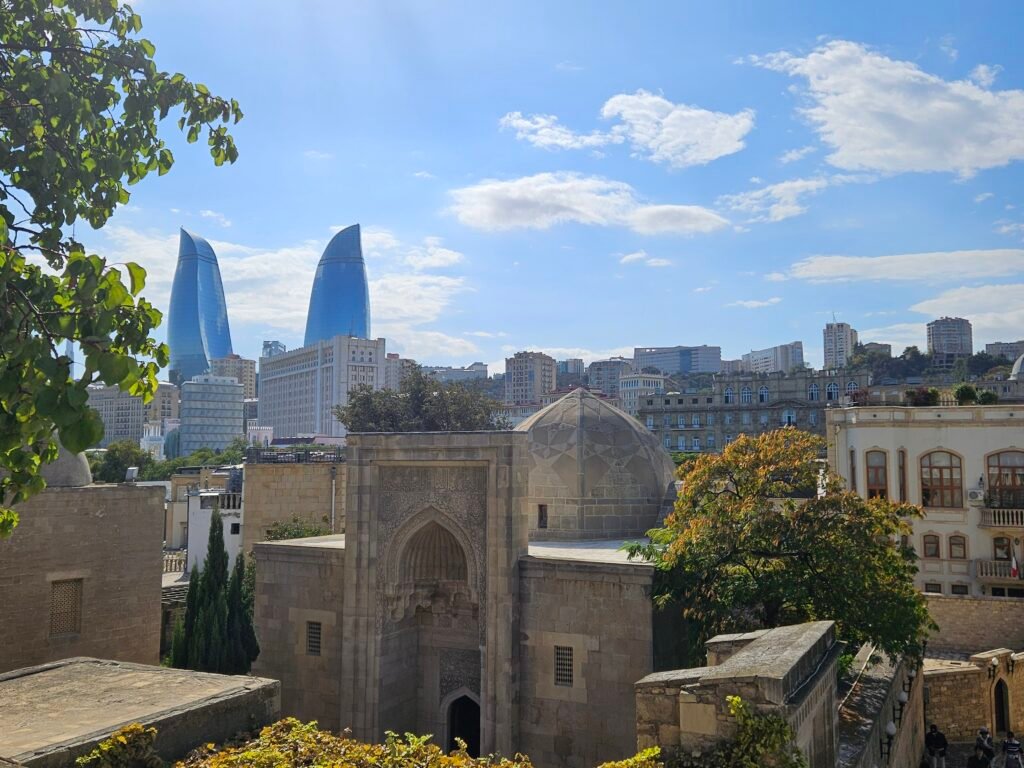
We also visited the Shirvanshah’s Palace while exploring Baku’s Old City, and it was one of the places I would definitely include if you are already visiting the Maiden Tower.
The palace dates mainly from the 15th century and was built during the reign of Shirvanshah Khalilullah I, after the Shirvanshah rulers moved their capital from Shamakhi to Baku. It became the political and cultural centre of the Shirvan state. The complex includes the main palace, a reception courtyard, a mosque, mausoleums, a bathhouse and other buildings, all arranged across several courtyards.
It is a beautiful complex, with pale golden limestone, carved stone details and elegant courtyards. You can wander through the different parts of the palace and get a sense of what the medieval rulers’ world would have looked like without needing hours to see everything.
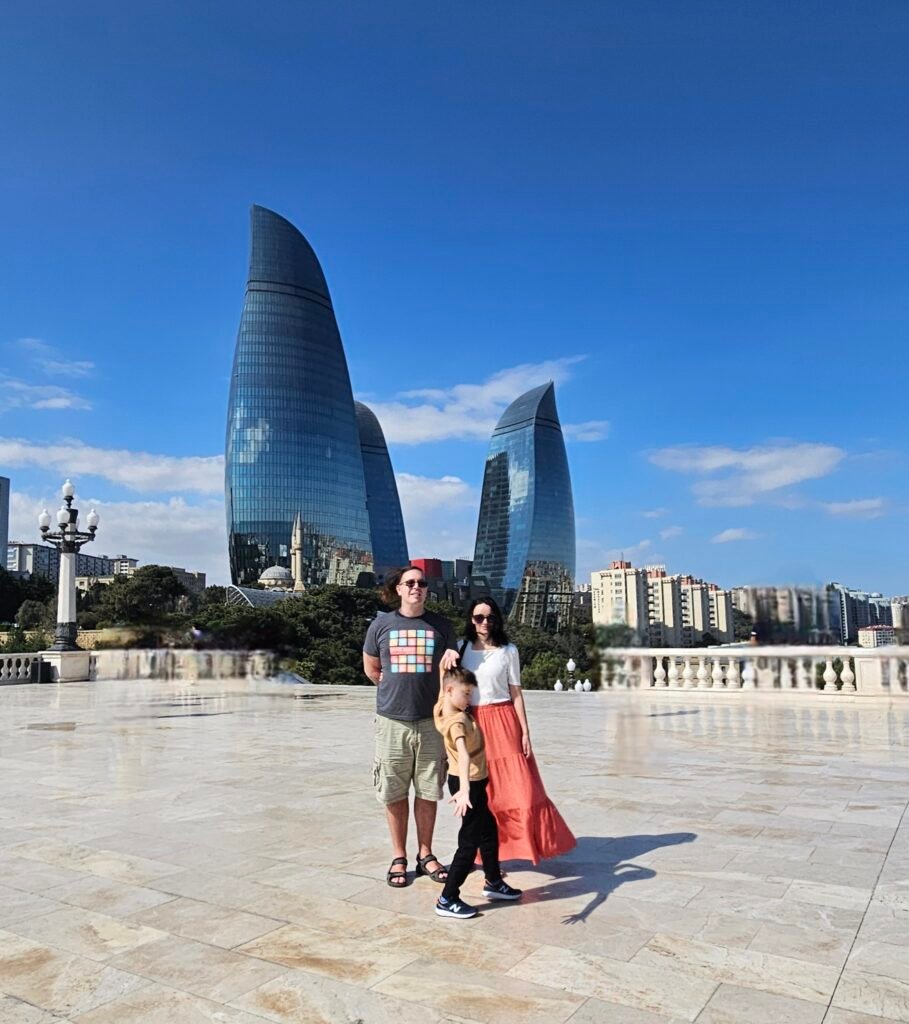
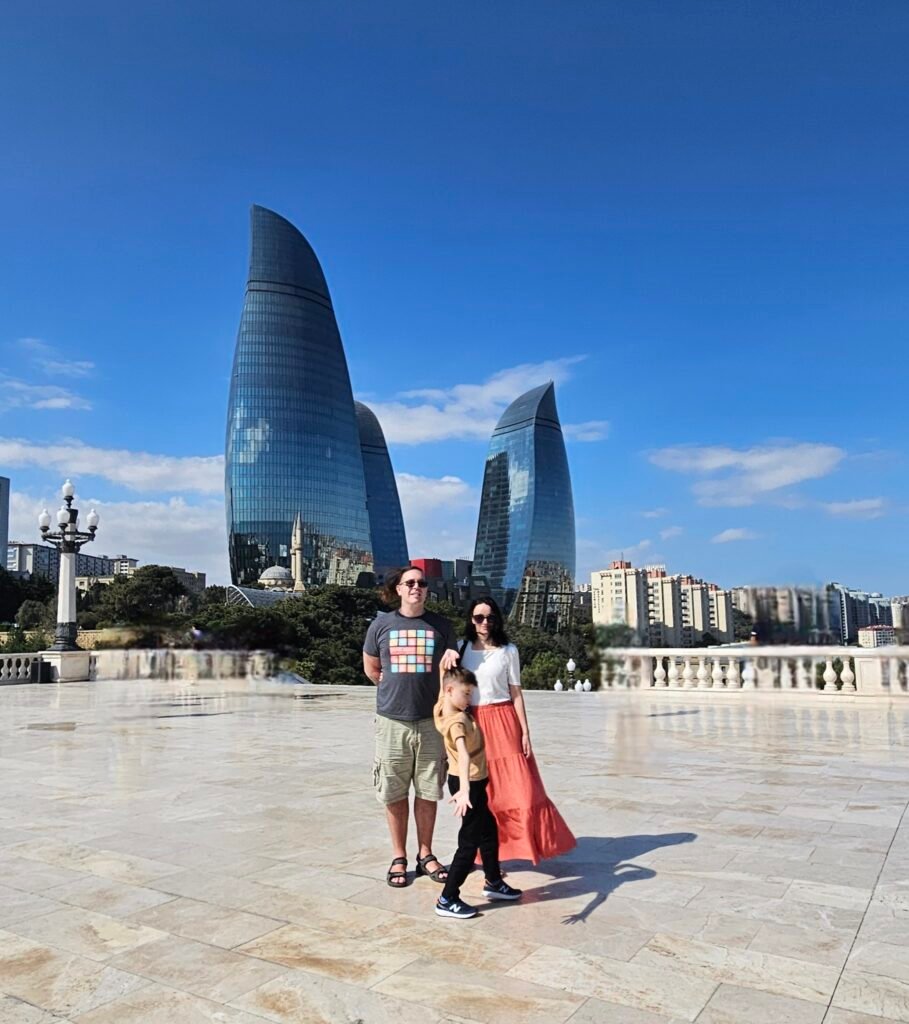
What I particularly liked, though, was looking beyond the old stone walls. From the palace, you can see Baku’s modern skyline, including the Flame Towers in the distance. The contrast is fantastic. You are standing in a 15th-century palace complex, surrounded by medieval stonework, while those enormous, futuristic towers rise behind the city. It is probably one of the clearest visual examples of how dramatically Baku has changed while still retaining its historic centre.
The Shirvanshah’s Palace, Maiden Tower and the surrounding Old City are part of the UNESCO World Heritage-listed Walled City of Baku.
Baku’s Caspian Sea waterfront
One of the things that genuinely surprised us about Baku was the city itself. Before visiting, we hadn’t really expected the capital to be quite so beautiful, modern and clean. There was a distinctly European feel to parts of the city, and in some areas it even reminded us of Paris, with the elegant stone buildings, wide streets and grand architecture.
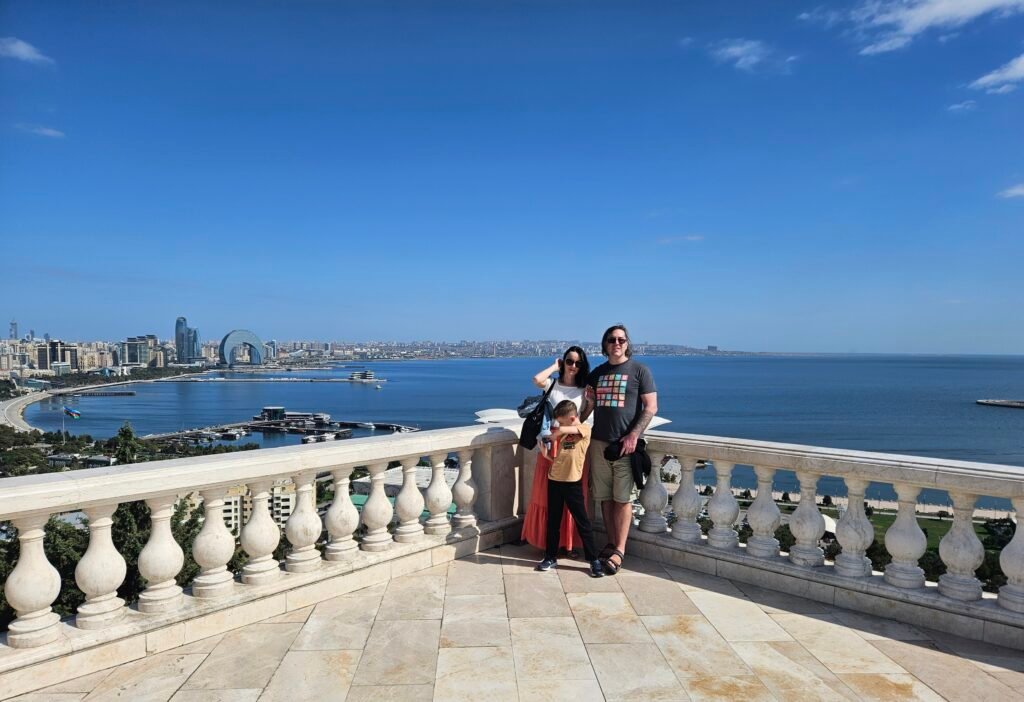
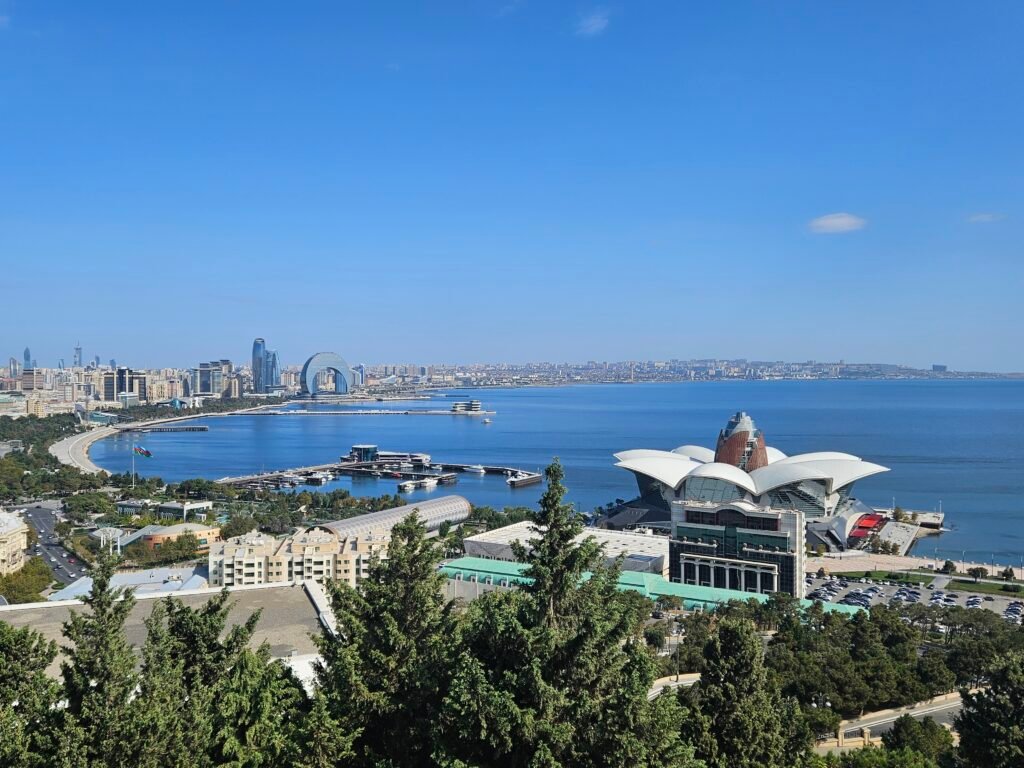
Then there is the Caspian Sea. We stopped at one of the viewpoints overlooking the water and had a beautiful view across the Caspian and over Baku. Seeing the sea stretching out beside such an impressive city gave Baku a completely different feel from the historic Old City we had just been exploring.
The waterfront is part of Baku’s long-established Seaside Boulevard, which was first developed in the early 20th century and has since grown into a large promenade and park along the Caspian.
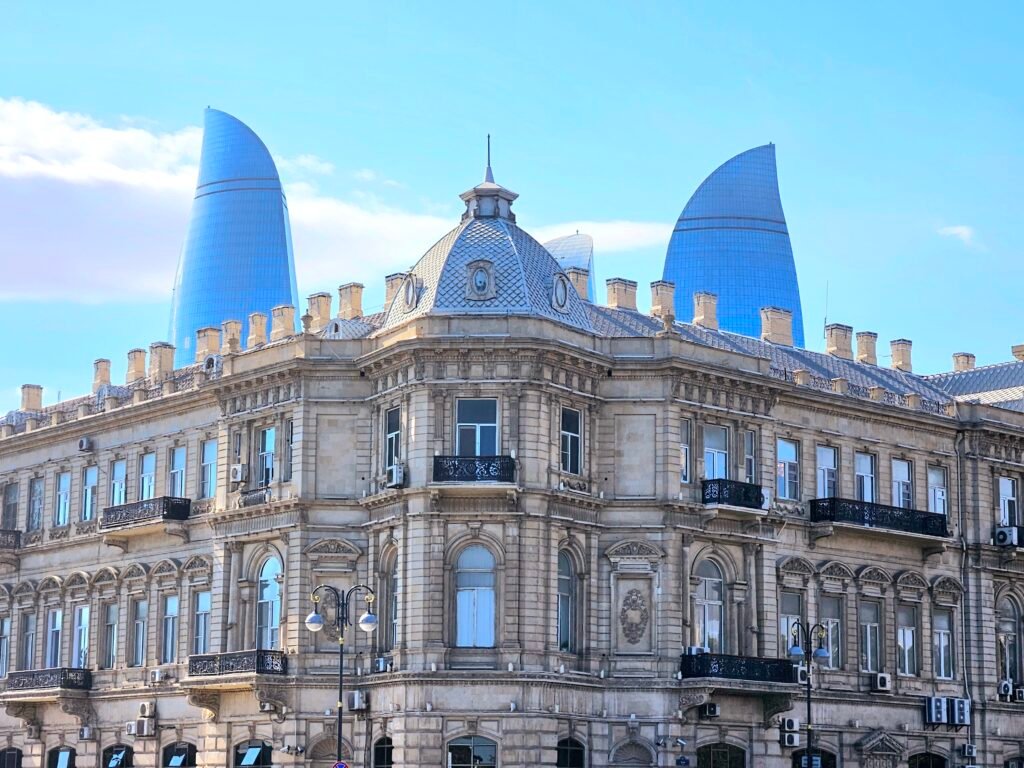
What I particularly liked about Baku was this mixture of old, elegant European-influenced architecture, the medieval Old City, the enormous modern skyline and the sea. The city’s late 19th- and early 20th-century oil boom brought European architectural influences to Baku, and the city was even nicknamed the “Paris of the Caucasus”.
It wasn’t really what we had pictured when we planned a trip to Azerbaijan, and that was one of our favourite surprises about the capital.
Little Venice
🕐 Opening Hours: Hours vary
💰 Entry Fees: Boat ride approximately 20 AZN
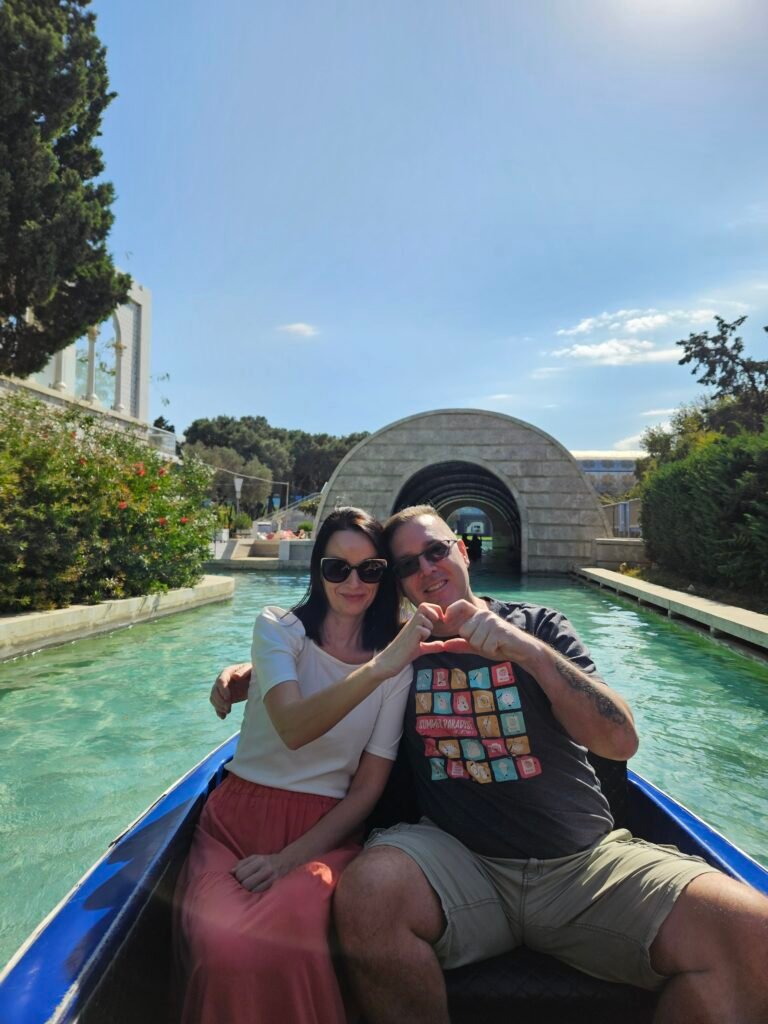
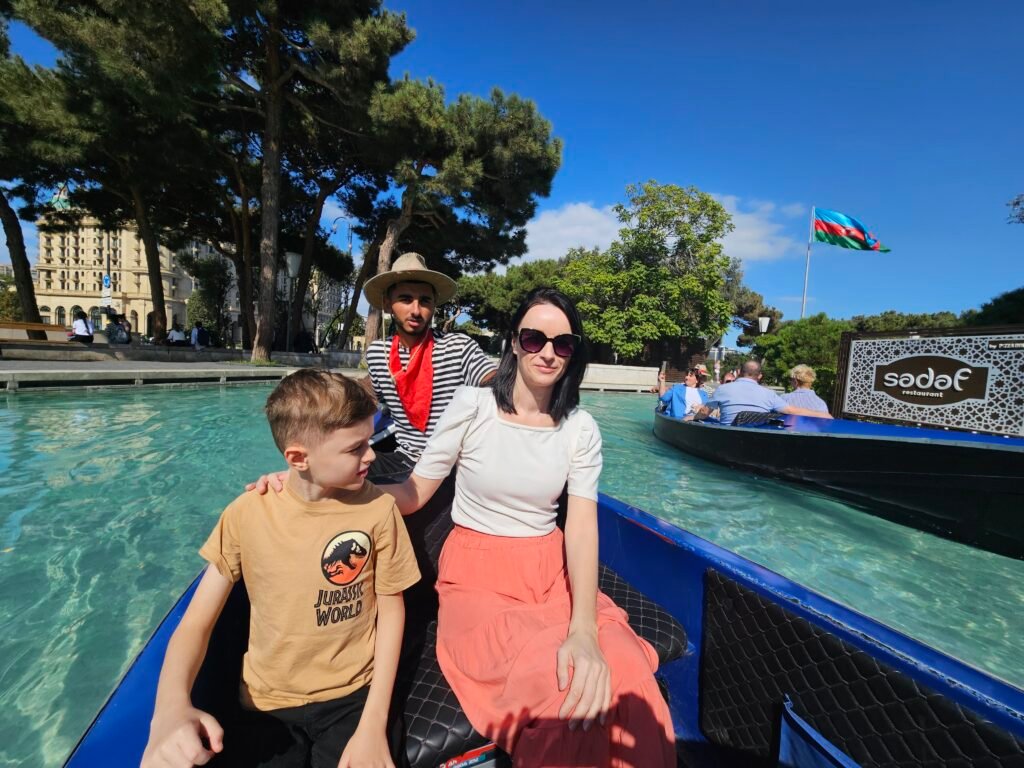
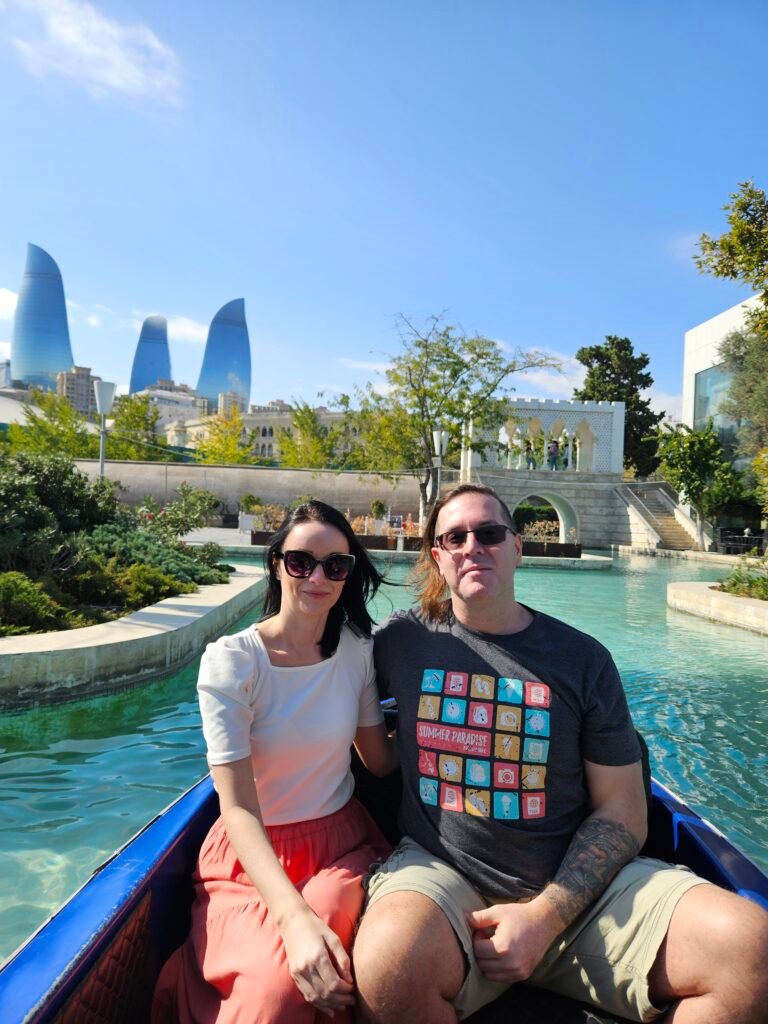
Little Venice was one of the slightly more unusual things we did in Baku.
It is a man-made canal area along the waterfront where you can take a small boat ride.
I would not travel to Baku specifically for Little Venice, but if you are already around the Boulevard, it is an easy activity to add. Our son enjoyed the boat ride, and it made for a nice break in the sightseeing.
Heydar Aliyev Centre
🕐 Opening Hours: Tuesday – Sunday, 10:30 AM – 6 PM | Monday: Closed
💰 Entry Fees: 15 AZN adults. The exterior and surrounding plaza are free to visit.
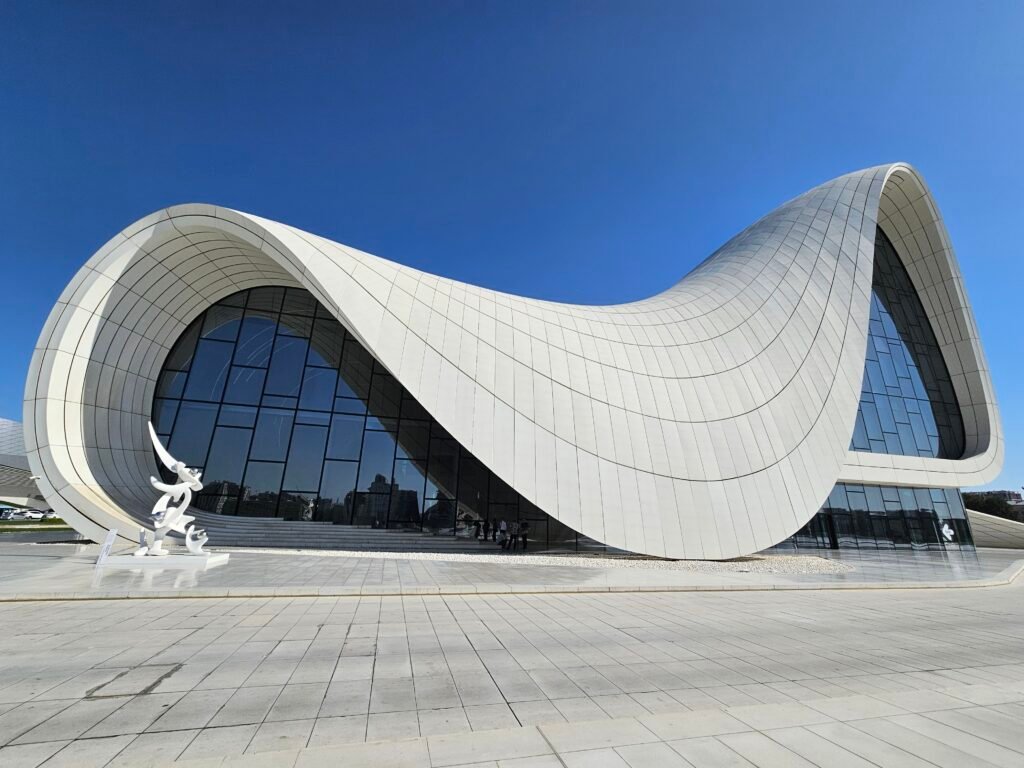
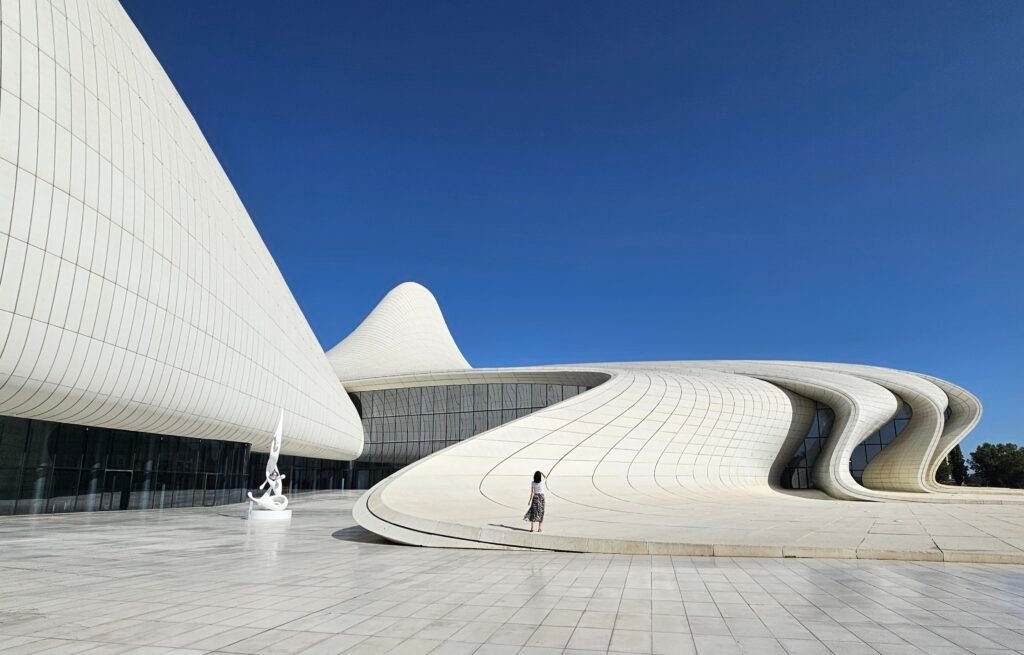
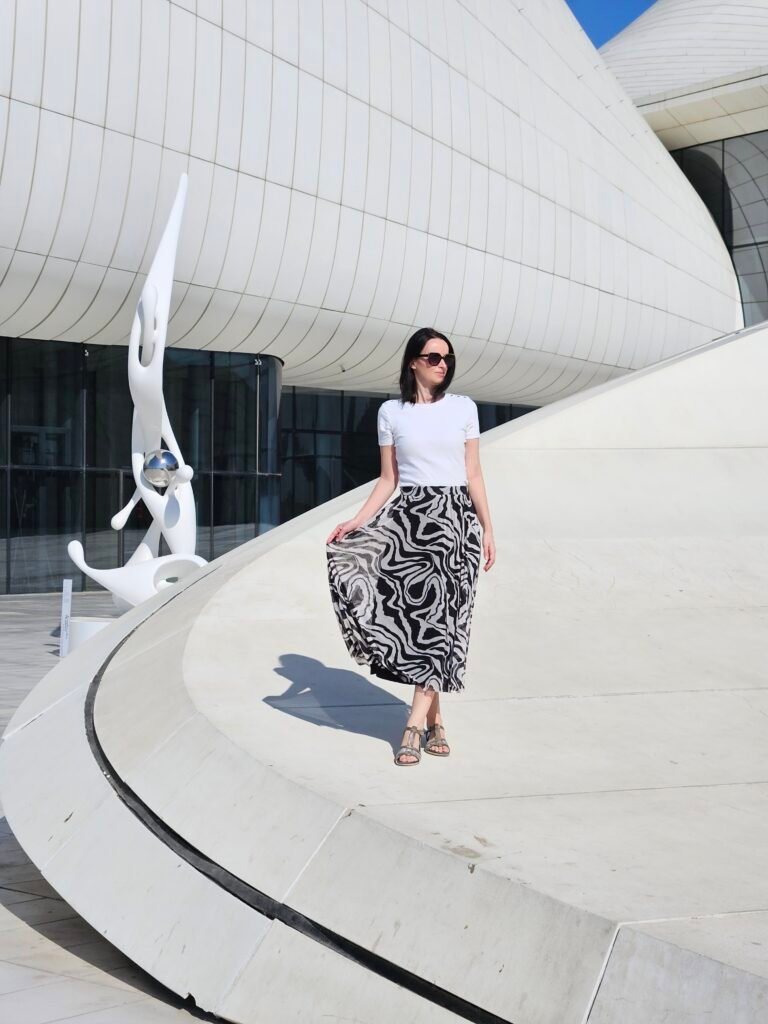
The Heydar Aliyev Centre is one of the most famous modern buildings in Baku.
It was designed by architect Zaha Hadid and opened in 2012. The building is famous for its sweeping white curves and lack of conventional straight lines. It won the Design Museum’s Design of the Year award in 2014.
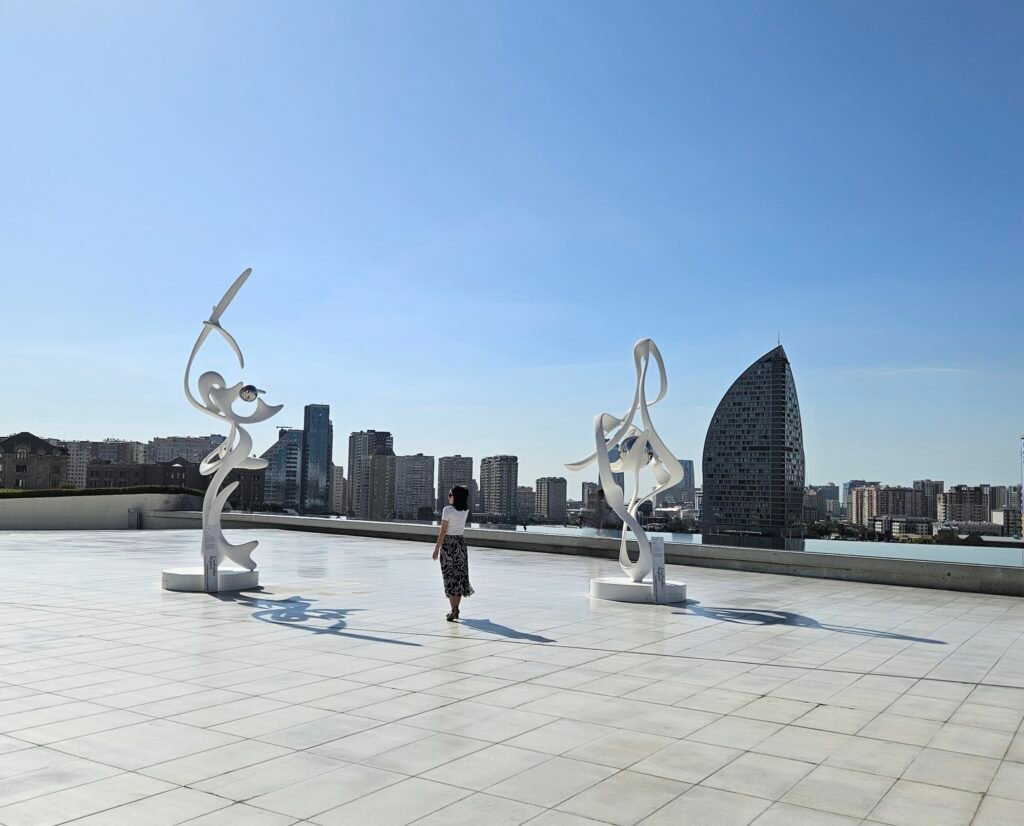
We visited the centre, and it was one of the most visually different places on our Azerbaijan trip. Even if you are not particularly interested in architecture, the building itself is worth seeing. Inside, there are exhibitions and collections, including a Mini Azerbaijan exhibition and a collection of classic cars, alongside temporary exhibitions.
The surrounding grounds also give kids some space to move around after spending time indoors. For a worldschooling family, this was an especially easy place to connect architecture with geography and modern history.
Other Baku attractions worth knowing about
Flame Towers
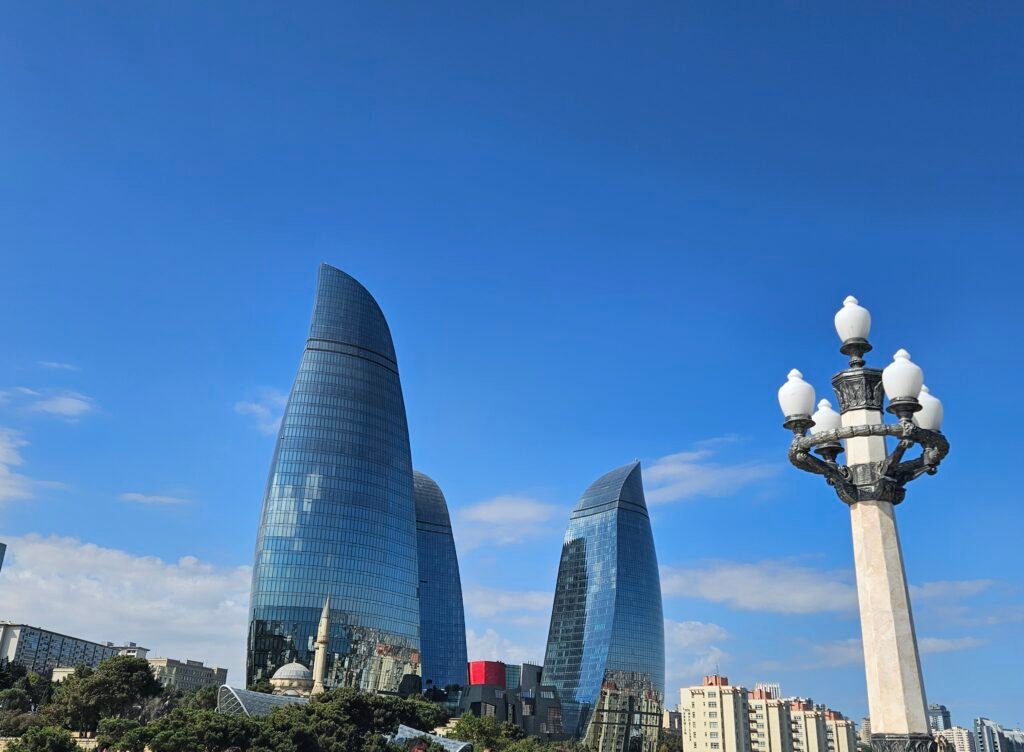
The Flame Towers are probably the most recognisable part of Baku’s modern skyline.
The three towers dominate views across the city, particularly from higher viewpoints.
You do not necessarily need to visit them as a separate attraction. Seeing them from around Baku is part of experiencing the city’s skyline.
Azerbaijan Carpet Museum
The Carpet Museum is on the waterfront and is housed in a building designed to resemble a rolled carpet.
Inside is a collection of Azerbaijani carpets and other examples of traditional weaving.
For families interested in crafts, history or worldschooling, this could be a particularly useful addition.
Baku Ferris Wheel
The Ferris wheel sits on the waterfront and gives another perspective over the Caspian and the city.
It is an easy option if you want something that is more straightforwardly child-friendly than another historical site.
Baku’s oil-boom architecture
One of the more interesting things about central Baku is the architecture left behind by the city’s oil boom in the late 19th and early 20th centuries.
The official tourism board recommends walking tours focusing on this period, when European architects were invited to Baku and created buildings that mixed different architectural traditions.
This is why Baku is so full of beautiful elegant European buildings.
Ateshgah Fire Temple
🕐 Opening Hours: Every day, 10 AM – 7 PM
💰 Entry Fees: 15 AZN foreign visitors | Free for foreign children under 12
After exploring Baku, we headed outside the city to see some of the country’s famous fire-related sites.
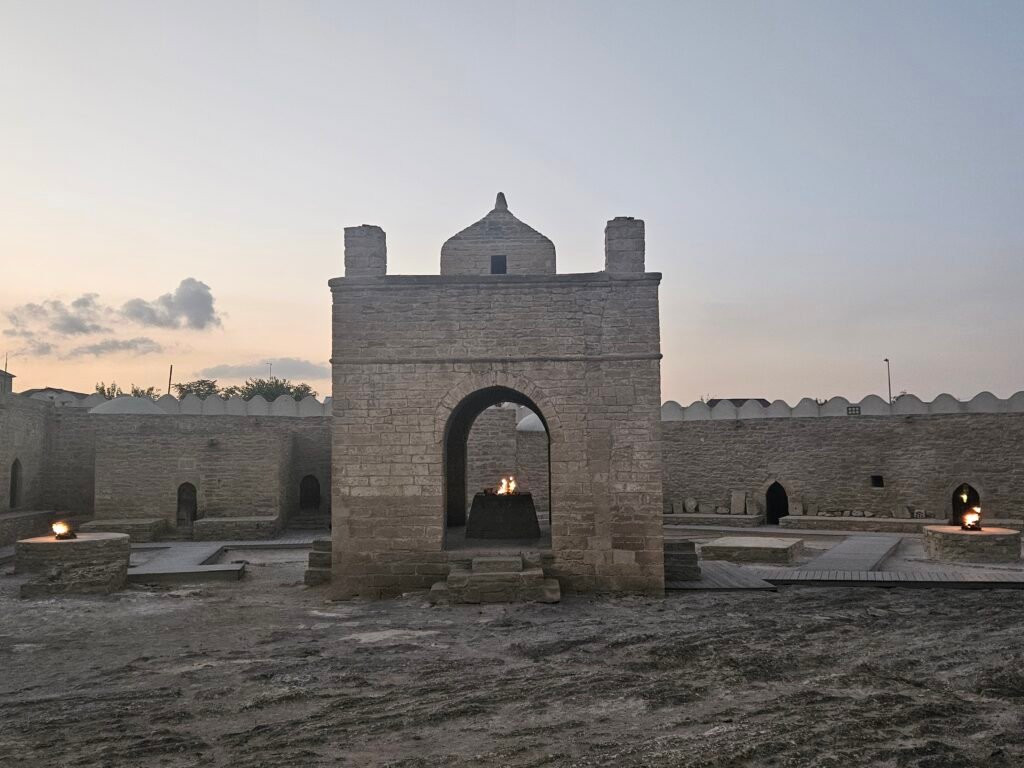
Azerbaijan has long been associated with natural gas fires and fire worship, which is one reason it acquired the nickname “Land of Fire”. Ateshgah is a historic fire temple on the Absheron Peninsula.
The temple is now an open-air museum and is connected with the Zoroastrian history of the region. It is also on Azerbaijan’s tentative UNESCO list. This was a particularly interesting stop because the story combines religion, geology and history.
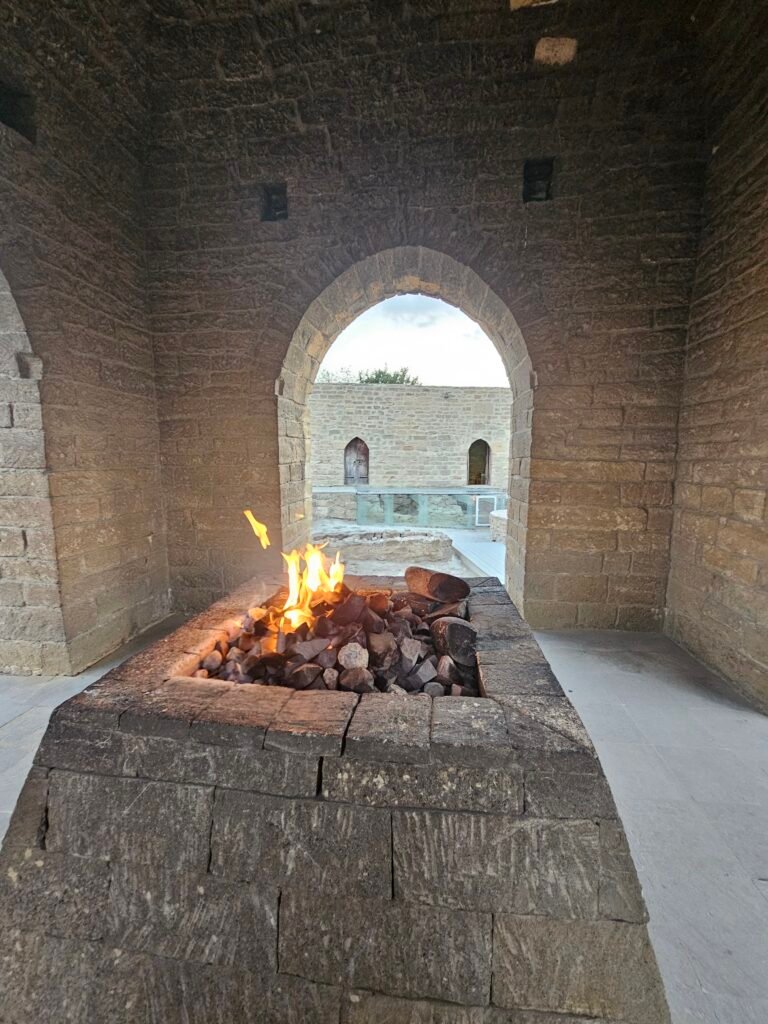
The site was built around naturally occurring gas flames and became a pilgrimage centre for fire worshippers, with the present temple dating mainly from the 17th and 18th centuries. Zoroastrians were among those who revered the site, while pilgrims from India, including Hindus and Zoroastrians, travelled here to worship at the sacred fire.
Standing in the courtyard with the flames burning as the light faded, knowing that people had travelled here for generations to worship the fire, gave the place a very different atmosphere from an ordinary historical monument. It was one of those moments on the trip where the history felt much more tangible.
Yanardag, the Burning Mountain
🕐 Opening Hours: Every day, 10 AM – 7 PM
💰 Entry Fees: 15 AZN foreign visitors | Free for foreign children under 12
These are the current prices published by the Yanardag National Reserve. There is also a 25 AZN combination ticket for Yanardag + Ateshgah.
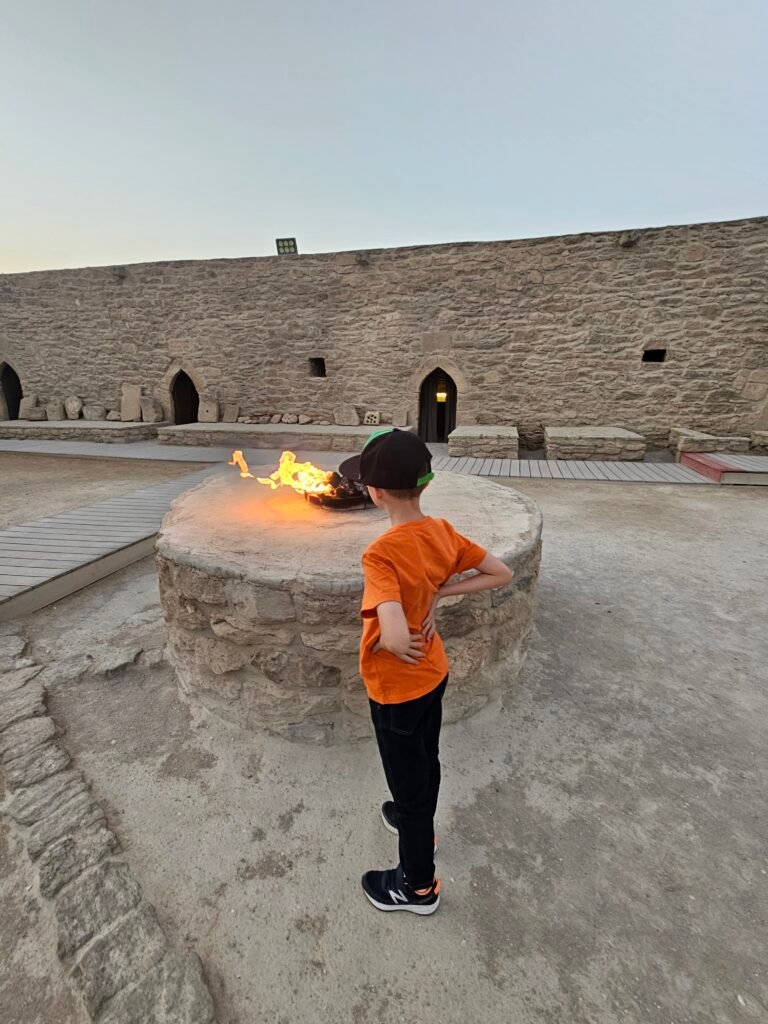
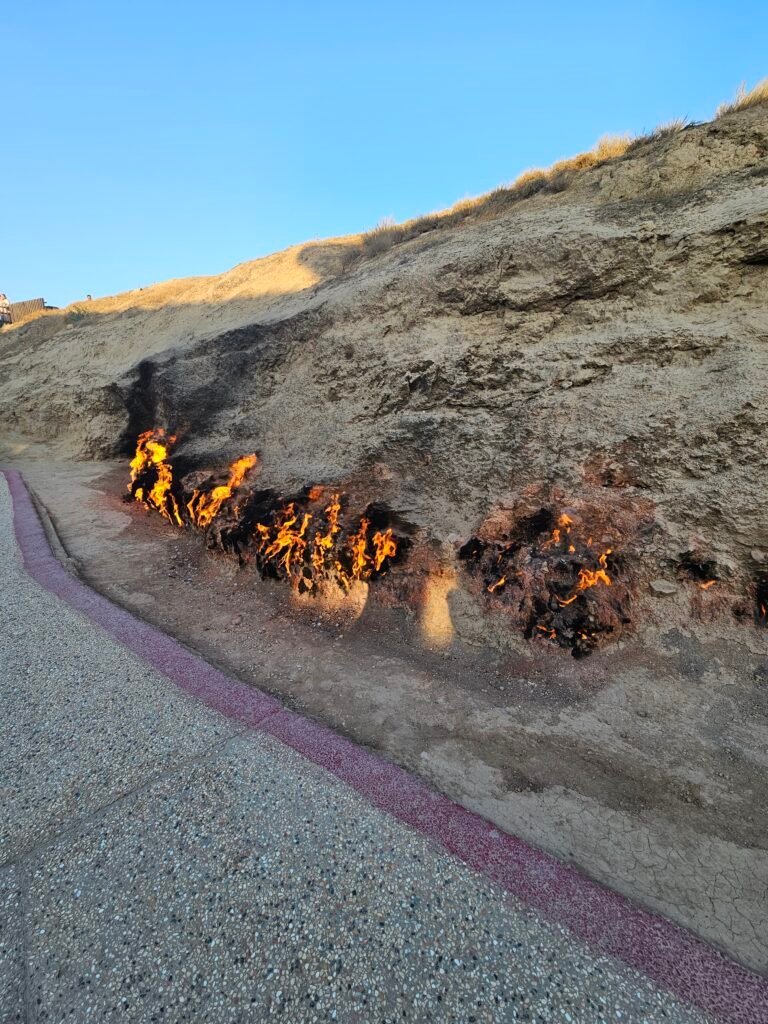
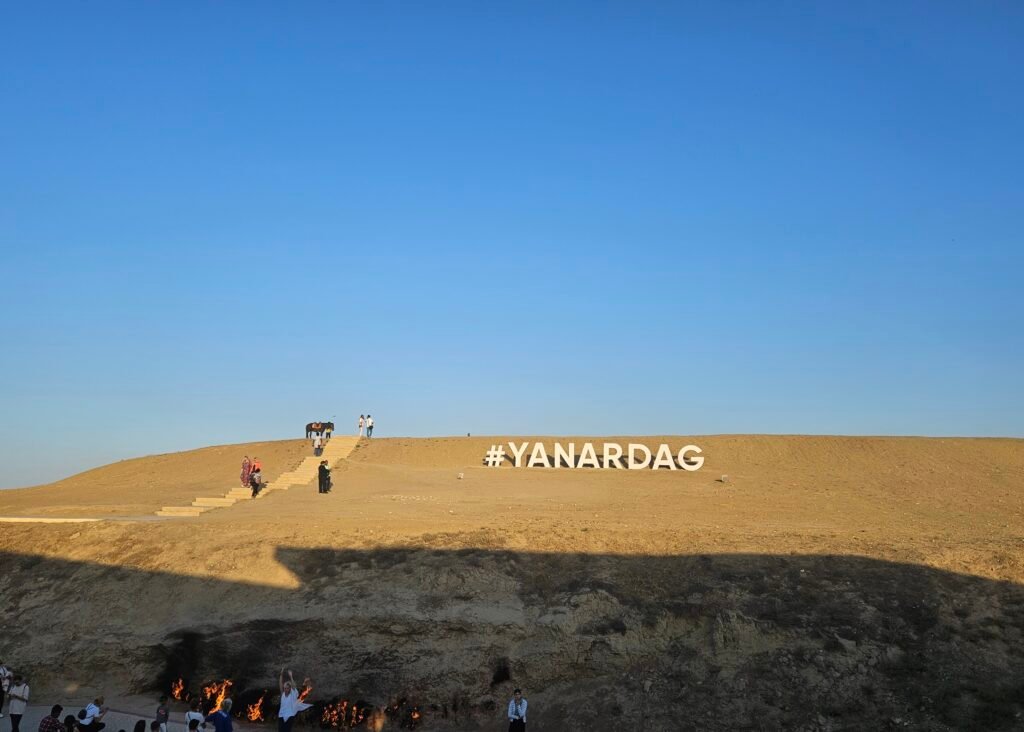
Yanardag means “burning mountain” and is another of Azerbaijan’s famous fire sites. Unlike a conventional volcano, this is a natural gas fire emerging from the ground. The flames can continue burning because of the gases escaping from beneath the surface.
There is also a modern interactive museum on site, which our son really enjoyed. One of the displays lets you become a fire creature on screen and control it with your movements, so needless to say we got stuck there for about half an hour.
We visited Yanardag as part of the same general exploration of Azerbaijan’s fire-related sites. It is easy to combine with other attractions in the area, such as the Ateshgah temple, mud volcanoes, and Gobustan, like in this tour.
Gobustan with kids
Gobustan: Ancient Rock Art in the Azerbaijani Landscape
🕐 Opening Hours: 10 AM – 5 PM
💰 Entry Fees: Up to 15 AZN
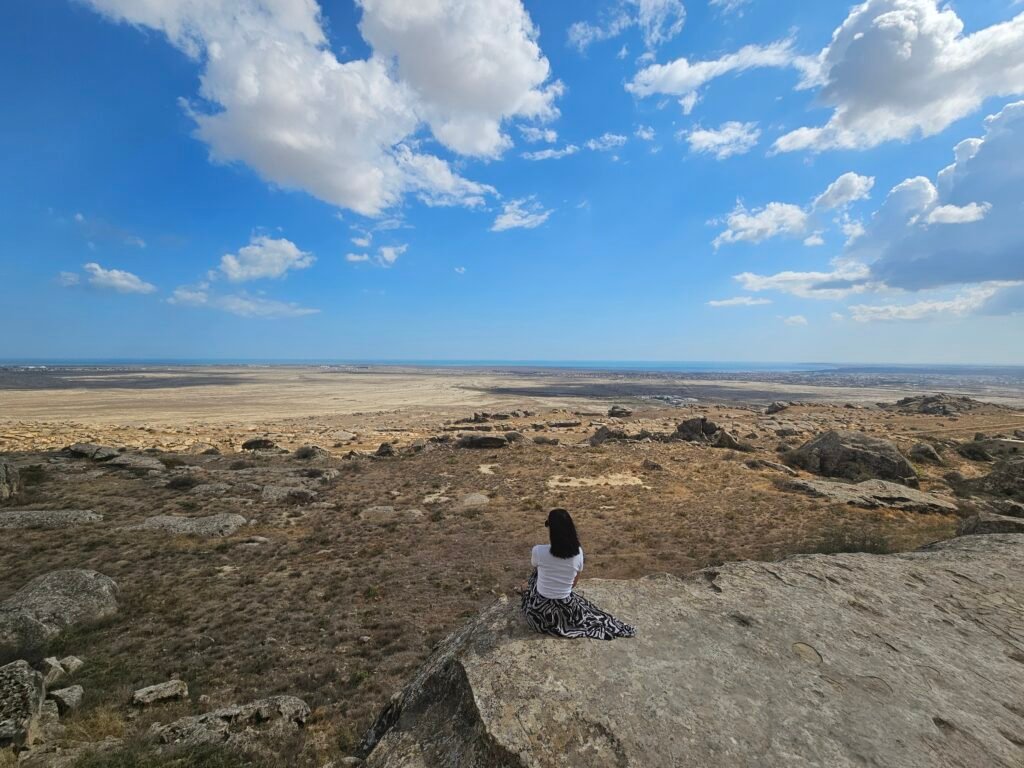
Gobustan was one of the places we were most curious to see because it gives you a glimpse into life in this part of the world thousands of years ago.
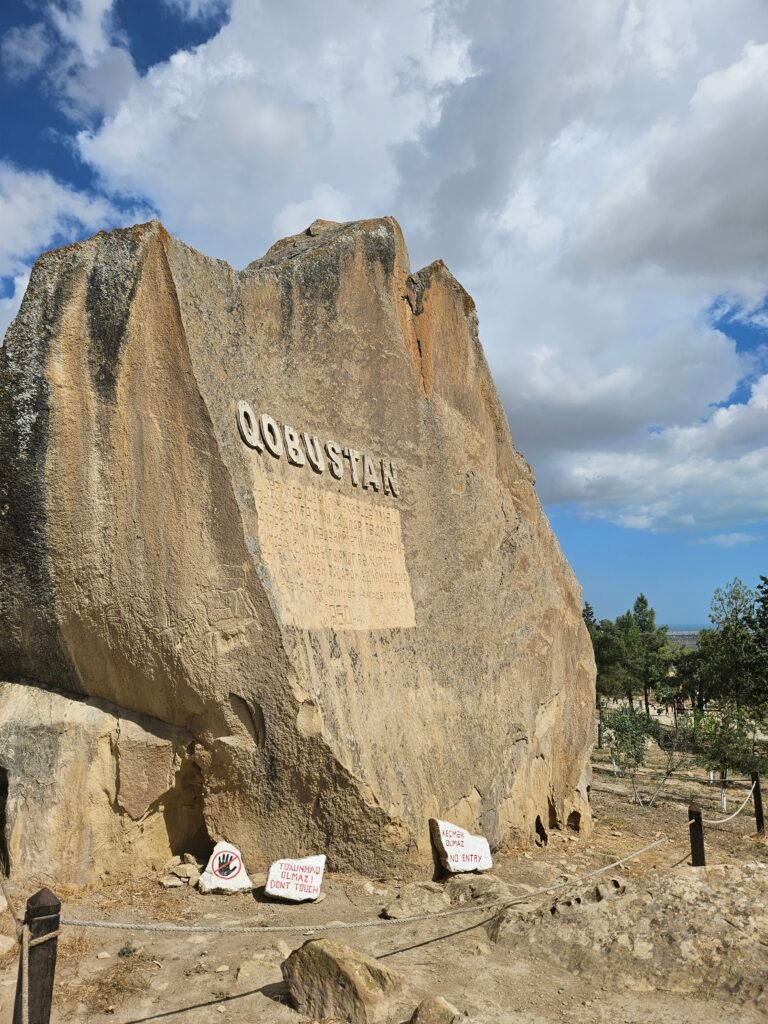
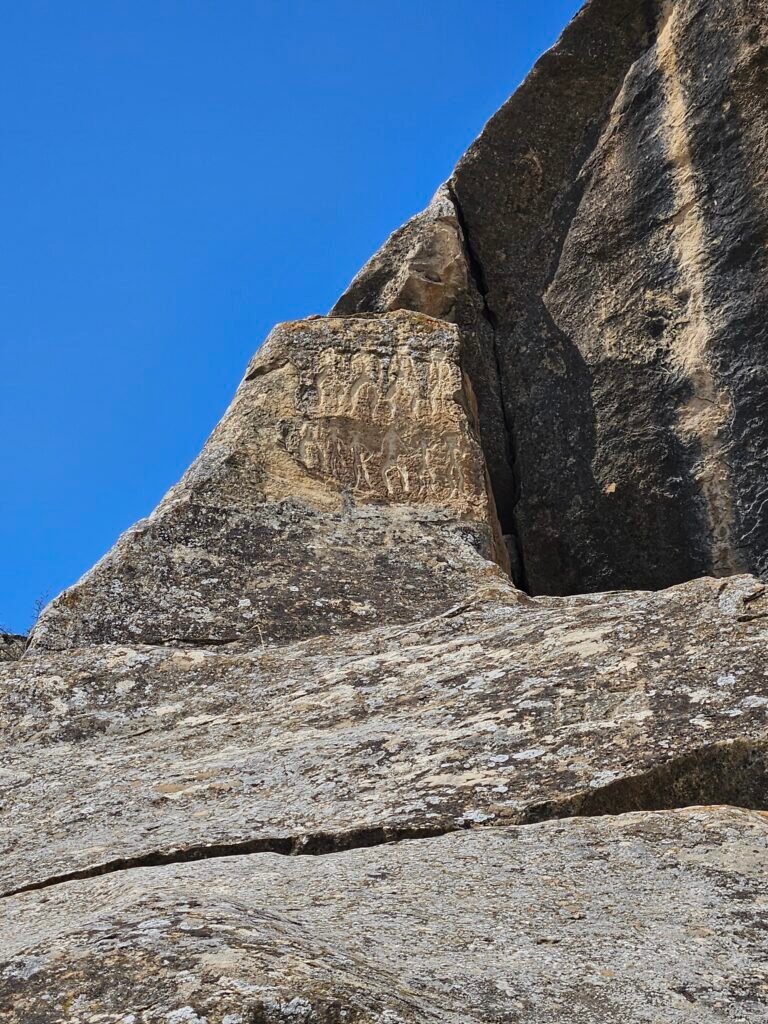
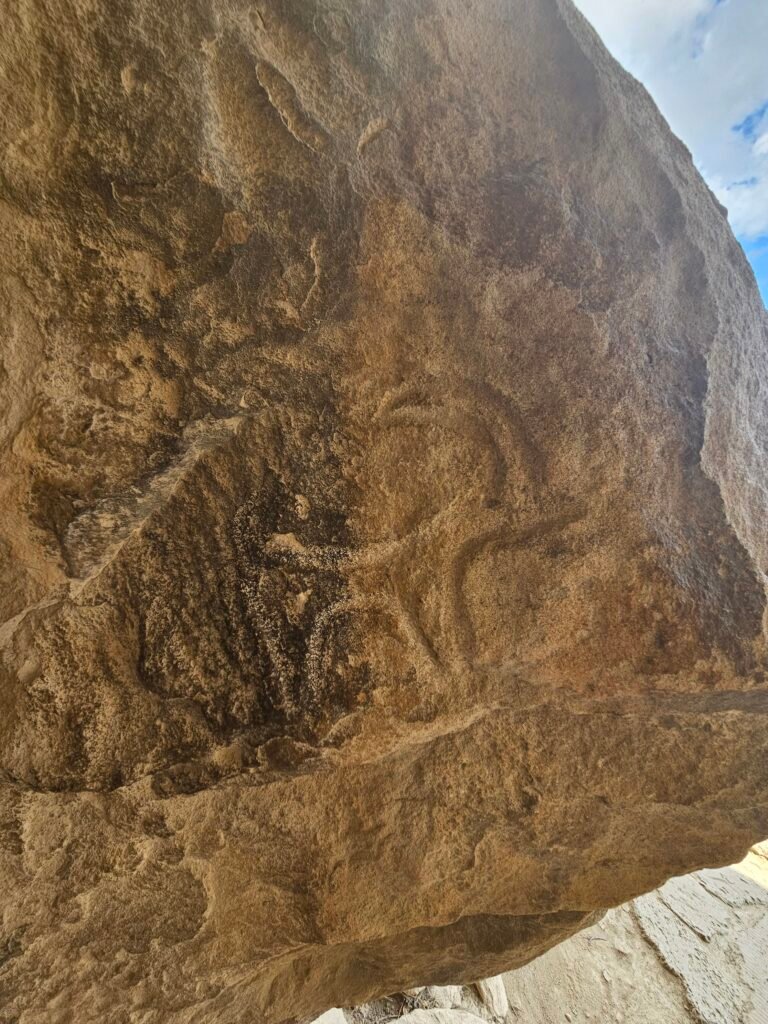
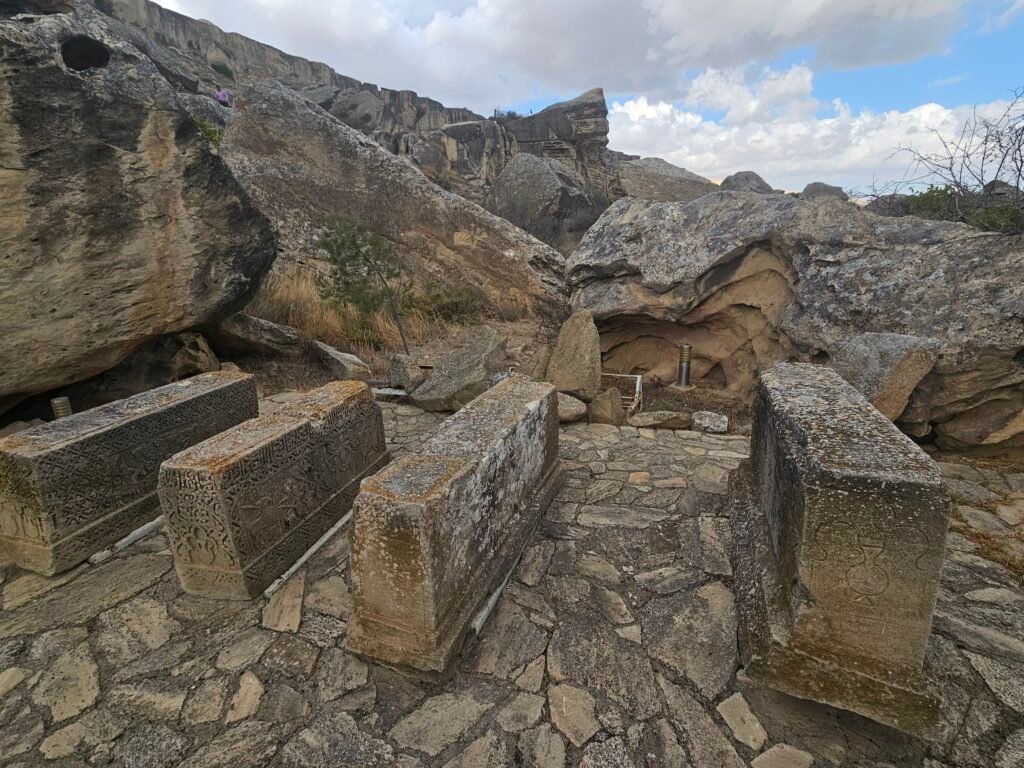
About 60 km south of Baku, the Gobustan Rock Art Cultural Landscape is a UNESCO World Heritage Site, famous for the thousands of carvings scattered across its rocky landscape. Some date back as far as the Upper Palaeolithic period, while others were made much later, giving the site an enormous span of history. UNESCO estimates that the area contains more than 6,000 rock engravings. (UNESCO)
The carvings show people hunting and dancing, animals, boats and scenes from everyday life. Looking at them, you start to get a sense of what people living here were seeing and doing thousands of years ago. There is something quite remarkable about standing in the same landscape where those people lived and then looking at images they left behind on the rocks.
One of the more unusual things to look out for is the gaval dash, a large musical stone that produces a resonant sound when struck (which was highlight of the trip for our son!) There is also a Roman inscription carved into the rock, left by a Roman legionary around the 1st century AD. It is a small detail compared with the enormous collection of prehistoric carvings, but it is a fascinating reminder that people continued passing through and leaving their mark on this landscape long after the earliest rock art was created.
The mud volcanoes
🕐 Opening Hours: Every day, 10 AM – 8 PM
💰 Entry Fees: From 3 AZN.
There is also a 35 AZN combination ticket covering the Mud Volcanoes Tourism Complex, Yanardag and Ateshgah. The combination ticket is valid for 72 hours after first entry.
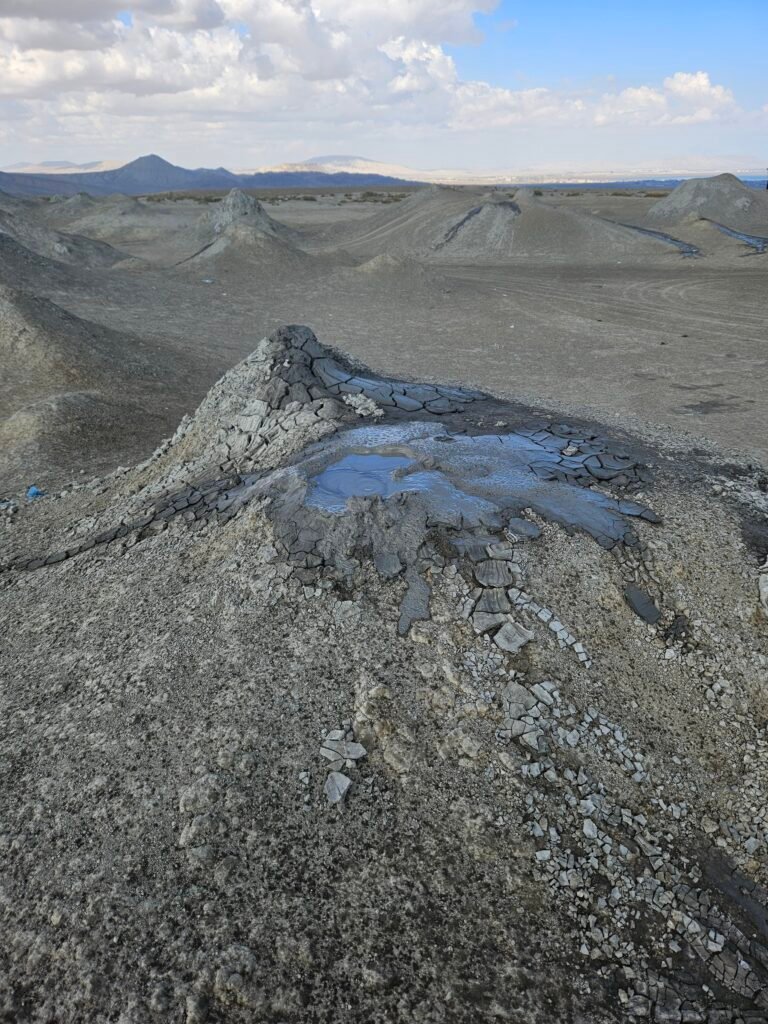
The mud volcanoes were another completely different experience.
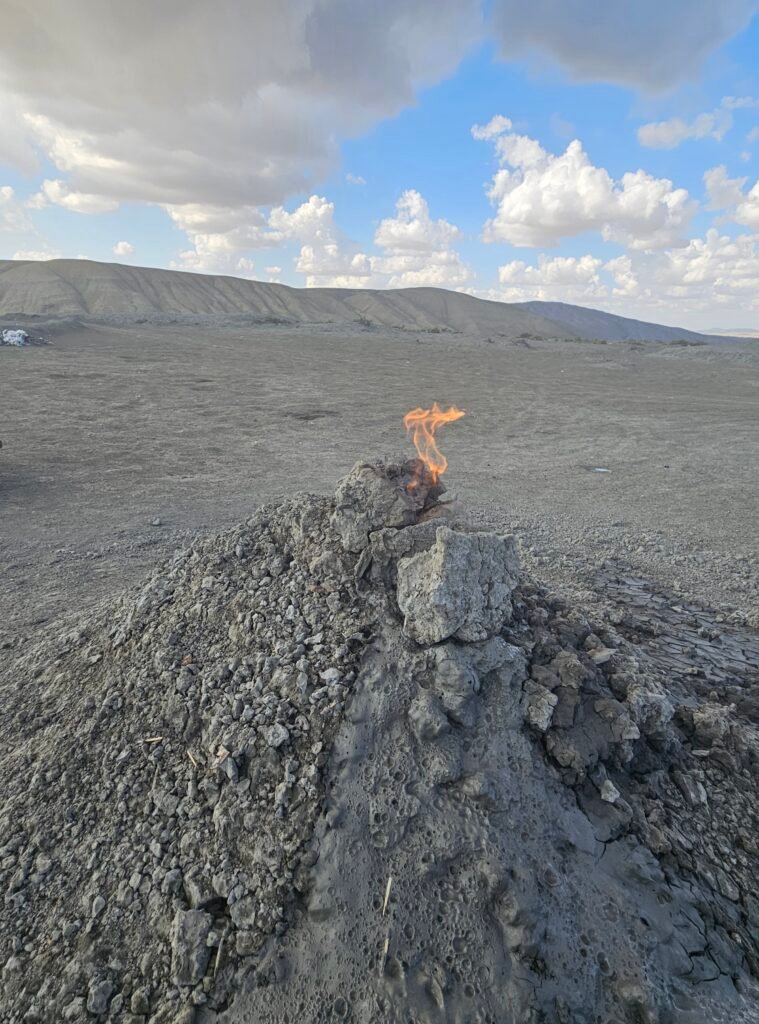
Azerbaijan has an unusually large concentration of mud volcanoes. These are not the lava-filled volcanoes most people picture. They form when underground gases and mud reach the surface through geological processes. The landscape around the volcanoes looks strange and almost otherworldly.
The Dashgil mud volcano area near Gobustan is about a 1.5-hour drive from Baku according to Azerbaijan Travel, while the newer Mud Volcanoes Tourism Complex is around 80 km from central Baku and lists opening hours of 10:00 to 19:00.
The mud volcano roads can also be rough, which is another reason we preferred having a private driver rather than trying to organise this ourselves.
Sheki: the long drive that was worth it
Sheki is quite a drive from Baku (about 4 hours or longer, depending on the traffic), but for us it was absolutely worth making the journey. In fact, our only regret was that we didn’t stay longer. If we were planning the trip again, I would stay at least one night in Sheki, because there is much more to see than we had time for on a day visit. This two day tour is a perfect way to visit Sheki and the local sites without a huge rush.
The historic centre is a UNESCO World Heritage Site, and there is a lot packed into the relatively compact old part of the city. You have the Khan’s Palace, the old fortress, caravanserais, traditional craft workshops, historic houses and cobbled streets, all with the Greater Caucasus mountains providing the backdrop. Sheki was also an important stop on the Silk Road, with its wealth historically connected to silk production and trade.
It is a beautiful place to simply walk around, and I think it deserves more time than we gave it.
Sheki Khan’s Palace
Sheki Khan’s Palace
🕐 Opening Hours: Every day, 9 AM – 7 PM
💰 Entry Fees: 15 AZN for foreigners
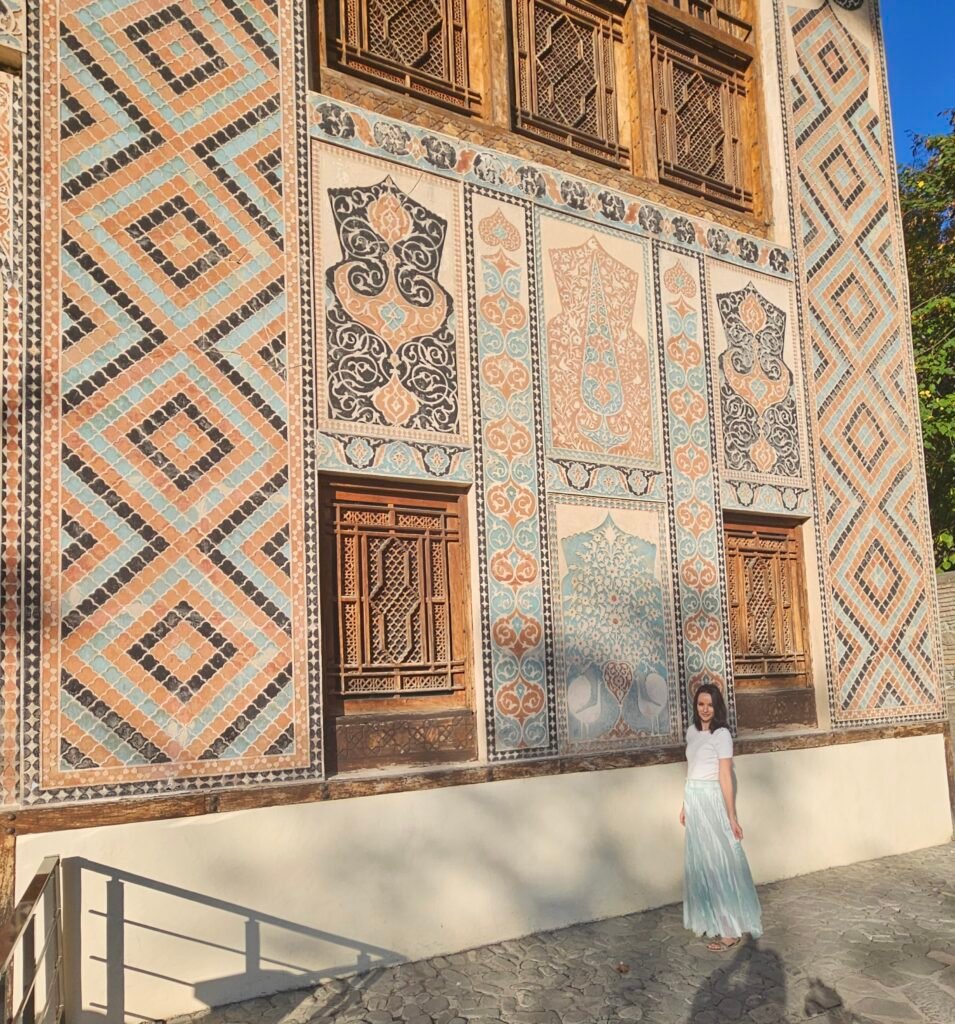
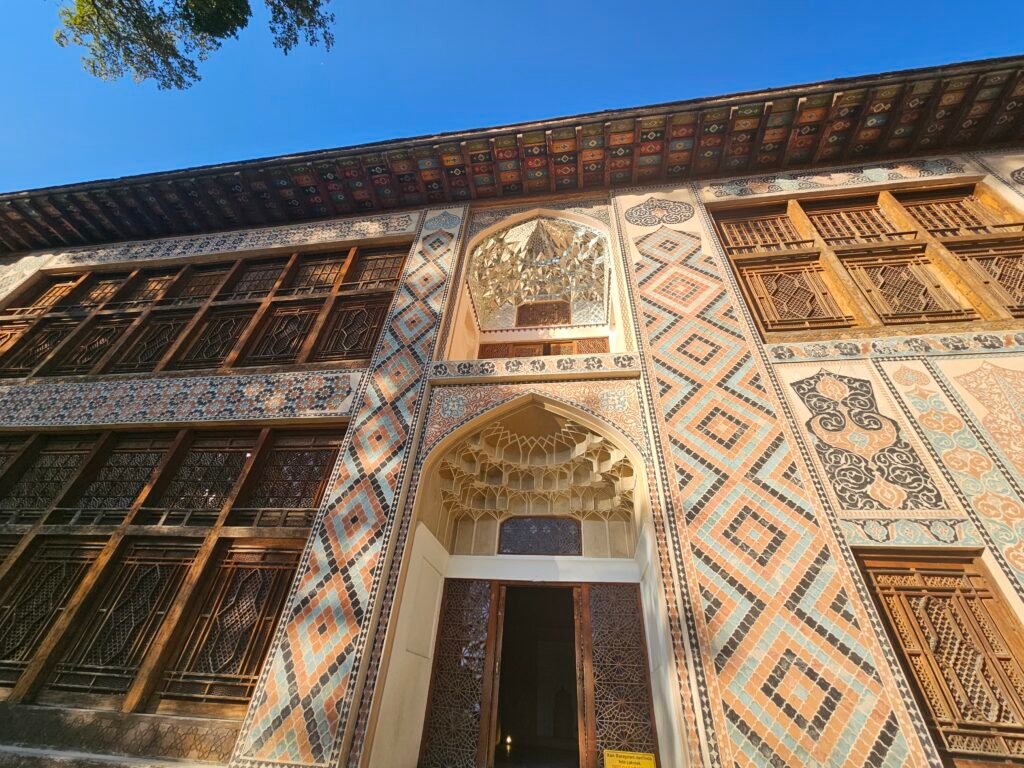
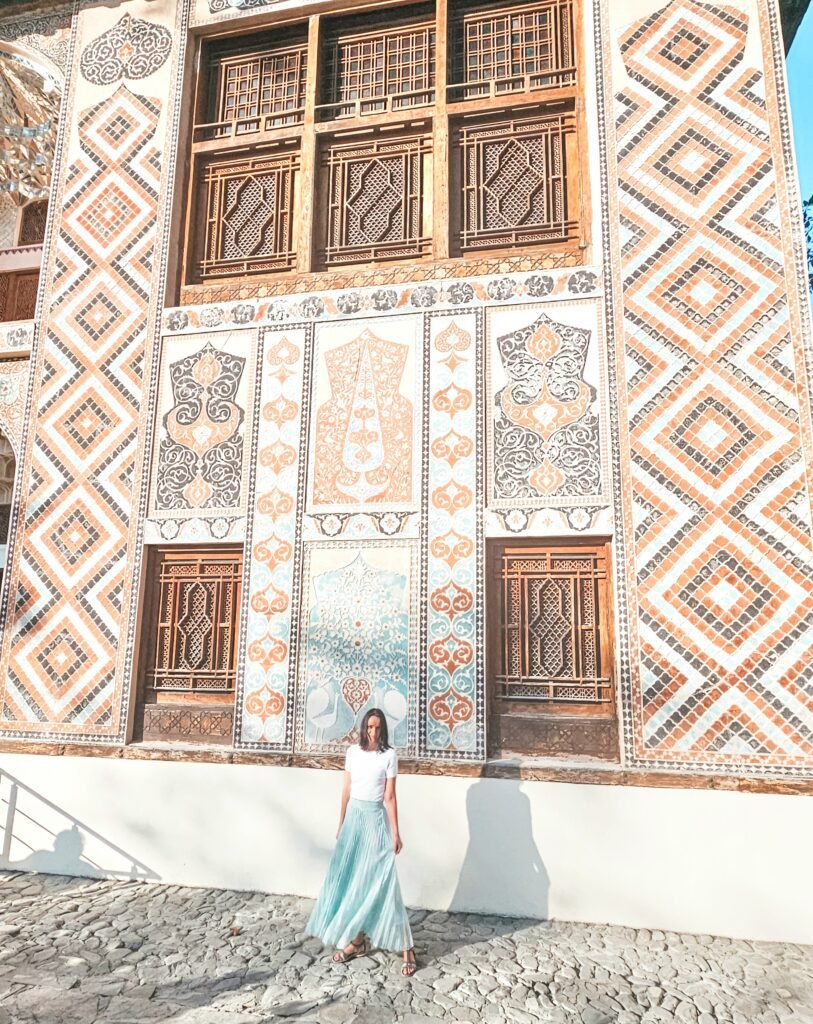
The Sheki Khan’s Palace was the main reason we wanted to visit Sheki, and it was one of the highlights of the trip.
The palace was built in the 18th century during the period of the Sheki Khanate. It served as a summer residence for the khans and is particularly famous for its incredibly detailed decoration, colourful stained-glass windows and painted interiors. The palace sits within the old fortress, surrounded by enormous plane trees that are themselves hundreds of years old.
The outside of the palace is beautiful, but the real reason to go inside is the shebeke windows. This is a traditional Azerbaijani craft where tiny pieces of coloured glass are fitted into wooden latticework without using glue or nails. The effect is incredibly intricate, particularly when the light comes through the coloured glass.
One practical thing to know before you visit is that photography is not allowed inside the palace. You can take photographs outside, so you can still get plenty of pictures of the building and its surroundings, but once you go inside, you’ll need to put the camera away.
The palace isn’t enormous, so the visit doesn’t take hours, but it is worth taking your time because there are so many small details in the paintings, patterns and windows. The palace and the historic centre of Sheki were added to the UNESCO World Heritage List in 2019.
Sheki’s Caravanserai
🕐 Opening Hours: Approximately 11 AM – 7 PM
💰 Entry Fees: Free
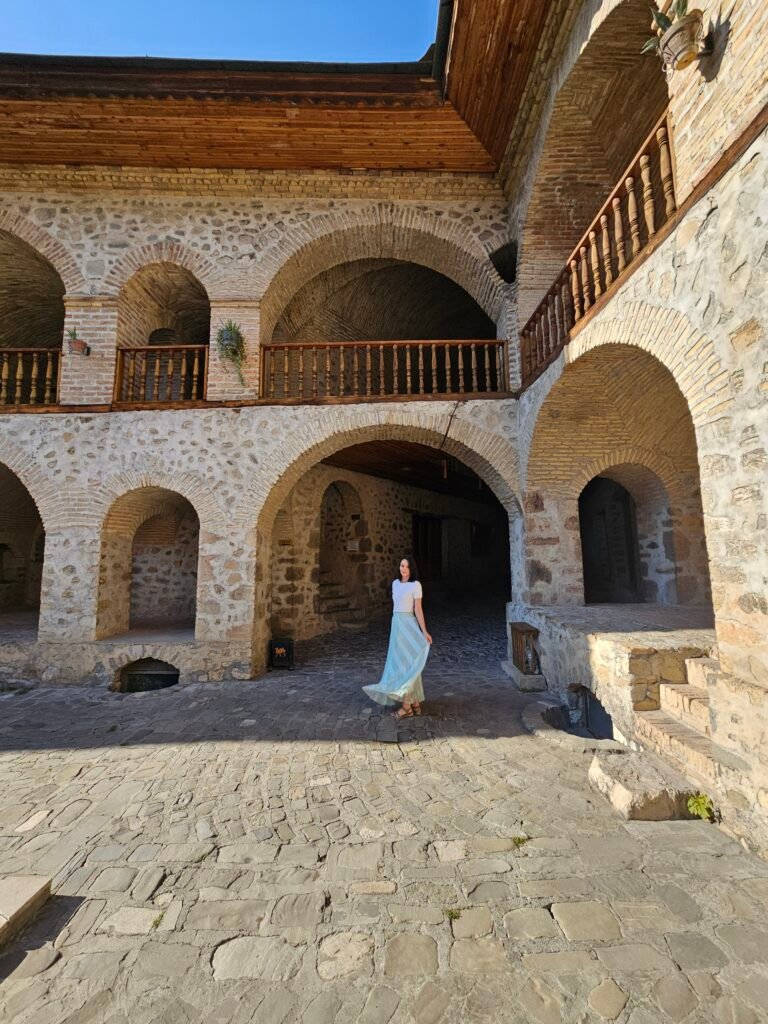
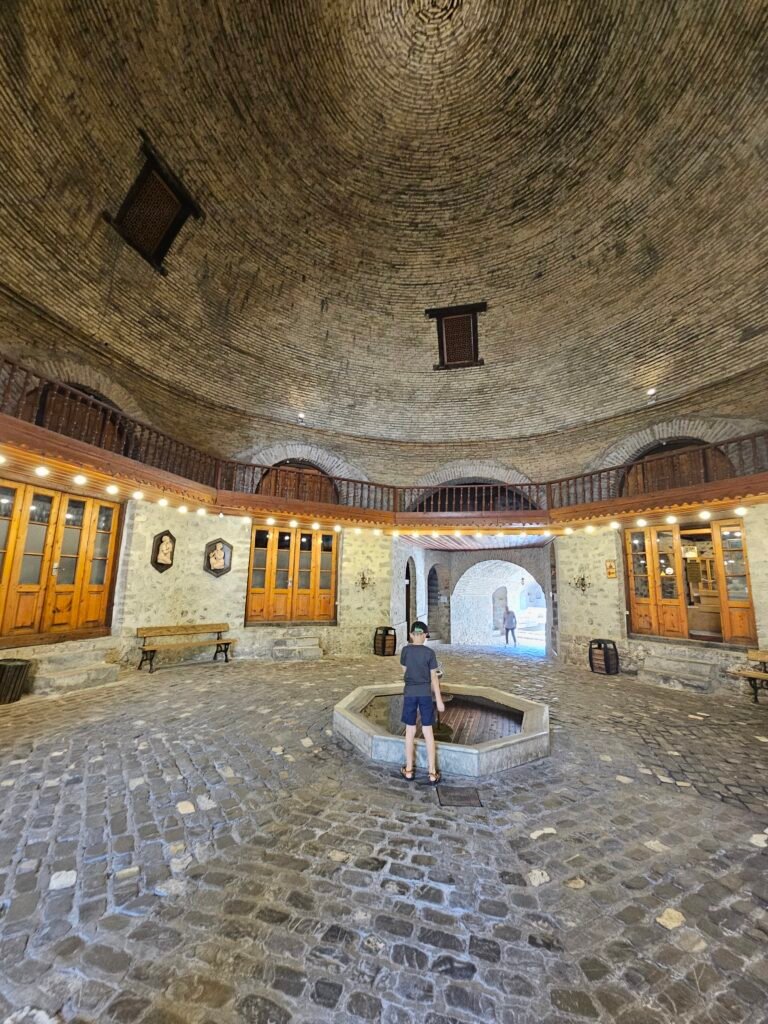
Another place we visited in Sheki was the Upper Caravanserai. It is worth including because it gives you a very different idea of what Sheki was like when it was an important Silk Road trading centre.
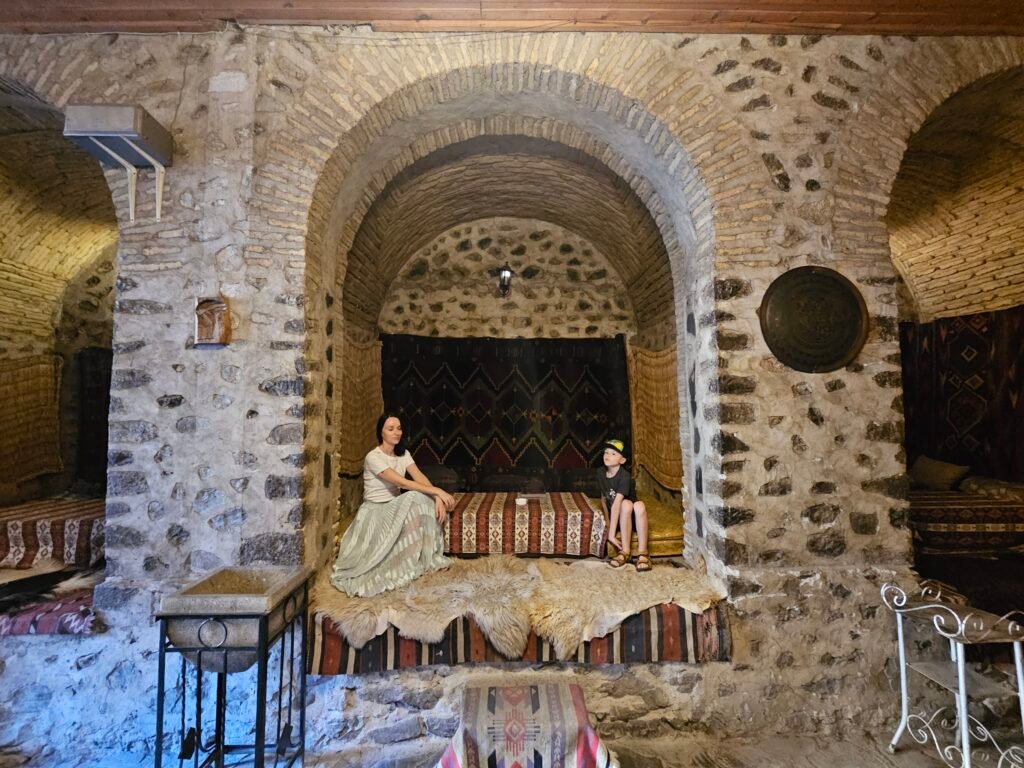
A caravanserai was essentially a roadside inn for merchants travelling long distances with their goods. Traders could stop, rest, store their merchandise and look after their animals before continuing their journey.
Sheki has both an Upper and a Lower Caravanserai, dating from the period when the city was an important trading centre. The Upper Caravanserai is particularly impressive, with its large stone courtyard surrounded by rows of rooms and arched passages.
Today, the Upper Caravanserai functions as a hotel, so it is possible to stay in a building that was originally designed for travellers centuries ago. There is also an opportunity to experience traditional tea there.
Even if you aren’t staying there, I think it is worth walking through the courtyard and taking a look. The caravanserai is also very close to other attractions in Sheki’s historic centre, so you can easily combine it with the palace and the other old buildings rather than making a separate trip.
And this is another reason I wish we had stayed overnight. Sheki isn’t just a place where you drive in, see the palace and leave. There is enough in the historic centre to spend a proper day exploring, particularly if you are interested in history, architecture and traditional crafts.
The colourful mountains
🕐 Opening Hours: Open 24 hours
💰 Entry Fees: Free
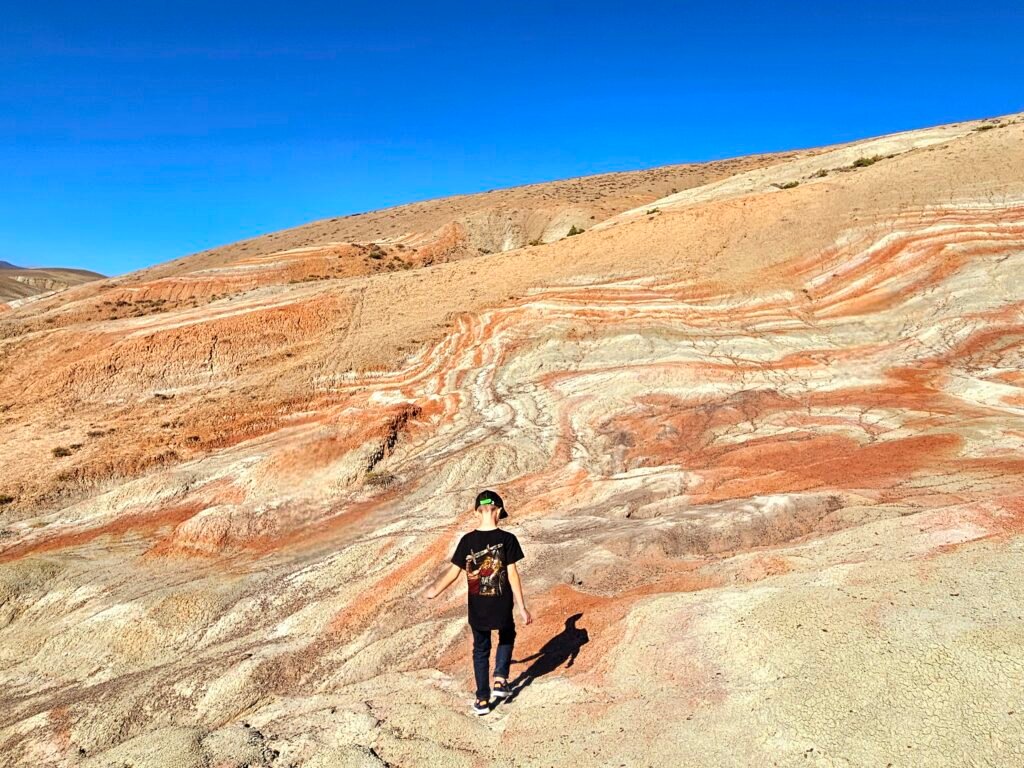
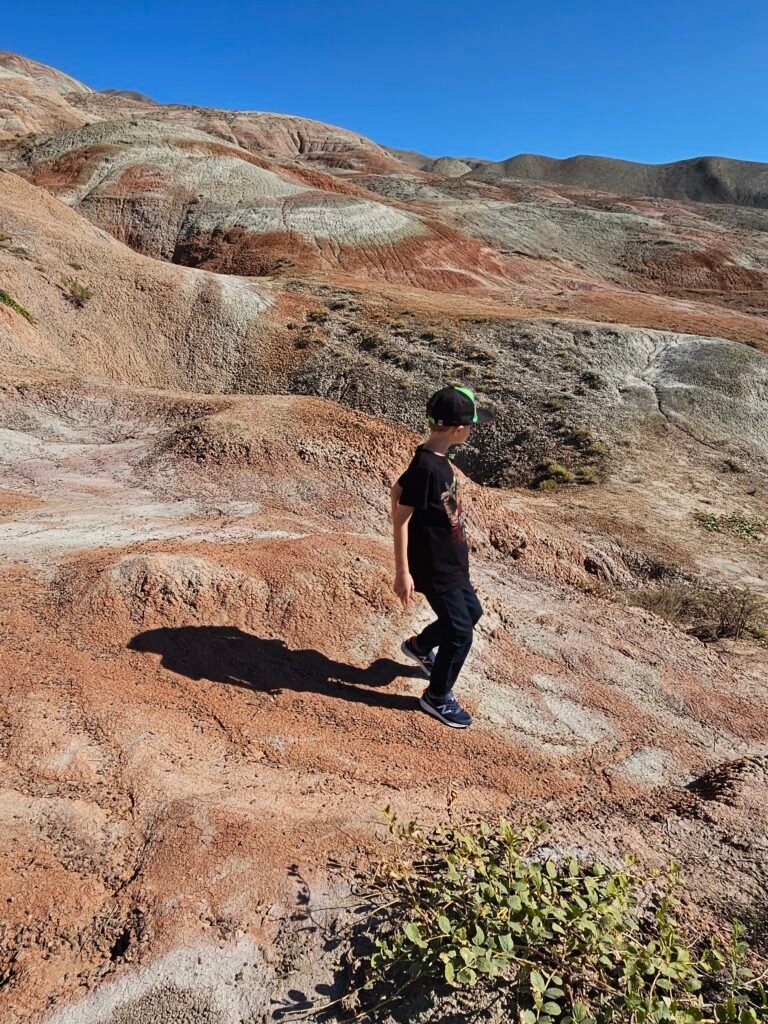
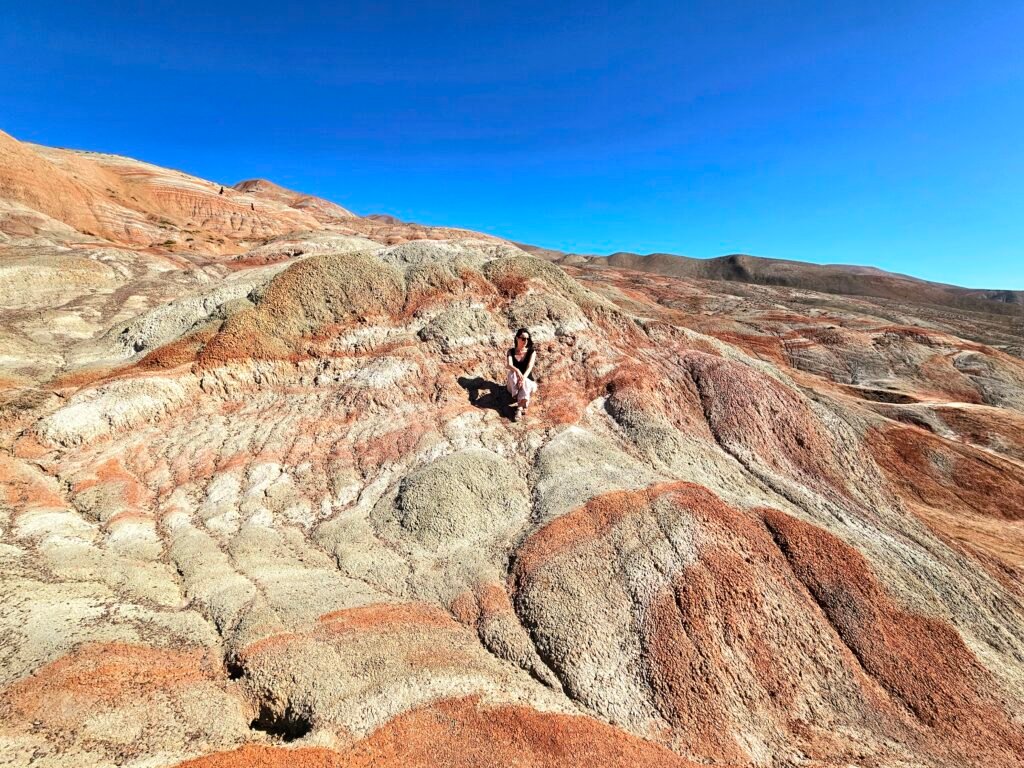
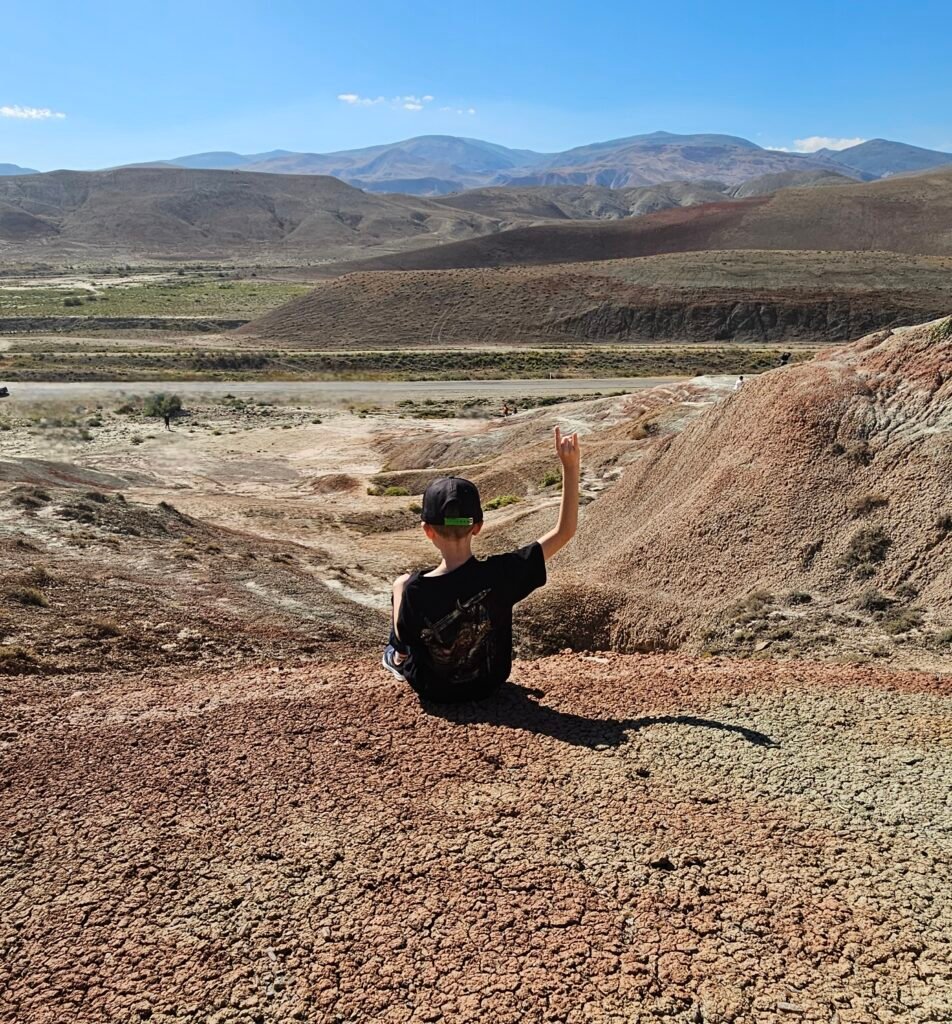
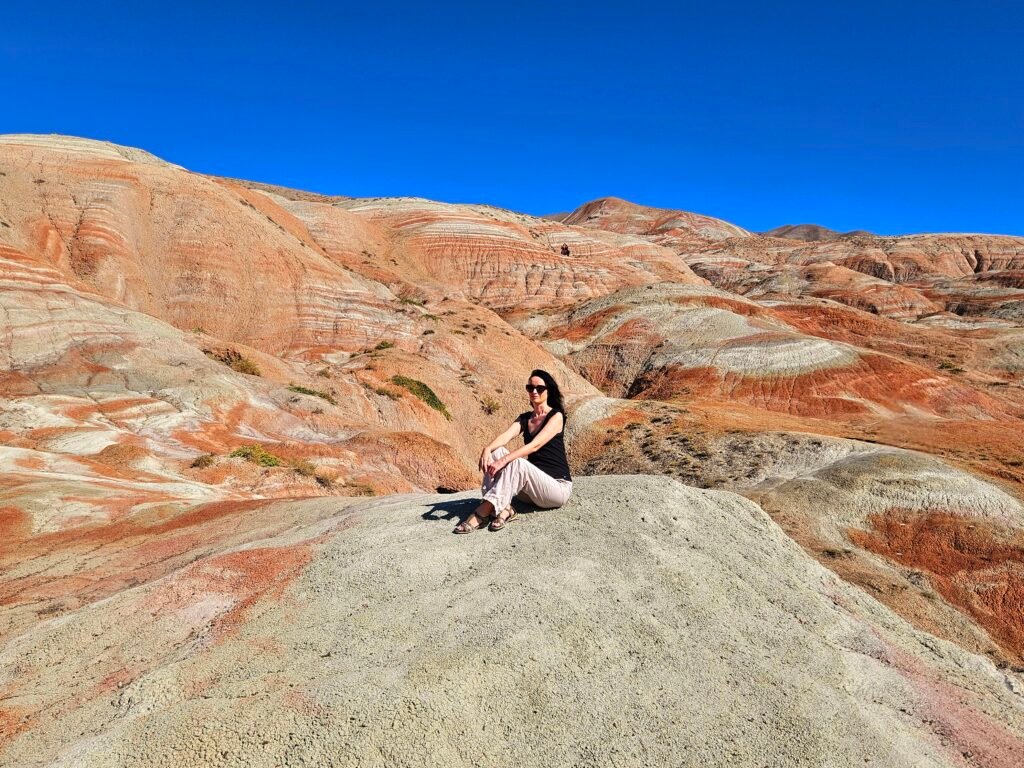
Another stop on our northern route was the colourful mountain landscape around Khizi, located about an hour and a half drive from Baku.
These are often called the Candy Cane Mountains, although the name sounds considerably more sugary than the landscape actually is. The hills have striking bands of red, pink, orange and pale rock. The colours are related to the geological composition and oxidation of iron compounds within the shale.
This is one of those places where having a private driver is useful because you can stop and look at the landscape rather than being tied to a fixed bus schedule. It also works particularly well on the way towards the Caucasus.
Driving through the Caucasus
One of my favourite parts of the northern journey was not a single attraction at all.
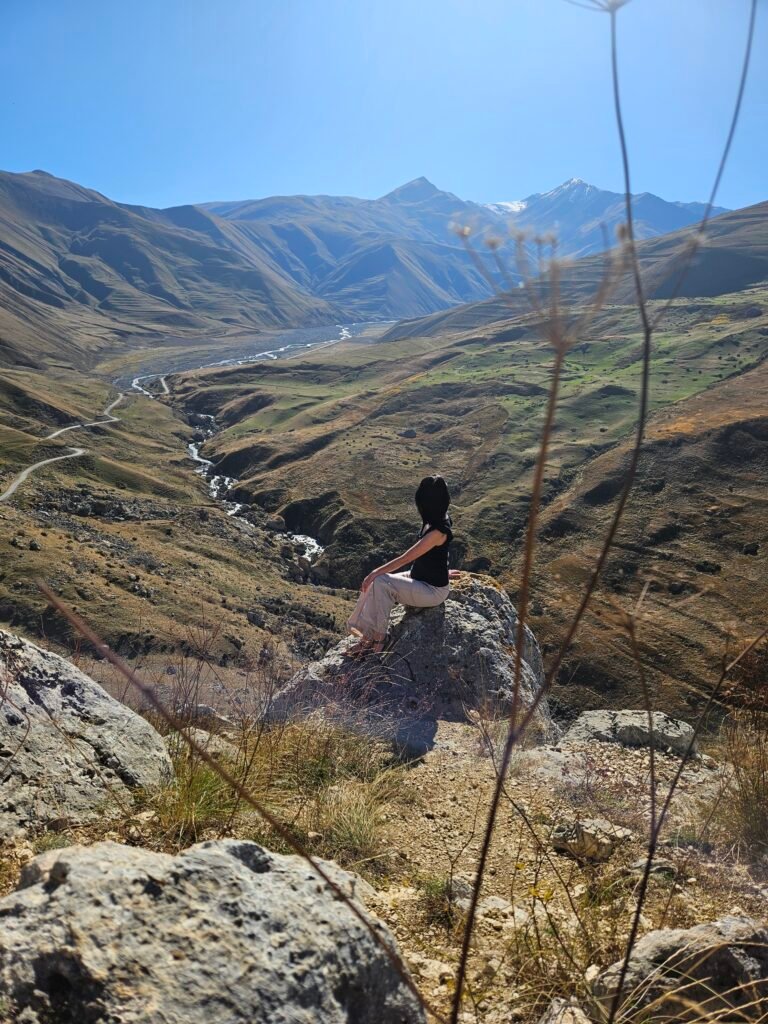
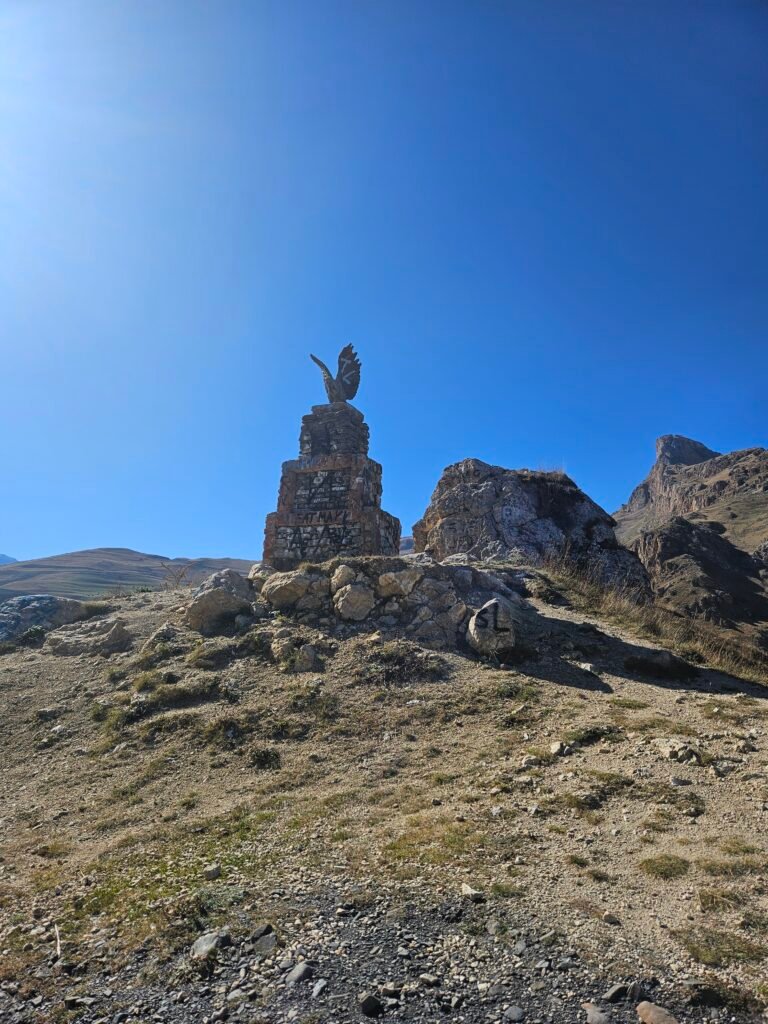
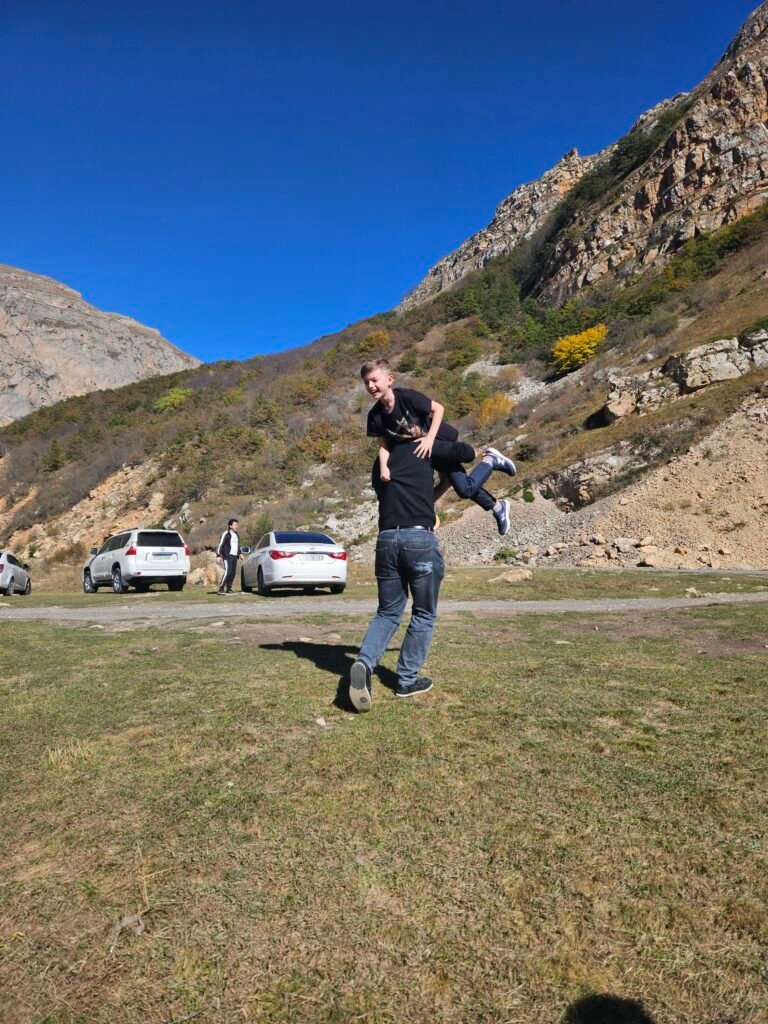
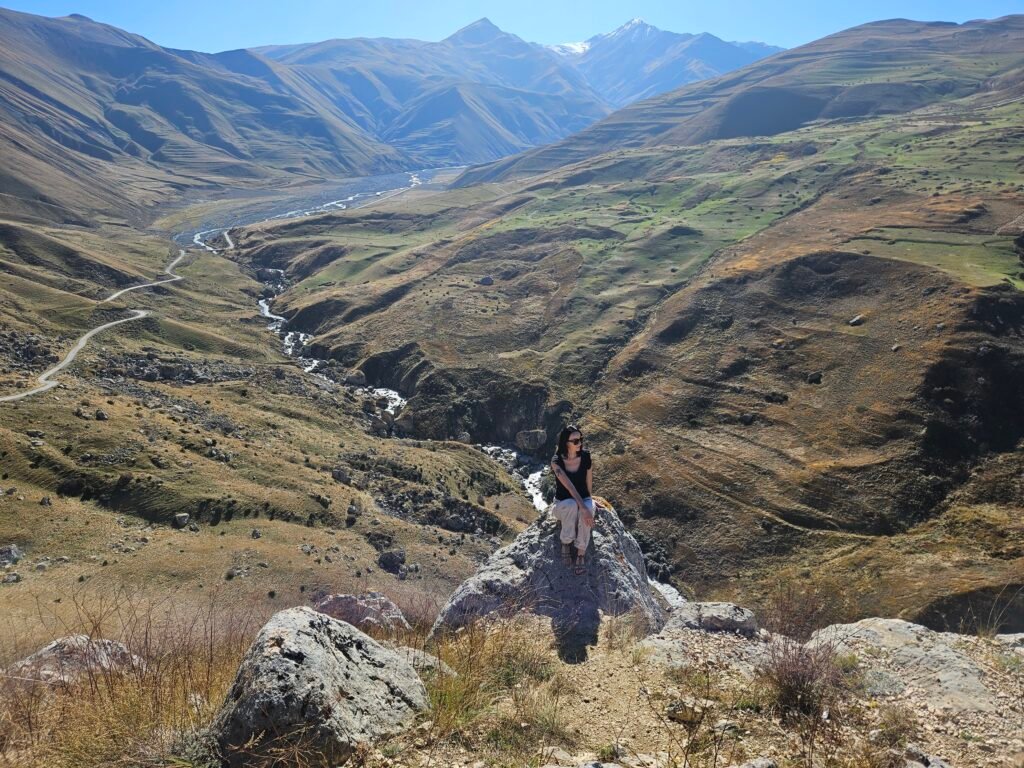
It was the drive. As we continued towards Khinalig, the scenery changed dramatically. Azerbaijan’s Greater Caucasus mountains are a completely different environment from Baku’s dry Caspian landscape. You pass through mountain roads, valleys and increasingly remote settlements.
This is one of the reasons I would recommend having a driver for this part of the trip. You can look out of the window, stop for views and let someone else deal with the road. And there is quite a lot to look at.
The northern route also includes destinations such as Quba and the Khizi region, with the road eventually reaching the high mountain areas around Khinalig. The official tourism information describes the northern route as running from Baku along the Caspian coast and into the Caucasus.
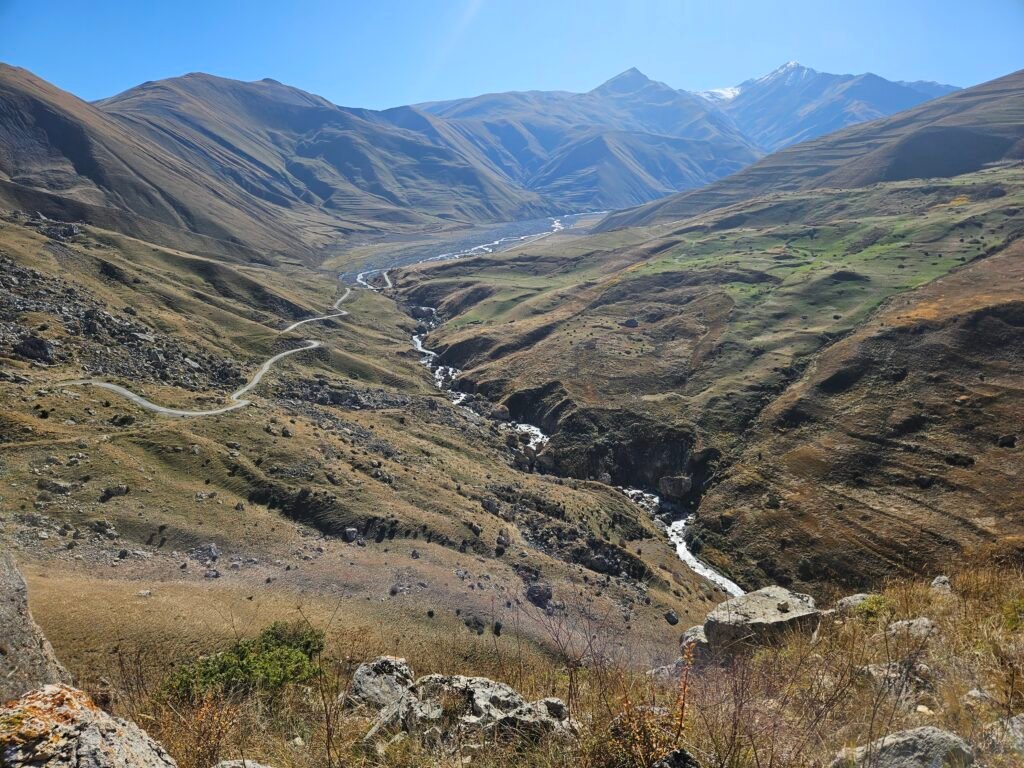
Khinalig village
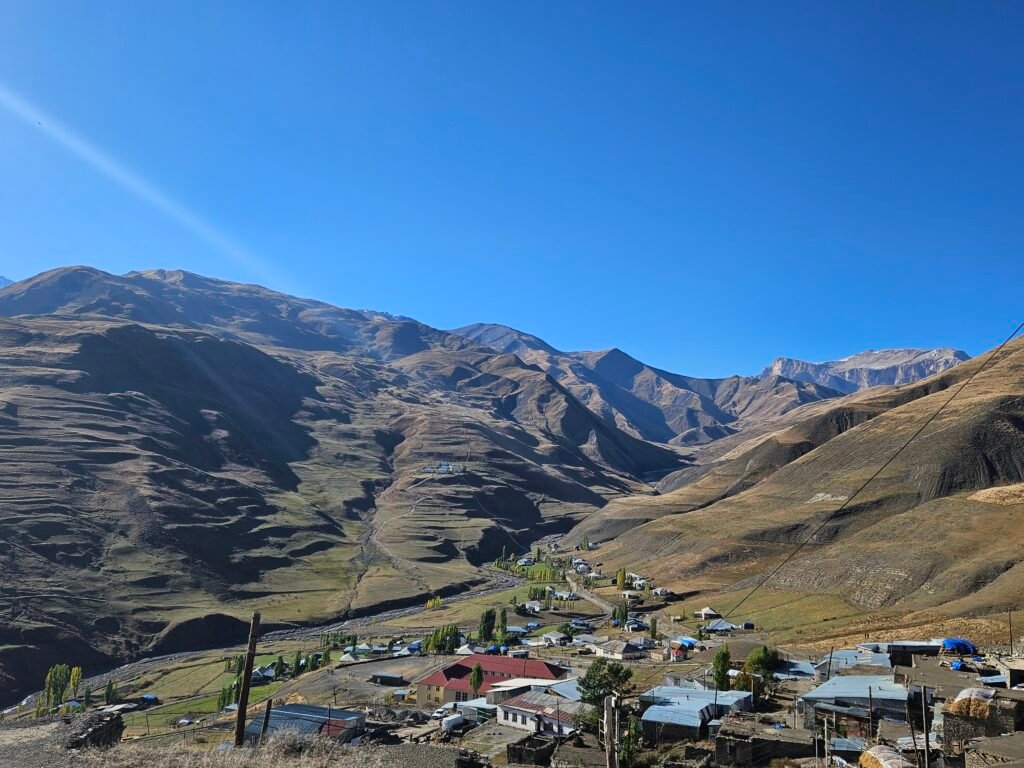
Khinalig was probably the most dramatically different place we visited in Azerbaijan.
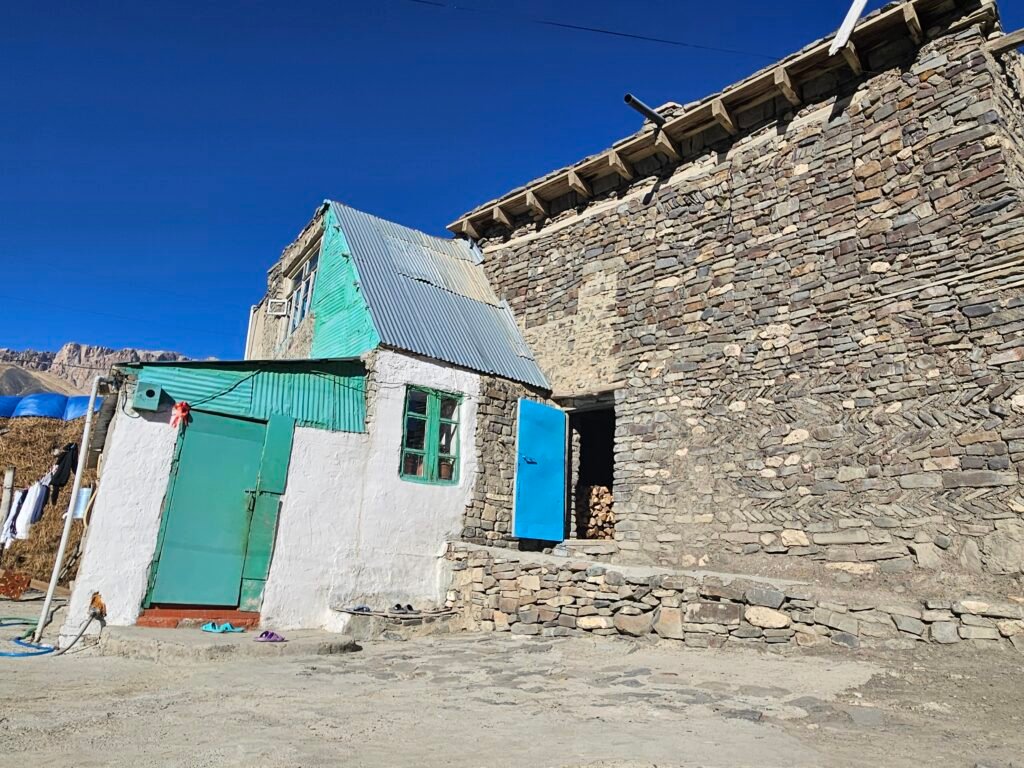
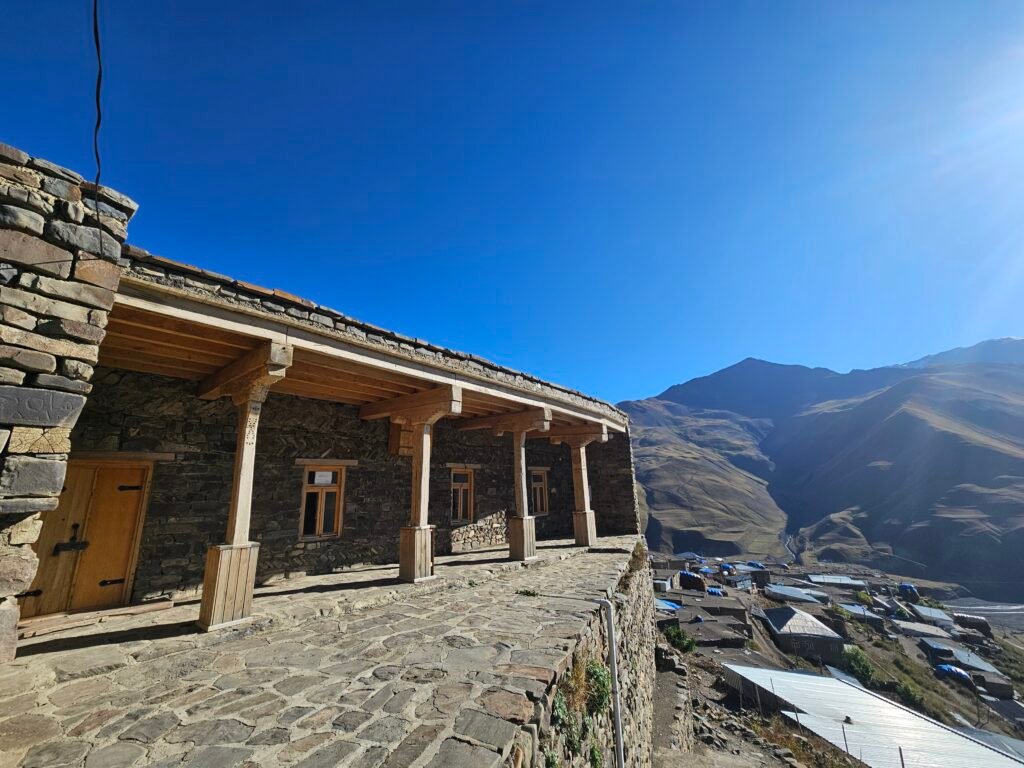
The village sits high in the Greater Caucasus and has a very distinctive architectural layout, with stone houses built closely together on the steep mountainside. The official Khinalig reserve places the village at around 2,200 metres above sea level and about 230 km from Baku.
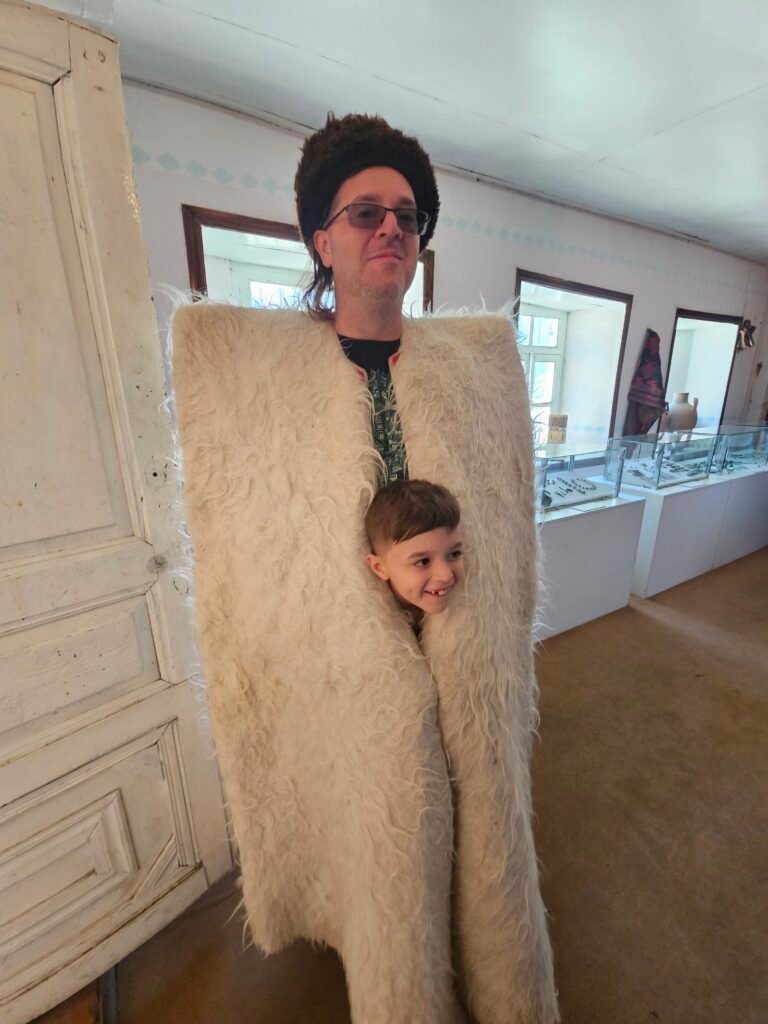
The village has its own language, traditions and cultural history. In 2023, the Cultural Landscape of Khinalig and the Köç Yolu Transhumance Route was added to the UNESCO World Heritage List. That makes Khinalig much more than a scenic mountain viewpoint. It is a living cultural landscape.
The village’s traditional houses are particularly interesting. Because the settlement is built on such steep terrain, houses are positioned closely together and the roof of one can effectively form a terrace or courtyard for another.
What makes Khinalig so fascinating is how different everyday life here is from the rest of Azerbaijan. The village sits high in the mountains, surrounded by steep slopes and dramatic valleys, and its traditional stone houses are built closely together along the hillside. After the wide, dry landscapes around Baku, arriving here felt like entering a completely different part of the country. It was a chance to see a side of Azerbaijan that you simply don’t get in the capital or on the more usual tourist route.
Getting to Khinalig
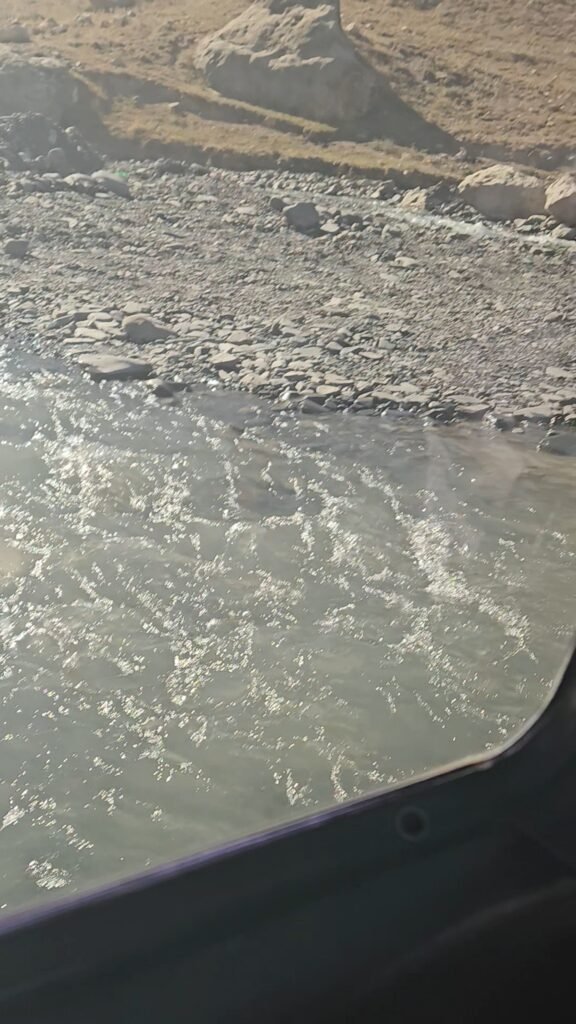
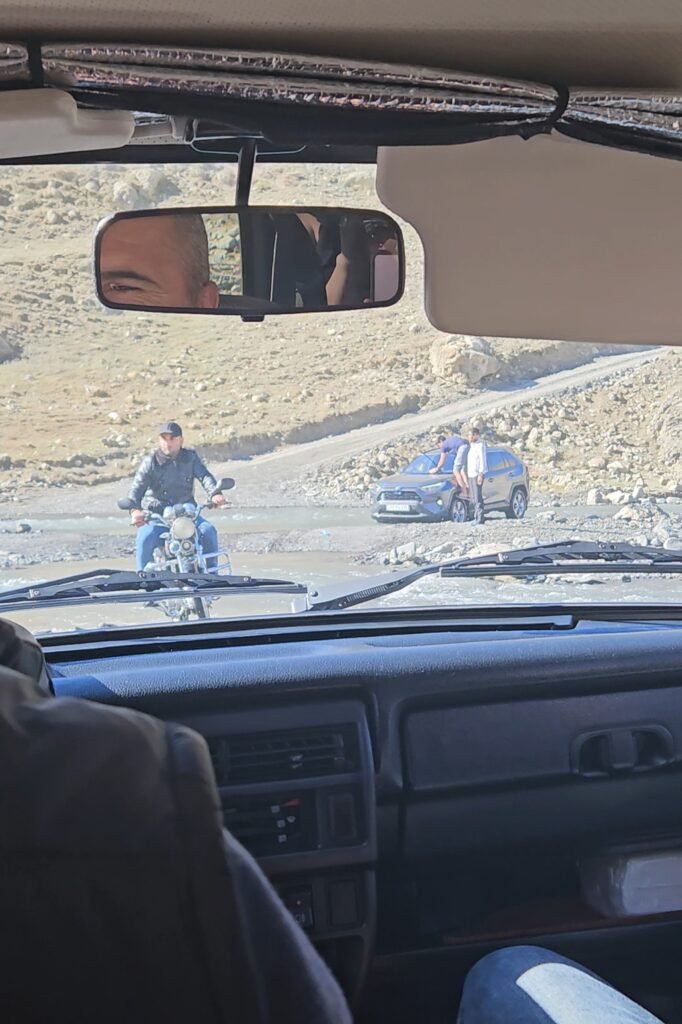
This is where I would strongly recommend a private driver or suitable 4WD excursion.
The official reserve says Khinalig is around 3.5 hours from Baku. There is no conventional public transport all the way to the village. The official Azerbaijan tourism information says that local taxis from Quba can take visitors to Khinalig, with off-road vehicles used for the journey.
The road has improved considerably over time, but this is still a mountain journey, not a quick city excursion. If you are travelling with younger children, keep that in mind. We were travelling with an eight-year-old and were comfortable doing the long journey, but I would not pretend it is a short or effortless day.
We recommend this tour which takes you along the beautiful route in the Caucasus, with a stop at the Candy Cane mountain on the way to Khinalig.
A worldschooling perspective on Azerbaijan
Azerbaijan worked particularly well for us as a worldschooling destination because you can connect so many different subjects to the actual places you are visiting.
In five days, you can cover:
History
The Old City of Baku, Maiden Tower, Shirvanshahs’ Palace, Gobustan, Ateshgah and Sheki all provide completely different historical stories.
Geography
The contrast between the Caspian coast, semi-desert landscapes and the Greater Caucasus is enormous.
Geology
The mud volcanoes and colourful mountains make geology much more concrete than reading about rocks in a textbook.
Archaeology
Gobustan’s thousands of petroglyphs provide an obvious introduction to prehistoric archaeology.
Architecture
You can compare the medieval architecture of the Old City with the oil-boom buildings of Baku and then the futuristic curves of the Heydar Aliyev Centre.
Culture
Khinalig provides a completely different perspective on the diversity of communities living within Azerbaijan.
This is one of the things we love about travelling with our son. A place does not have to look like a classroom to become part of his education.
Getting around Azerbaijan as a family
We used private-driver tours from Baku for the longer excursions. For us, that was the right choice.
The main advantage was flexibility. We could combine several attractions into one trip and did not have to spend time working out connections between places that are not designed around international tourists travelling independently.
This was particularly useful for:
- Gobustan and the mud volcanoes
- Ateshgah and Yanardag
- Sheki
- Khinalig
- The northern mountain route and colourful mountains
Local food to try in Azerbaijan
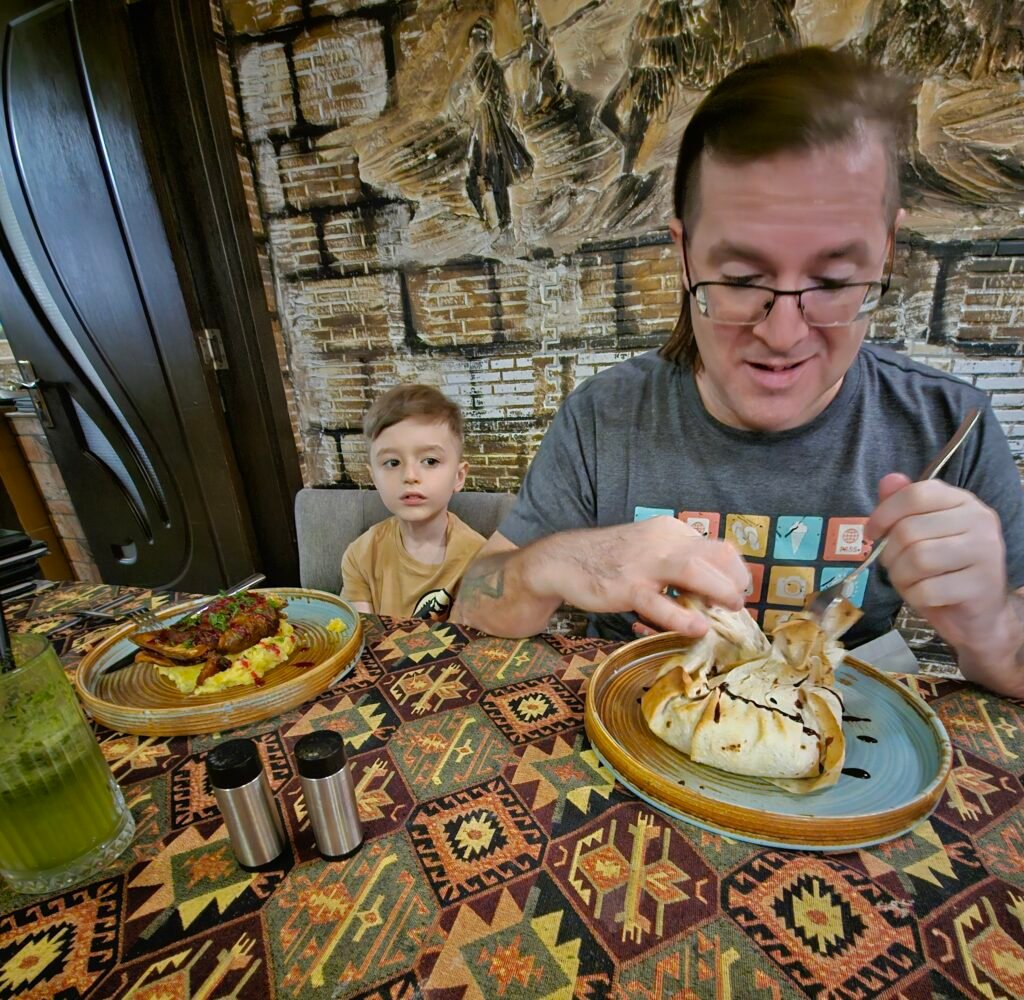
We are not a family that plans an entire holiday around food, but Azerbaijani cuisine is worth paying attention to.
Some dishes you are likely to encounter include:
Plov
Azerbaijani plov is rice-based and comes in many varieties. Some versions are served with meat, dried fruit, chestnuts, onions or other accompaniments.
The official tourism board lists more than 50 known types of suzme plov, so there is considerably more variety than simply “rice with meat”.
Dolma
Dolma is familiar across much of the region.
A common Azerbaijani version uses grape leaves stuffed with meat, rice and herbs and is often served with yoghurt.
Qutab
Qutab is a thin stuffed flatbread or pancake-like dish. Fillings vary and can include meat, herbs, cheese or vegetables.
This is one of the easier foods to try with children because it is familiar in form even if the filling is new.
Piti
Piti is particularly associated with Sheki. It is a slow-cooked dish traditionally prepared with meat and chickpeas.
If you are visiting Sheki, this is one of the local foods worth looking for. The Azerbaijan tourism board specifically identifies piti as one of the city’s traditional specialities.
Sheki halva
Despite the name, Sheki halva is much closer to the family of layered nut-and-syrup sweets that many visitors would associate with baklava.
It is one of Sheki’s signature foods, and local sweet shops are part of the city’s food culture.
Best time to visit Azerbaijan with kids
For the combination of Baku, Gobustan, Sheki and the Caucasus, I would favour spring or autumn. We went in early October, and the weather was lovely, with about 25-26c in Baku, and slightly cooler, but still warm in the mountains.
Azerbaijan’s official tourism board identifies May as a particularly good month for exploring historical monuments and destinations such as Sheki, while autumn brings cooler temperatures that work well for walking and mountain trips.
Baku can get hot in summer. Long-term climate averages put July and August around the high 20s Celsius for average daytime highs, with August the hottest month on average. Baku is also famously windy.
The mountains are different. Sheki has a more pronounced seasonal climate, with warm summers and much colder winters. And Khinalig is at around 2,200 metres, so conditions can be considerably cooler than in Baku. That means you need to think beyond the weather forecast for Baku. If your itinerary includes Khinalig, pack layers even if the capital is warm.
Visa and entry requirements for Azerbaijan
This is one section where I would definitely check the rules shortly before travelling.
Azerbaijan’s official ASAN Visa system currently offers eligible nationalities a single-entry e-visa allowing a stay of up to 30 days. The standard e-visa fee is currently US$20 plus a US$9 service fee, and the official portal says applications should normally be submitted at least three working days before arrival.
Not every nationality has the same visa requirements, so check your specific passport against the official list rather than relying on a generic travel blog.
The passport used for the e-visa also matters. Azerbaijan’s e-visa system explicitly says that travellers with multiple nationalities must apply using the passport they will actually use to travel, and the e-visa becomes invalid if the travel document does not match.
There is also an important current change for travellers coming from Georgia: Azerbaijan’s Ministry of Foreign Affairs says railway entry and exit between Azerbaijan and Georgia on the Baku-Tbilisi-Baku route resumed from 25 May 2026, but the rule specifically applies to Azerbaijani citizens and foreign citizens who have the right to enter Azerbaijan visa-free.
That distinction matters. If you are travelling on an e-visa rather than under a visa-free arrangement, do not assume that you can simply take the Tbilisi-Baku train into Azerbaijan. Check the current rules for your passport before booking.
Safety and practical tips for families
Azerbaijan felt like a very safe destination for a family trip, but there are a few things worth knowing.
Be careful about where you travel outside the main tourist route
The biggest safety issue is not really Baku sightseeing.
There are areas of Azerbaijan affected by the former conflict with Armenia where unexploded weapons and landmines remain a risk. Current UK government advice recommends against travel to some parts of south-western Azerbaijan and against travel within 5 km of the Armenia border.
For a normal Baku, Gobustan, Sheki and Khinalig itinerary, this is not something you need to obsess over.
The important rule is simple: stay on established routes and do not wander into restricted or uncleared areas.
Take water on road trips
Some of the attractions outside Baku are exposed and have little shade.
This is particularly relevant around Gobustan, the mud volcanoes and the mountain roads.
Take more water than you think you need, especially in summer.
Bring layers for the mountains
Baku and Khinalig can feel like two different climates.
Khinalig is high in the mountains, so even if you leave Baku in warm weather, take something warmer for the journey.
Expect long car days
This is probably the biggest practical point for families.
Our itinerary covered a lot of ground in five days, but that came with long journeys.
If your child dislikes being in the car for hours, I would add more time and split the itinerary.
Cash and cards
Cards are widely used in Baku and larger tourist areas, but I would still carry some Azerbaijani manat when heading into smaller towns and remote areas. Even in the main city centre of Baku most of the street food vendors do not accept card.
Same goes for the small roadside stops or rural services.
Internet and connectivity
Baku is a modern capital with good connectivity, but once you head into the mountains, coverage can become less reliable.
If you are using your phone for navigation, download maps before heading into remote areas.
Travel insurance
Make sure your travel insurance covers the activities and destinations you actually plan to visit.
This is particularly important if you intend to hike, travel into mountainous areas or use off-road vehicles.
Final thoughts on travelling to Azerbaijan with children
We enjoyed seeing how different Azerbaijan was from what we expected, particularly the contrast between modern Baku, the dry landscapes around Gobustan and the mountains of the Caucasus.
Our five days were busy, and I would not recommend trying to squeeze this entire route into five days if you prefer slow travel.
But if you are happy with long driving days and want to see a lot, it is possible.
The places that made the biggest impression on our itinerary were the ones that felt completely different from one another. Baku’s Old City, the strange landscape around the mud volcanoes, the Sheki Khan’s Palace and the journey into the mountains towards Khinalig all gave us very different sides of the country.
Come if you enjoy variety, history, unusual landscapes and getting out on the road. If you do, don’t spend the whole trip in Baku. The capital is interesting, but some of the best parts of our Azerbaijan family trip were waiting several hours away, somewhere beyond the city and up in the Caucasus.
2 Comments