


The Best eSIMs for International Travel: Airalo vs Nomad and the Alternatives
Finding the best eSIM for international travel can feel harder than it should be, with dozens of providers all claiming to be the top choice. After using several of them ourselves across 90+ countries, here is what we have actually learned about which ones are worth your money.
Last checked: September 2026
Affiliate disclosure: Some links in this article are affiliate links, which means we may earn a small commission at no extra cost to you. We only recommend products and services we genuinely believe are useful for travellers.
Our Top Picks
- Best overall: Airalo | Skip to review
- Best alternative to compare: Nomad | Skip to review
- Best for unlimited data: Holafly | Skip to review
- Best for built-in security features: Saily | Skip to review
- Best for Europe and Asia trips: Ubigi | Skip to review
- Best for optional phone-number functionality: aloSIM | Skip to review
- Best for cruise travel: GigSky | Skip to review
- Best for comparing lots of plans: MobiMatter | Skip to review
After travelling to more than 90 countries as a family, we’ve learned that mobile data is one of those things you don’t really appreciate until you arrive somewhere without it.
You need Google Maps to find your accommodation. You need to message a driver. You need to translate something. You need to check a booking, contact a host, order an Uber or simply figure out where on earth you are.
When you’re travelling for weeks at a time, and especially when you’re moving between countries regularly, having mobile data the moment you arrive makes life considerably easier.
That’s why we’ve increasingly used travel eSIMs. We’ve personally used Airalo and Nomad, and overall we’ve had good experiences with eSIMs across many different parts of the world. They’re not perfect, though, and we’ve also learned that an eSIM should never be treated as a guarantee that you’ll have a connection everywhere.
So which eSIM should you actually buy? The answer depends on where you’re going, how much data you use, how long you’re travelling and whether you need one plan to follow you across multiple countries.
An eSIM is just one part of how we actually stay connected on the road. It sits alongside the travel gear we actually use, the phones, chargers and backup batteries that make it possible to use that data once we have it.
Here’s what we found after comparing the major options available in 2026.
Quick answer: which travel eSIM should you choose?
There isn’t one single best eSIM for international travel that suits everyone.
Our shortlist looks like this:
| If you are… | We’d look at… | Why |
|---|---|---|
| A frequent international traveller | Airalo or Nomad | Broad local, regional and global options and a very large destination selection |
| A heavy data user | Holafly | Strong focus on unlimited-data plans, although fair-use and hotspot restrictions matter |
| Interested in built-in security features | Saily | Includes features such as web protection, ad blocking and virtual location |
| Travelling mainly around Europe or certain Asia destinations | Ubigi | Competitive regional pricing and reusable eSIM structure |
| Want to compare lots of different eSIM plans | MobiMatter | Marketplace approach rather than a single provider |
| Travelling on a cruise | GigSky | Particularly strong cruise and ship-to-shore offering |
| Want a data plan plus optional phone-number functionality | Saily / aloSIM / selected Airalo plans | Phone-number availability varies by plan |
The important part is that the cheapest-looking plan isn’t necessarily the best plan for your trip.
Before buying, check the actual destination, network partners, data allowance, validity, hotspot rules and activation conditions. Whichever provider you land on, the goal is the same: finding the best eSIM for international travel for your specific itinerary, not just the most heavily advertised one.

What is an eSIM?
An eSIM is essentially a digital SIM built into your phone.
Instead of buying a physical SIM card when you arrive in another country, you download a mobile plan and install it electronically.
For travellers, the biggest advantage is convenience.
You can often:
- buy your plan before leaving home
- install it before your flight
- keep your normal SIM in the phone
- use the travel eSIM for mobile data
- switch plans when you change countries
- avoid hunting for a SIM shop immediately after landing
The important thing to understand is that an eSIM is the technology; the provider is the company selling you access to a mobile network.
That distinction matters because an eSIM provider doesn’t magically create its own mobile network.
Your connection ultimately depends on the local networks that provider has access to in the destination.
The Best eSIMs for International Travel We’ve Actually Used
Airalo
Airalo is one of the largest travel eSIM marketplaces and currently offers local, regional and global plans covering more than 200 locations. Its plans include both fixed-data and unlimited options, depending on the destination.
We’ve personally used Airalo in many parts of the world and have mostly had very good experiences with it. For many travellers, it’s the closest thing to a default answer when searching for the best eSIM for international travel.
The biggest thing we like is simply the familiarity. When we’re travelling somewhere new, we can check the destination, see the available plans and have an eSIM ready before we arrive.
Airalo also supports regional plans, which can make sense when you’re crossing several borders rather than staying in one country. For example, its current Europe plans include packages ranging from small short-term data allowances through 50 GB and longer-validity options.
There are also plans that include calls and texts in some destinations, although many travel eSIMs are data-only. Airalo explains the distinction clearly on its current plan information.
Our Airalo Experience in Azerbaijan
So far we had only one experience where we had issues with Airalo eSIM connecting – in Baku, Azerbaijan.
On our trip to Azerbaijan, our Airalo eSIM connected initially, but then disconnected and wouldn’t connect again. We tried to get it working, but ultimately gave up and bought a local physical SIM.
This is worth mentioning because we don’t want to turn one bad experience into a blanket claim that Airalo doesn’t work in Azerbaijan. In fact, Airalo currently sells Azerbaijan eSIMs and lists local networks including Azercell, with both fixed-data and unlimited options.
So our experience was just that: our experience at that time.
And that’s actually the useful lesson. Mobile connectivity depends on the provider, the specific plan, the local network, your phone and the circumstances at the time.
If you’re travelling somewhere where being connected is important, it’s sensible to have a fallback. For us, that meant buying a physical SIM locally. It wasn’t what we planned to do, but it solved the problem.



Nomad
Nomad is the other major travel eSIM provider we’ve personally used, and it’s a serious contender if you’re comparing options for the best eSIM for international travel.
Its current offering covers 200+ destinations and includes local, regional and global eSIM options.
Nomad also supports hotspot/data sharing, and its current service information says travellers can keep their home number for calls and texts while using Nomad for data.
One useful feature for long-term travellers is the ability to add more data to an existing eSIM rather than necessarily starting from scratch every time.
We’ve used Nomad ourselves, so it belongs in a different category from the providers we’ll discuss below.
Airalo vs Nomad: Which Is the Best eSIM for International Travel?
This is probably the comparison we’re asked about most often, and unfortunately there isn’t a universal winner.
Both offer:
- local plans
- regional plans
- global plans
- prepaid data
- eSIM installation
- data top-ups on eligible plans
- broad international coverage
- support for keeping a primary SIM alongside the travel eSIM
Nomad currently advertises 200+ destinations, while Airalo also advertises 200+ locations.
The more useful question is:
Which one is better for your particular trip?
Coverage
Both have broad coverage, but don’t assume that “200+ countries” means the two providers use exactly the same networks in every country.
The network available to you is determined by the provider’s agreements in that destination.
That means two eSIMs can both say they cover a country while offering different network choices.
This is one reason we recommend checking the actual plan details before purchasing if you’re heading somewhere remote or somewhere where connectivity is especially important.
Price
Price is one of the areas where Airalo and Nomad are genuinely worth comparing before you buy. Neither is consistently cheaper across every destination, because the cost depends on the country or region, data allowance, validity period and whether you’re choosing a fixed-data or unlimited plan.
For example, when we checked current plans in September 2026, both Airalo and Nomad had a range of options at different price points, so there isn’t a simple rule that one is always the better-value choice.
Rather than choosing based on the provider alone, we recommend checking both Airalo and Nomad for your specific destination and comparing the amount of data, validity, network options and price.
And if you’re travelling through several countries, compare their regional plans too. A slightly more expensive plan can still be better value if it covers your entire itinerary and means you don’t need to buy separate eSIMs every time you cross a border.
Installation
Both are designed to make installation relatively straightforward.
Nomad currently promotes one-tap installation or QR-code installation, while Airalo provides installation instructions through its app and support centre.
For us, the bigger practical consideration is not which app has the prettier installation process.
It’s whether we’ve installed everything before we need it.
Hotspot
Airalo supports tethering when the device and network support it, although some plans may require APN configuration.
Nomad also supports hotspot/data sharing.
If you’re planning to use one phone to provide internet to a laptop, tablet or child, check the specific plan rather than assuming every eSIM allows unrestricted tethering.
Refunds
Airalo’s current terms allow refunds in certain situations, with different conditions depending on whether the eSIM has been activated or used. Technical/service failures can qualify under its stated conditions.
Nomad’s current refund policy says requests generally need to be made within 30 days, with unused/uninstalled plans eligible for a full refund and activated plans potentially eligible for a partial refund when a verified network or technical failure occurred.
The important takeaway isn’t which policy sounds better on paper.
It’s this:
If your eSIM isn’t working, contact support while you’re still travelling and before you’ve consumed much of the plan.
So, Airalo or Nomad?
For us, there’s no need to choose one forever.
We use both.
If we’re travelling somewhere, we’ll often compare the actual plans available for that destination.
And if one provider offers a significantly better regional plan for the itinerary, that can outweigh brand loyalty.
Our practical approach
If you want a familiar all-round travel eSIM with huge destination coverage: start by checking Airalo.
If you’re comparing prices and plan structures: check Nomad too.
If the difference is small: choose the one with the better network options and plan conditions for your particular destination.
And remember that the “best” provider can change from country to country.

Other Options for the Best eSIM for International Travel
Airalo and Nomad aren’t the only serious options.
We’ve researched the current offerings of several others, but these are research-based recommendations rather than providers we’ve personally tested.
Holafly: Best suited to heavy data users
Holafly has built much of its offering around unlimited-data plans. If heavy data use is your priority, it’s worth comparing when you’re deciding on the best eSIM for international travel.
That can be attractive if you’re the sort of traveller who uses a lot of mobile data for:
- video calls
- streaming
- social media
- navigation
- work
- uploading photos and videos
- tethering other devices
But there’s an important distinction between unlimited data and unlimited high-speed data with unlimited hotspot use. Holafly’s current terms state that unlimited plans can be subject to fair-use policies and that network operators may reduce speeds after unusually high usage.
Hotspot allowances can also differ by destination and plan. Holafly specifically advises travellers to check the hotspot allowance in the technical specifications. So don’t read “unlimited” and assume you can run a family of four from one phone indefinitely.
Save 5% on your next purchase with code FREEDOMATLAS if you purchase Holafly eSIM — valid for any destination!
Who should consider Holafly?
It’s worth comparing if you’re a heavy data user and don’t want to monitor every gigabyte.
For someone who mainly needs:
- Maps
- occasional browsing
a large fixed-data package may be considerably better value.
Saily: Best for travellers interested in built-in security features
Saily is another major travel eSIM provider, offering plans in more than 200 destinations. It’s worth comparing if built-in security features matter as much as finding the best eSIM for international travel.
One thing that makes Saily different is its built-in security feature set.
Saily currently includes features such as:
- virtual location
- ad blocking
- web protection
and says these are powered using technology from Nord Security/NordVPN.
It’s worth being precise here: Saily itself says its virtual-location feature is not the same thing as a full dedicated VPN.
Saily also currently offers an optional US phone number and call/SMS packages, rather than every plan simply being data-only.
Another interesting feature for frequent travellers is that Saily says you can add new destination plans to your existing Saily eSIM instead of installing a completely new eSIM for every country.
Who should consider Saily?
I’d look at Saily if:
- you travel frequently
- you like managing everything through one app
- security features matter to you
- you want regional/global options
- you like the idea of adding plans to an existing eSIM
Ubigi: Worth a close look for Europe and Asia
Ubigi is particularly interesting if your travel is concentrated in regions where its plans are competitive, and it’s a strong contender for the best eSIM for international travel if your trip is mostly in Europe or parts of Asia.
Its current offering covers 200+ destinations, supports data sharing, and uses a reusable eSIM structure that can be topped up.
Its European pricing is especially worth checking.
At the time of our September 2026 research, Ubigi listed:
10 GB / 30 days in Europe — €15
with a wide range of European networks listed on the plan page.
That’s substantially cheaper than the current $31 price listed for Airalo’s 10 GB/30-day Europe Eurolink plan.
This doesn’t mean Ubigi is “better than Airalo.”
It means that you should compare actual regional plans before buying.
If you’re spending a month travelling around Europe and need 10 GB, the difference can be meaningful.
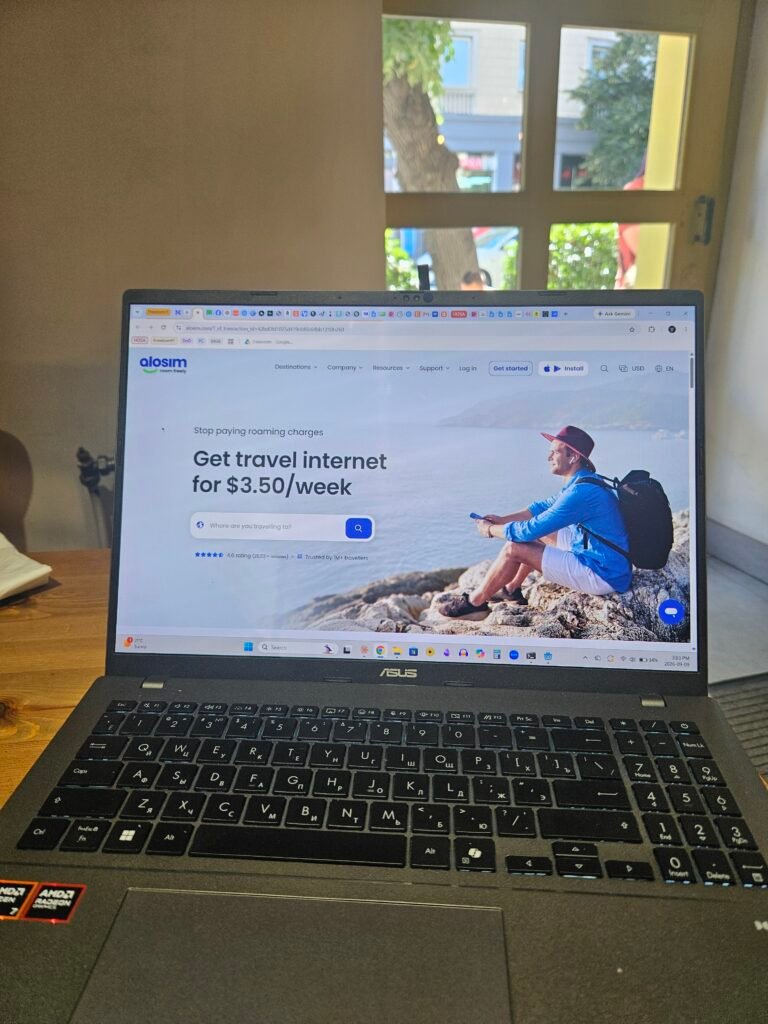
aloSIM: Interesting if phone-number functionality matters
aloSIM is another option worth checking.
Its standard eSIM packages are generally data-focused, but aloSIM currently offers a phone-number option through its sister service Hushed with many eSIM purchases.
Hotspot use is supported, although the specific plan and device still matter.
Who should consider aloSIM?
It’s worth comparing if:
- you want data plus optional phone-number functionality
- you use hotspot frequently
- its destination pricing is competitive
It’s less compelling to choose a provider purely because it offers a phone number if you’re perfectly happy using your existing number and WhatsApp.
GigSky: Particularly interesting for cruise travel
GigSky is another established travel eSIM provider, with coverage across 200+ countries and specific cruise connectivity offerings.
This is where GigSky stands out.
It has plans designed for travellers who need connectivity both on land and on cruise ships, with specific ship-to-shore functionality.
GigSky also supports hotspot sharing, and some current plan specifications show unlimited hotspot use.
Who should consider GigSky?
I’d put it high on the research list if your trip involves:
- cruises
- multiple countries
- frequent travel
- needing one reusable eSIM
- hotspot sharing
For an ordinary week in Paris, you probably don’t need to choose an eSIM based on its cruise capabilities.
MobiMatter: Best thought of as a marketplace
MobiMatter is slightly different from the other companies on this list.
It’s an eSIM marketplace, meaning it lets you compare plans from different providers rather than offering only its own network products.
That can be extremely useful for experienced travellers.
Instead of asking:
“Which company is best?”
you can ask:
“Which plan gives me the best combination of network, data, validity and price for this particular trip?”
MobiMatter currently covers 200+ destinations and displays information about individual plans, including network and hotspot details.
Get up to 50% cashback credits (up to $5) in your account wallet on your first purchase when you purchase an eSIM using promo code FREEDOMATLAS.
Our Current Shortlist: The Best eSIMs for International Travel
After researching the current 2026 market, this is how we’d think about the main options:
| Provider | Best suited to | Main strength | Main thing to check |
|---|---|---|---|
| Airalo | Frequent international travellers | Huge range of local, regional and global plans | Exact network and price for your destination |
| Nomad | Frequent travellers comparing mainstream options | Broad coverage and flexible plan choices | Destination-specific pricing/network |
| Holafly | Heavy data users | Unlimited-data focus | Fair-use and hotspot limits |
| Saily | Security-conscious travellers | Built-in security features | Exact plan/data pricing |
| Ubigi | Regional travellers, especially Europe/Asia | Competitive regional plans and reusable eSIM | Coverage for your exact itinerary |
| aloSIM | Travellers wanting optional number functionality | Data + optional Hushed number | Whether you actually need the number |
| GigSky | Cruise and multi-country travellers | Cruise + global connectivity | Destination-specific plan terms |
| MobiMatter | Travellers willing to compare | Multiple providers in one marketplace | The individual plan/network you’re buying |
We haven’t built a table of prices for every destination, because they change too often to make a permanent comparison useful. But a same-day snapshot of one comparable plan is still worth seeing, so you know roughly what to expect before you start checking live prices for your own trip.
What a Comparable Europe Plan Actually Costs (September 2026 Snapshot)
To make the providers genuinely comparable, we checked each one’s own site for the plan closest to 10 GB of data valid for 30 days in Europe, which is a reasonable baseline for a typical month-long trip. Holafly doesn’t sell a fixed 10 GB plan for Europe, so we’ve included its nearest unlimited equivalent instead.
| Provider | Closest plan | Price | Approx. $/GB |
|---|---|---|---|
| Ubigi | 10 GB / 30 days | $15 | $1.50 |
| MobiMatter | 10 GB / 30 days (Sparks network, cheapest listing) | from $10.49 | from $1.05 |
| GigSky | 10 GB / 30 days | $22.99 | $2.30 |
| Nomad | 10 GB / 30 days | $23 | $2.30 |
| Airalo | 10 GB / 30 days (Eurolink, broader coverage) | $31 | $3.10 |
| Saily | 10 GB / 30 days | $35.99 | $3.60 |
| aloSIM | 10 GB / 30 days | $36 | $3.60 |
| Holafly | Unlimited / 30 days (no fixed 10 GB option) | $73.90 | n/a (unlimited) |
A few things worth noting about this table:
- Airalo also sells a narrower “EUconnect” Europe plan (28 countries) at 10 GB/30 days for around $24, cheaper than the broader Eurolink plan we’ve listed. Which one shows up for you depends on exactly which countries you’re visiting, so check the coverage list, not just the headline price.
- MobiMatter’s price depends entirely on which underlying network you pick that day, we’ve listed its cheapest Europe 10 GB listing, but pricier options from other networks on the same page can run $20+ for the same 10 GB.
- Holafly and Saily both also sell short-stay unlimited plans (3 to 15 days) that can undercut this 30-day comparison if your trip is shorter, so don’t rule either out based on this table alone if you’re only away for a week.
The spread here is the real takeaway: on this one comparable plan, prices range from about $10 to nearly $74, a 7x difference for the same 10 GB in the same region. That’s exactly why we don’t recommend defaulting to one provider out of habit, always check the live price for your specific destination before buying.
Country-Specific vs Regional vs Global eSIMs for International Travel
This is one of the most important decisions you’ll make.
Choosing between these three structures is one of the biggest factors in finding the best eSIM for international travel for your specific trip.
Country-specific eSIM
If you’re going to one country for a week or two, this is usually the simplest option.
For example:
Georgia → Georgia eSIM
Japan → Japan eSIM
Thailand → Thailand eSIM
You’re buying coverage specifically for that destination.
This can often give you more data for your money than a global plan.
Regional eSIM
A regional plan makes more sense when you’re crossing borders.
Imagine you’re travelling:
France → Spain → Portugal → Italy
Rather than buying four separate plans, you could buy a European regional plan.
That’s exactly the kind of situation where regional eSIMs become useful.
Airalo currently offers European plans covering dozens of countries, while Ubigi also offers regional European packages.
Global eSIM
Global plans are designed for travellers who don’t want to keep thinking about which country comes next. For this kind of itinerary, a global plan can be the best eSIM for international travel.
They’re particularly useful for:
- digital nomads
- long-term travellers
- frequent flyers
- multi-continent trips
- people crossing borders regularly
- anyone travelling long-term rather than on a fixed two-week trip
If that sounds like your trip, it’s worth reading more of our long-term travel resources on pacing yourself across multiple countries, since connectivity is only one part of making extended travel sustainable.
The downside is value. A global plan can be more expensive per gigabyte than a country-specific or regional plan. For someone spending six weeks in Thailand, buying a global plan because it sounds convenient may be unnecessary.
For someone travelling:
Georgia → UAE → Thailand → Japan → USA → Mexico
the convenience becomes much more compelling.
eSIM vs Local SIM: Which Should You Use for International Travel?
We don’t think eSIMs have made physical SIM cards obsolete.
Both approaches can work, and the right answer for the best eSIM for international travel often depends on how long you’re staying and how much data you use.
They’ve just made them less necessary.
eSIM advantages
- Install before departure
- No physical SIM to lose
- No SIM tray swapping
- Can be ready when you land
- Easy for border-hopping
- Excellent for short trips
- Useful for frequent international travellers
- Can keep your home SIM in the phone
Local SIM advantages
- Often cheaper for long stays
- May offer larger data allowances
- May include a local phone number
- Can sometimes provide better local network choices
- Useful when a travel eSIM fails
- Useful where travel eSIM coverage is limited
We’ve personally experienced the last point.
When our Airalo connection failed in Azerbaijan, a local SIM was the solution.
And sometimes, if we’re staying somewhere for a month or more, we’ll at least check local SIM prices before automatically buying another travel eSIM.
Recent traveller discussions also reinforce the general point that local SIMs can still be cheaper for longer stays, while travel eSIMs win on convenience. These are anecdotal experiences rather than universal rules, but they’re worth remembering.
Does My Phone Support eSIM?
Most modern flagship smartphones support eSIM, but don’t assume yours does.
Compatibility can vary according to:
- phone model
- country where the phone was purchased
- carrier
- regional version of the device
For example, Apple currently supports eSIM on a wide range of iPhone models, including the iPhone XS/XR and newer models, but dual-SIM capabilities vary by model and region.
The safest approach is:
- Check your exact phone model.
- Check whether it supports eSIM.
- Check whether your carrier has locked the device.
- Check the eSIM provider’s compatibility list.
Don’t wait until you’re standing at an airport trying to install an eSIM to discover that your phone isn’t compatible.
Do I Need an Unlocked Phone?
Usually, yes, if you want to use an eSIM from another carrier/provider alongside your normal service.
An unlocked phone can accept compatible plans from other providers.
Apple specifically notes that if you’re using two different carriers with Dual SIM, the iPhone needs to be unlocked, unless both plans are from the same carrier.
If you’re unsure, check your phone’s SIM-lock status before buying anything.
Can I Use My Normal SIM and a Travel eSIM at the Same Time?
This is one of the biggest advantages of eSIMs.
On compatible devices, you can keep your normal SIM active while using the travel eSIM for data.
Apple’s current Dual SIM documentation specifically describes using one line for your home number and another for a travel data plan.
This can be extremely useful for travellers.
Your setup might look like:
Home SIM → calls, texts and important verification messages
Travel eSIM → mobile data
The exact functionality varies between phones, but the principle is extremely useful.
Just be careful with roaming.
Keeping your home SIM active doesn’t automatically mean it is free to use overseas. Your home carrier may still charge for calls, SMS or data.
Will I Still Receive Calls and Texts?
It depends on the plan.
Most travel eSIMs are data-only.
That means the eSIM itself doesn’t give you a normal phone number.
Some providers offer plans with calls and texts, but you need to check the specific plan.
Airalo, for example, currently distinguishes between “Data Only” and “Data, Voice & Text” plans, and some of its global/local plans include phone numbers.
If you keep your normal SIM active, you may still be able to receive calls and SMS on your normal number while using the travel eSIM for data.
Again, check your carrier’s international roaming charges.
Can I Use WhatsApp With a Travel eSIM?
Yes.
This is one of the easiest things to misunderstand about eSIMs.
Your WhatsApp account is associated with the phone number you verified with WhatsApp, not with the SIM currently providing your mobile data.
So you can:
keep your normal WhatsApp number
while using:
a travel eSIM for internet access.
Your WhatsApp messages and calls continue to work as long as you have an internet connection.
The important exception is verification.
If WhatsApp asks you to verify your number while you’re abroad, having access to your normal number for SMS or calls can be very useful.
This is another reason we generally prefer keeping our primary SIM available when our phones support dual SIM.
Can I Use an eSIM for Hotspot?
Often, yes.
But this is one of those features you should check before buying.
Airalo says tethering is supported when the device and network support it, although some plans may require APN configuration.
Saily also provides hotspot instructions for iPhone and Android, while aloSIM states that its eSIMs support hotspot use.
The bigger question for families is:
How much data are you going to burn through?
Hotspotting a child’s tablet for a few hours is one thing.
Running a laptop, tablet, phone and streaming service through one mobile connection is another.
If you’re relying heavily on hotspot, look specifically for:
- hotspot allowance
- tethering restrictions
- high-speed data limits
- fair-use policies
How Much Data Does a Family Actually Need?
There’s no universal answer.
For a family mostly using:
- Google Maps
- translation
- booking apps
- occasional browsing
you may use surprisingly little data.
But data usage climbs quickly when you add:
- YouTube
- Netflix
- TikTok
- Instagram video
- video calls
- photo backups
- laptop tethering
- large downloads
For our family, we wouldn’t automatically buy three separate unlimited plans.
Depending on the trip, it can make more sense to have:
one or two adults with mobile data
and use hotspot for the children’s devices when necessary.
But there are situations where giving a child their own eSIM makes sense — particularly if they’re old enough to be travelling independently, attending activities without you, or need to contact you.
The right answer depends on how your family actually travels.
The “Don’t Land Without Data” Strategy
This is probably the most useful habit we’ve developed.
Install your travel eSIM before you leave.
You don’t necessarily have to activate the data plan before arriving — activation rules vary — but having the eSIM installed means you aren’t trying to download and configure it while standing in an airport with no connection.
Airalo, for example, explicitly says you can install its eSIM in advance while outside the coverage area, provided you have a stable internet connection.
Before leaving, we recommend having these things available offline:
- accommodation address
- booking confirmation
- airport transfer details
- hotel/host contact details
- passport information where appropriate
- important transport information
- screenshots of anything you absolutely need
Then, when you land:
- Turn on the travel eSIM.
- Select it for mobile data.
- Check whether data roaming needs to be enabled for that eSIM.
- Keep your primary SIM’s data roaming disabled unless you specifically need it.
- Give the phone a moment to connect.
That way, if something goes wrong, you’re troubleshooting a technical problem — not simultaneously trying to find your hotel, contact your driver and buy a SIM.
What Happens If Your eSIM Doesn’t Work?
This is where our Azerbaijan experience comes in.
If your eSIM isn’t connecting, don’t immediately assume it’s dead.
Try these steps:
1. Check that the eSIM is installed
Look in your phone’s cellular/mobile settings.
2. Make sure the eSIM is switched on
An installed eSIM isn’t necessarily active.
3. Check which line is selected for mobile data
Your phone may still be trying to use your home SIM.
4. Check data roaming
Many travel eSIMs require data roaming to be enabled for the travel line.
Do not automatically enable roaming on your home line.
5. Restart the phone
It’s boring advice, but it genuinely solves a surprising number of connectivity problems.
6. Check network selection
Some travel eSIMs automatically select a local network.
If that fails, manual network selection may help.
Airalo’s support documentation specifically notes that manual network selection can sometimes resolve connection problems when multiple networks are available.
7. Check the APN
Some eSIMs require specific APN settings.
Don’t copy an APN from a random internet forum.
Use the settings provided by your eSIM provider.
8. Check that the plan has actually activated
Some plans activate when they first connect to a supported network.
Others have different activation rules.
9. Check coverage
Your plan may cover the country but still have limitations regarding particular networks or regions.
10. Contact support
If you’re still stuck, contact the provider while you’re in the destination.
11. Have a local-SIM fallback
If you’ve tried everything and you need connectivity now, sometimes the fastest solution is simply:
buy the local SIM.
That’s exactly what we did in Azerbaijan.
Why eSIM Coverage Isn’t Quite as Simple as “Does This Company Cover the Country?”
This is probably the most important technical point in this entire article.
This is exactly why picking the best eSIM for international travel means looking past the marketing headline of “200+ countries.”
When an eSIM company says:
“We cover 200+ countries”
that doesn’t necessarily mean:
“You’ll have exactly the same network experience in every one of those countries.”
The provider needs agreements with local mobile networks.
Different plans can therefore have access to different networks.
And network quality can vary depending on:
- where you are
- which local carrier you’re connected to
- network congestion
- rural versus urban coverage
- the particular plan
- your phone
- roaming arrangements
That’s why checking which networks the specific plan uses can be more useful than simply looking at the number of countries in the provider’s marketing headline.
For example, current Ubigi plan pages list the actual network partners by destination, while Airalo also displays network information on its country pages.
Network Speed: What Each Provider Actually Says
We haven’t run formal speed tests on every provider ourselves, so we’re not going to pretend we have Mbps numbers to hand you. What we can do is tell you what each provider actually publishes about network generation and throttling, which is more than most comparison articles bother to check.
| Provider | Network generation (as published) | Throttling / fair use |
|---|---|---|
| Airalo | 4G/5G on capable plans, varies by destination | Fixed-data plans run at full speed until the data is used up. Its unlimited-tier plans throttle to 1 Mbps after roughly 3 GB/day. |
| Nomad | Markets “blazing-fast 5G, 4G” | Throttles to 512 Kbps after the daily high-speed allowance on plans with daily limits. |
| Holafly | Markets “3G/4G/5G maximum speed coverage” | Its Fair Usage Policy can throttle speeds for up to 24 hours to manage network traffic. Hotspot sharing is capped at 1 GB/day even on unlimited plans. |
| Saily | “3G/4G/LTE/5G, depending on local network providers” | Its unlimited plan throttles to 1 Mbps after roughly 3 GB/day; its fixed-data plans don’t publish a throttling policy. |
| Ubigi | 3G/4G/5G access; Ubigi’s own marketing claims it is faster and more stable than competitors, citing third-party rankings | No throttling published. Once a fixed-data plan is used up, you top up rather than continuing at reduced speed. |
| aloSIM | Markets “LTE/5G” | No throttling policy published on its plan pages. |
| GigSky | Markets 5G capability on its plans | No throttling policy published on its plan pages. |
| MobiMatter | Varies entirely by the underlying network you choose (eSIMGo, Sparks, and others) | Varies by underlying network, so check the specific listing rather than assuming a marketplace-wide policy. |
A couple of things worth reading into that table rather than just past it:
- “Unlimited” almost never means unlimited at full speed. Holafly, Airalo’s unlimited tier and Saily’s unlimited tier all throttle after a daily threshold, usually somewhere around 3 GB/day. If you’re planning to stream or work off an “unlimited” plan, that daily cap matters more than the headline word “unlimited.”
- Network generation claims (3G/4G/5G) are marketing language from the providers, not something we’ve independently measured. Even where 5G is technically available, you’re sharing the local carrier’s network with everyone else on it, including postpaid customers, so actual speed on the ground can still be worse than the plan page implies.
- Fixed-data plans (like Ubigi’s or Airalo’s non-unlimited tiers) generally don’t throttle at all, you get full speed until the data runs out, then you top up. If consistent speed matters more to you than a big “unlimited” number, a fixed-data plan can actually be the safer bet.
If reliable high-speed data matters for your trip, specifically for video calls, uploading content or working remotely, read the fair-use policy on the exact plan you’re buying, not just the provider’s homepage.
What We Would Do as a Family
After travelling to more than 90 countries, our approach to finding the best eSIM for international travel is fairly simple.
We don’t have one provider that we blindly use everywhere.
We usually check:
- Does Airalo cover the destination?
- What does Nomad offer?
- Is there a better regional option?
- What networks does each plan use?
- How much data do we realistically need?
- Can we hotspot?
- How long is the plan valid?
- Is a local SIM significantly cheaper?
- Do we need a phone number?
- Is this somewhere where we really need a backup?
For an ordinary trip, that takes a few minutes.
And those few minutes can save a lot of hassle later.
Our Final Verdict: The Best eSIM for International Travel
If you’re looking for one universal winner, you’re probably asking the wrong question. There isn’t a single best eSIM for international travel that works for every trip.
The best eSIM depends on your destination and the way you travel.
Best all-round option for frequent international travellers: Airalo
Airalo is where we’d start because of its broad destination selection, local/regional/global structure and the fact that we’ve personally used it successfully across many parts of the world.
We’ve had mostly good experiences with it.
But our Azerbaijan experience is exactly why we wouldn’t tell someone:
“Just buy Airalo and you’ll definitely be connected.”
You might be.
But you might occasionally have a problem.
Best alternative to compare alongside Airalo: Nomad
We’ve personally used Nomad too, and it deserves to be part of the comparison rather than being treated as an afterthought.
Its 200+ destination coverage, regional/global options and hotspot support make it a strong mainstream alternative.
Best option to investigate for unlimited data: Holafly
If you’re a genuinely heavy data user, Holafly’s unlimited-data approach is worth considering.
Just read the fair-use and hotspot conditions before buying.
Best option to investigate for built-in security features: Saily
Saily is interesting if you value its integrated security tools and the ability to manage plans through one eSIM.
Best value comparison for some regional trips: Ubigi
Ubigi is absolutely worth checking, particularly for Europe and certain Asian destinations.
Its current European pricing demonstrates why we don’t recommend automatically buying the same provider every time.
Best for comparing lots of plans: MobiMatter
If you’re comfortable comparing individual plans rather than simply choosing a provider, MobiMatter is worth a look because it operates as a marketplace.
Best specialist option for cruise travellers: GigSky
If you’re taking a cruise, GigSky deserves a separate look because cruise connectivity is one of its particular strengths.
Frequently Asked Questions
What is the best eSIM for international travel?
There isn’t one single best eSIM for international travel that fits every trip. Airalo and Nomad are our starting points, since we’ve used both extensively across 90+ countries, but the right choice depends on your destination, how much data you need and how long you’re travelling.
Is Airalo better than Nomad?
Not universally. Both offer local, regional and global plans across 200+ destinations. Compare the actual plan, price, network partners, validity and data allowance for your destination.
Is Airalo reliable?
We’ve personally had mostly good experiences with Airalo across many parts of the world. However, we also had an Airalo connection fail in Azerbaijan and had to buy a local SIM. Current Airalo plans do cover Azerbaijan, so our experience should not be interpreted as a statement that Airalo currently does not work there.
Is Nomad reliable?
Nomad is an established travel eSIM provider with coverage across 200+ destinations. We’ve personally used Nomad, but connectivity can still depend on the specific destination and local network.
Can I keep my normal phone number?
Usually, yes, if your phone supports dual SIM/eSIM functionality. You can keep your home line while using a travel eSIM for data.
Will WhatsApp work with a travel eSIM?
Yes. WhatsApp uses your verified phone number as your account identity and only needs an internet connection for messaging and calls.
Can I use a travel eSIM for hotspot?
Often, yes, but check the specific plan. Hotspot support and allowances can vary.
Is an eSIM better than a local SIM?
Not always. eSIMs are usually more convenient, while local SIMs can be cheaper and sometimes provide better local options for longer stays.
Should I install my eSIM before travelling?
Generally, yes. Installing it while you still have reliable Wi-Fi means you don’t have to deal with installation while standing at the airport without connectivity. Some plans activate only when they connect to a supported network, but always check the provider’s specific activation rules.
What if my eSIM doesn’t work?
Check installation, mobile-data selection, roaming settings, network selection, APN requirements and plan activation. Restart the phone and contact provider support. If you still can’t connect and need data immediately, buying a local SIM may be the fastest solution.