

Nakasendo Trail With Kids: Hiking Tsumago to Magome
Hiking the Nakasendo Trail with kids is very doable. The walk between Tsumago and Magome is about 8 km of easy to moderate walking, with one steady climb to Magome Pass, and most families need three to four hours including breaks. Our son was seven when we walked it, and he loved every part of it.
We’re a family of three who travel slowly and worldschool our son. We walked from Tsumago to Magome in May 2023, in the middle of our 12 days in Japan, and spent the night at Tajimaya, a traditional ryokan in Magome. This guide covers getting there, luggage, food and toilets, and how a seven-year-old actually found the walk.
Some of the links in this post are affiliate links. If you book or buy through them, we may earn a small commission at no extra cost to you. We only recommend things we’ve used or would use ourselves.
Planning Your Nakasendo Hike?
🏨 Where to stay in Magome and Tsumago:
- Tajimaya Ryokan (Magome, traditional ryokan with dinner and breakfast) 👍 Where we stayed
- Magome Chaya (Magome, budget guesthouse with triple and quad rooms)
- Hotel Fuki no Mori (near Tsumago, hotel with hot spring baths and triple rooms)
🥾 Guided hike: 1-Day Tour from Nagoya: Hiking the Historic Nakasendo Trail (Tsumago to Magome, the same direction we walked)
📱 eSIM: Nomad or Airalo (compare them in our eSIM guide)
🏷️ Airalo discount: New customers get 15% off with code NEWTOAIRALO15 (valid until December 31, 2026)
🩺 Travel Insurance: Genki Traveler or SafetyWing Nomad Insurance (compare them in our insurance guide)
Nakasendo Trail With Kids at a Glance
| Distance | About 8 km between Tsumago and Magome |
| Walking time | 2.5 to 3 hours of walking. It took us about 4 hours with lunch, tea and photos. |
| Difficulty | Easy to moderate. Around 200 m of climbing, with the highest point at Magome Pass (about 800 m). |
| Best ages | School-age kids who are used to walking. Our son was 7. |
| Luggage | Forward it. The towns run a ¥1,000 (about $6) per bag service from 20 March to 30 November. |
| Cost | The trail is free. Local buses cost ¥300 to ¥1,000 (about $2 to $6) per adult. |
| Strollers | Not suitable |
Prices are in Japanese yen, with US dollars at roughly ¥160 to $1.
What Is the Nakasendo Trail?
The Nakasendo, the “central mountain road”, was one of five official highways that ran out of Edo, today’s Tokyo, during the Edo period (1603 to 1868). It took an inland route of around 540 km through the mountains to Kyoto, with 69 post towns along the way.
Post towns, or juku, were where travellers ate, slept and changed horses. Samurai, merchants and messengers all used the road. Counting from Edo, Tsumago was the 42nd post town and Magome the 43rd.
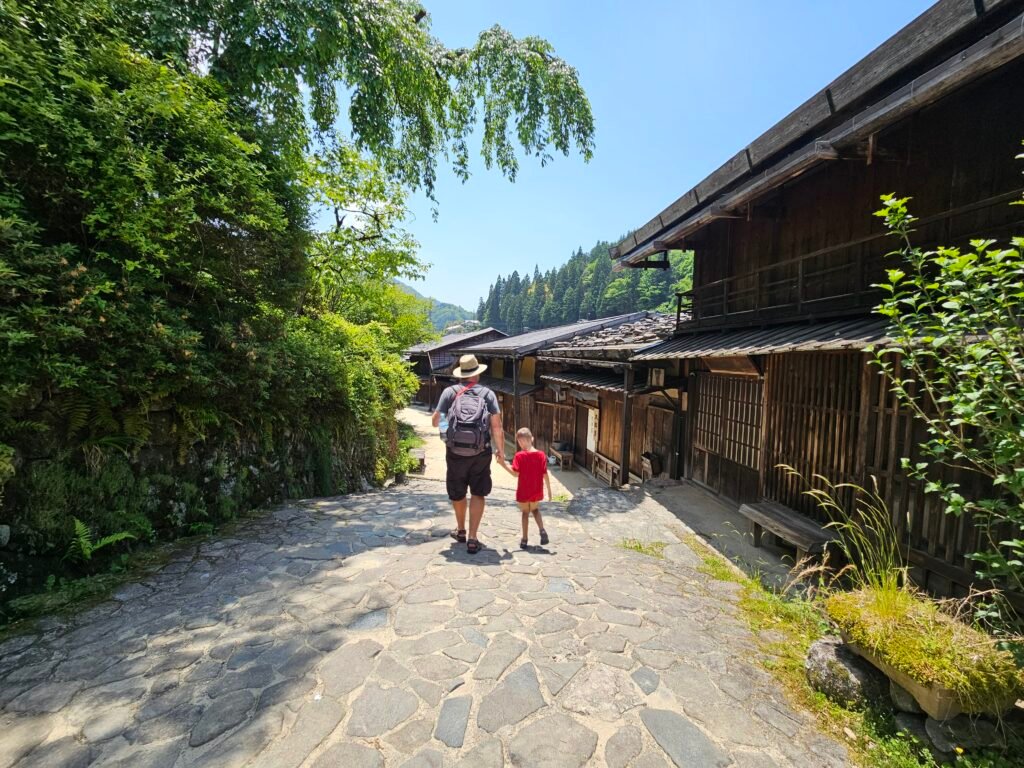
Most of the old highway has since disappeared under railways and modern roads. The section between Tsumago and Magome survived, with stone paving, forest paths and rows of wooden inns and shops. That’s why it’s now the most popular stretch to walk, and the easiest one to do with children.

How to Get to Tsumago and Magome From Tokyo or Kyoto
Neither town has a train station. Tsumago’s nearest station is Nagiso, and Magome’s is Nakatsugawa. Both are on the JR Chuo Line, which runs from Nagoya up through the Kiso Valley. From either station, you finish the journey by local bus.
From Tokyo: our travel day, step by step
We did everything in one day: trains from Tokyo in the morning, the hike in the middle of the day and dinner at our ryokan in Magome that evening. Here’s exactly how it worked.
🚆 Shinjuku to Tokyo Station: Our suitcases had already gone ahead to Kyoto, so we left our Shinjuku hotel early with a small overnight bag and our daypacks. The JR Chuo Line takes about 15 minutes.
🚄 Tokyo to Nagoya by Shinkansen: The Tokaido Shinkansen takes about 1 hour 40 minutes. Book this leg ahead so you can sit together. Long train days are when our favourite travel games come out.
🚃 Nagoya to Nagiso: The Shinano limited express takes about an hour, but only some Shinano trains stop at Nagiso. If yours doesn’t, ride it to Nakatsugawa (about 50 minutes) and change to a local train for the short hop to Nagiso. Check this connection before you leave Tokyo.
🚌 Nagiso to Tsumago by bus: The Ontake Kotsu bus takes about 7 minutes and costs ¥300 (about $2). On the current timetable, morning buses leave Nagiso Station at 8:40, 10:10, 10:30, 11:15, 12:10 and 12:40. Plan your trains around the bus, not the other way round.
How long it takes: allow around four hours from Shinjuku to Tsumago. Leaving Tokyo by about 7:30 AM puts you on the trail by late morning, with plenty of time to reach Magome before ryokan check-in closes.
From Kyoto
Take the Tokaido Shinkansen to Nagoya (35 to 45 minutes), then follow the same route as from Tokyo.

How to get to Magome from Tokyo (if you’re starting there)
If you’d rather walk Magome to Tsumago, get off the Shinano at Nakatsugawa. From there, the Kitaena bus to Magome leaves from stop 3 outside the station. It takes about 25 minutes and costs ¥800 (about $5). Buses run roughly hourly, with daily departures from 9:10 AM to 4:15 PM on the current timetable.
Is it covered by the Japan Rail Pass?
The JR trains on this route are covered by the pass. The local buses to Tsumago and Magome are not. We bought individual tickets, because a rail pass didn’t make sense for the trips we were doing.
Rural buses run nothing like the frequency of Tokyo’s trains, so always check the latest timetables before you travel. The Nagiso Tourism Association has English bus and train times, and JR Central has Shinkansen and Shinano information.
What to Do With Your Luggage
One thing made the whole Nakasendo day easier: we didn’t take our suitcases with us. You have two good options, depending on your route.
Option 1: send it ahead to your next hotel (what we did)
Before leaving Tokyo, we took our bags to a Yamato Transport counter in Shinjuku and sent them straight to our hotel in Kyoto. It cost us about $55 for two large suitcases and one small one in 2023. We set off carrying only what we needed for the hike and one night in Magome.
There was no way I’d have wanted to drag full luggage through the Kiso Valley with a seven-year-old. Arriving in Kyoto to find our suitcases already waiting felt like magic.
Yamato has several counters around Shinjuku. Send bags at least two days before you check in, and ask your hotel to confirm it will accept them.
Option 2: Nakasendo luggage forwarding between the two towns
If you’re doing the walk as a day trip, or staying in one town and walking from the other, the tourist information centres in Tsumago and Magome will move your bags for you. You don’t need to book ahead.
- 💰 Price: ¥1,000 (about $6) per bag
- 🕘 Drop off: 8:30 to 11:30 AM at the tourist information centre in your starting town
- 🕐 Pick up: 1:00 to 5:00 PM at the centre in the other town
- 📅 Season: 20 March to 30 November
Check the latest details with Go Nagano or the Tsumago tourist office before you go.
Family travel tip: the 11:30 AM drop-off is tight if you’re coming from Tokyo on the same day. If you’re combining the Nakasendo with Tokyo and Kyoto, forwarding your main bags to your next hotel is much simpler. And if you want to travel lighter in general, here’s how we pack for long-term family travel.
Hiking Tsumago to Magome With a 7-Year-Old
Most guides recommend walking from Magome to Tsumago, because it involves a little less uphill. We knew that and went the other way anyway. We wanted to end the day at Tajimaya in Magome, so finishing there made more sense for our itinerary.
My advice is to look at your whole plan rather than automatically picking the “easier” direction. If you’re staying in Tsumago, start in Magome. If you’re staying in Magome, Tsumago to Magome works perfectly well.
We walked in May, and the weather was perfect for hiking: warm, dry and neither too hot nor cold. The trail wasn’t busy at all. We met a few other walkers along the way, but it never felt crowded.
Our son managed it easily. He’d done a few long hikes before and walks a lot in general, which helped. But what stood out was how much he enjoyed it. He loved the views, the atmosphere, the traditional Japanese houses, chatting to other hikers and stopping for tea. He wasn’t bored for a single minute.
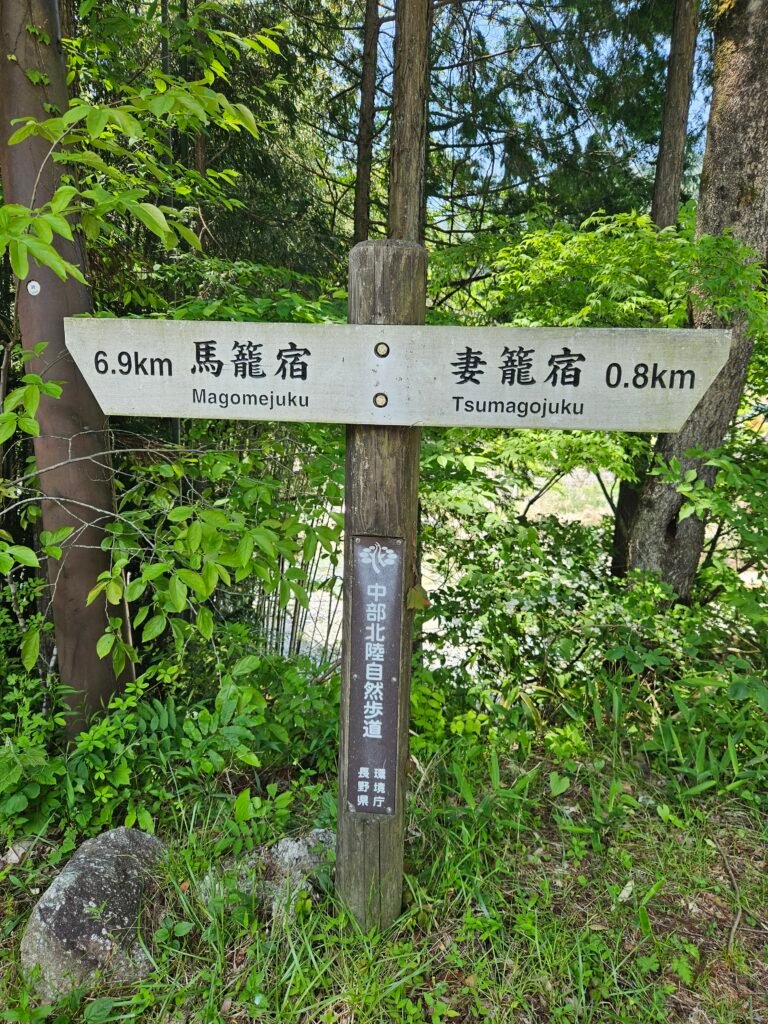
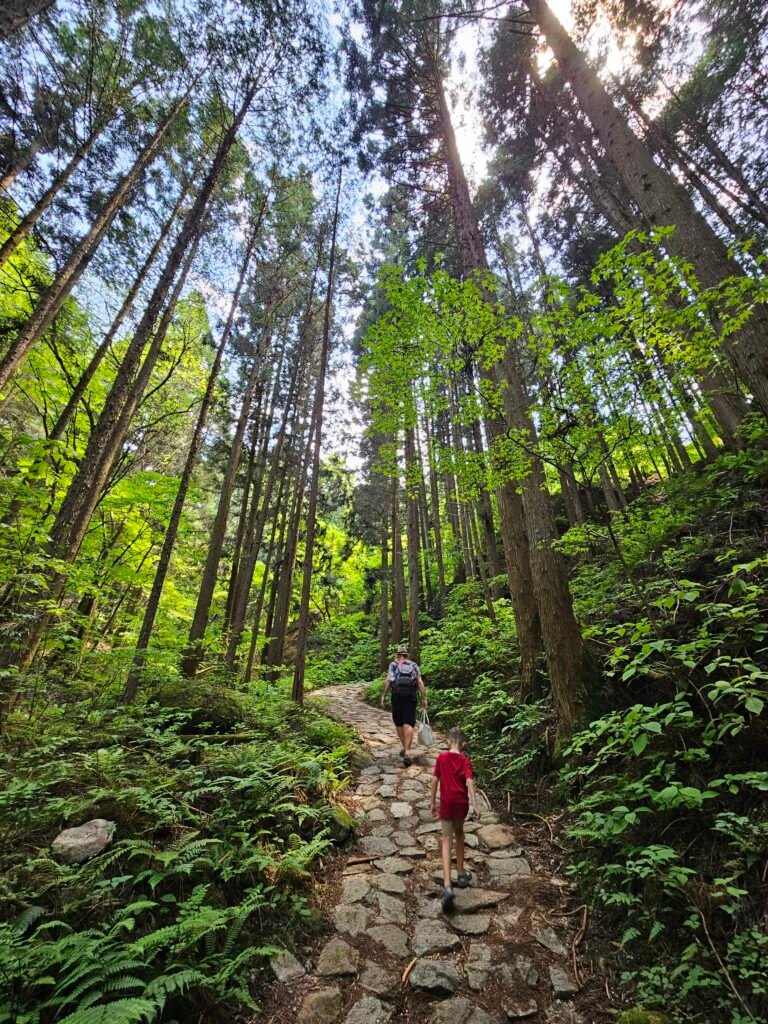
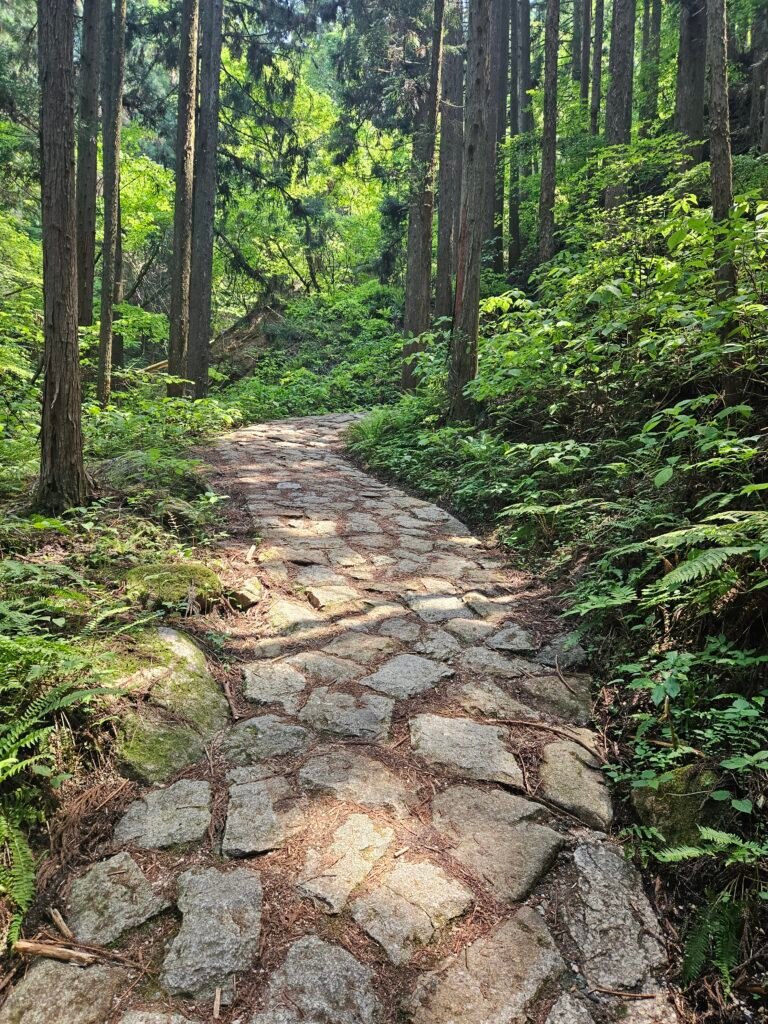
We set off just before midday and walked into Magome at around 4 PM. That’s about four hours at a very leisurely pace, with lunch, photos and tea along the way. The trail is well signposted in English and Japanese. It mixes forest paths, unpaved sections, old stone paving and short stretches beside quiet roads.

Starting in Tsumago
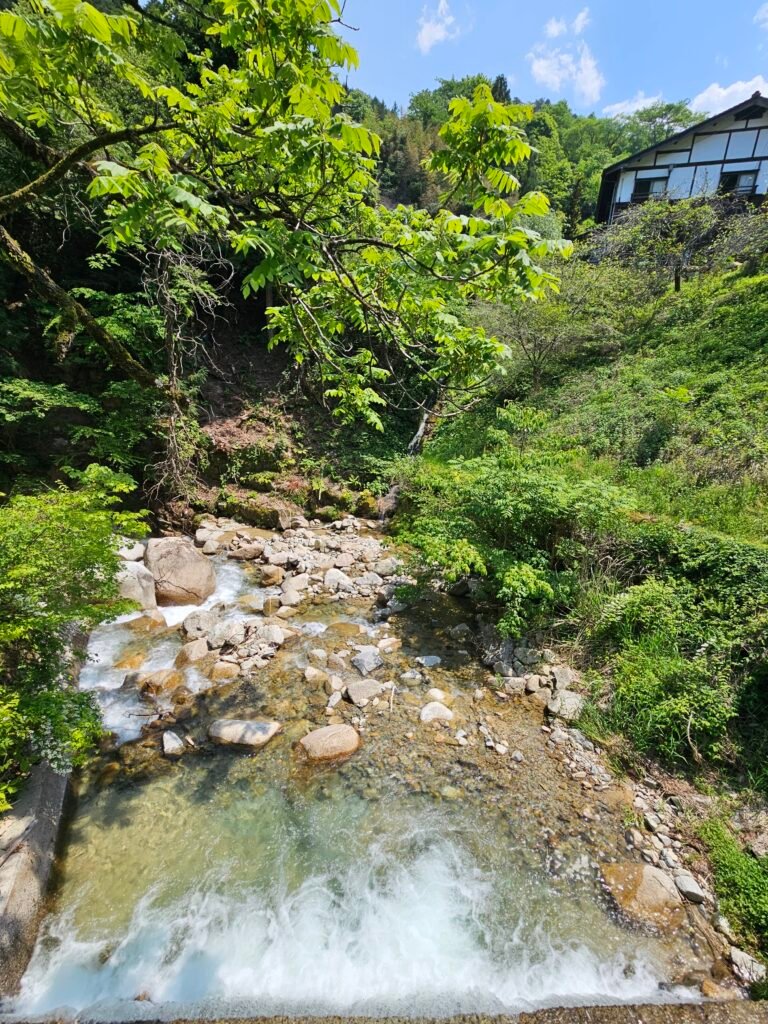
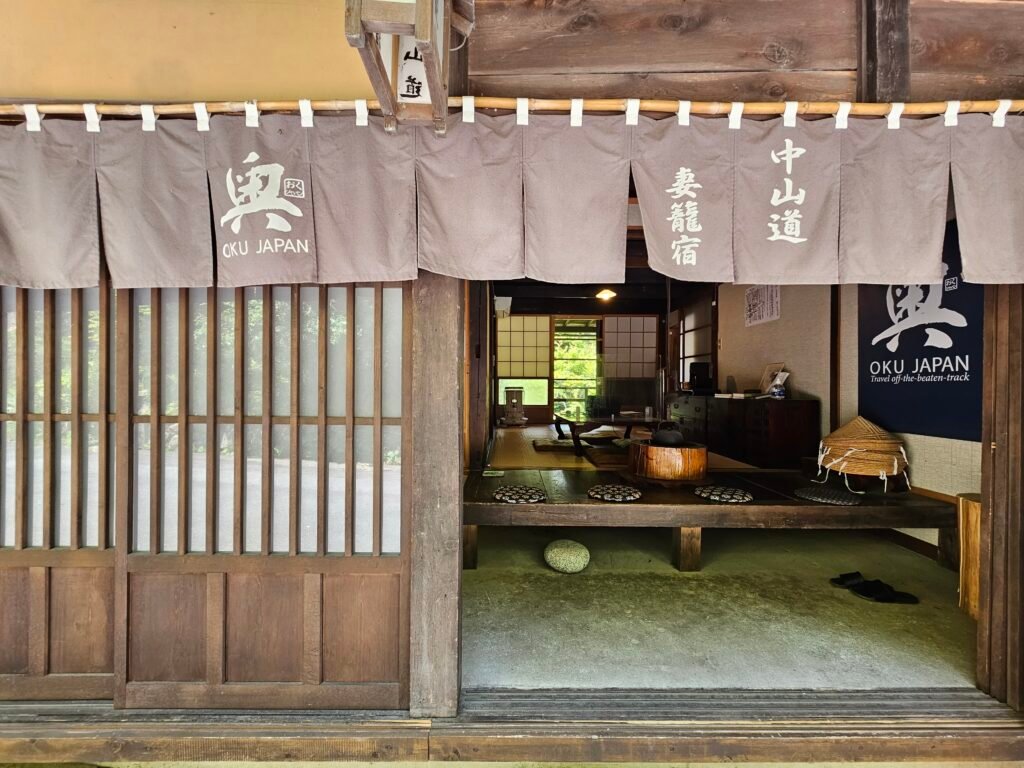
Tsumago is one of the best-preserved post towns in Japan, and it’s worth walking the whole main street before you set off. We wandered through the town and sat down at a café for a drink before starting the hike. It’s a nice way to ease a child into a long walk.
Ringing the bear bells
Along the forested stretches, you’ll find bells hanging beside the trail. Asian black bears live in the Kiso Valley, and the bells are there so walkers can make noise and avoid surprising one. Our son loved ringing every bell we passed. It turned into a game that kept him going between stops.
We didn’t see any bears, and most walkers never do. Still, it’s sensible to follow the local advice:
- Ring the bells, talk and walk together as a group.
- Take extra care early in the morning, in the evening and on rainy days.
- If you see a bear, never approach it. Leave the area calmly and quietly.
- Ask at the tourist information centre about recent sightings before you start.


The Odaki and Medaki waterfalls
In the first half of the walk from Tsumago, the trail passes two waterfalls side by side. Odaki, the “male” waterfall, is the taller one. Medaki, the “female” waterfall, is the smaller one beside it. Official signs sometimes spell them Otaki and Metaki.
There’s a great story here for kids. In Musashi, a classic samurai novel by Yoshikawa Eiji, the hero stands under the male waterfall to clear his head and focus on his sword training.


Free tea at the old Tateba rest house
Roughly halfway along the trail is the Tateba tea house (Ichikokutochi Tateba Chaya), a traditional old house with an irori fire pit inside. Staff serve Japanese tea to walkers for free, and visitors are encouraged to leave a donation.
This was one of our favourite stops. We sat down inside, drank our tea and ate the packed lunch we’d brought with us. Our son loved it, and so did we.
Climbing to Magome Pass
Walking this direction, the main climb comes after the tea house. The trail rises to Magome Pass (Magome-toge), the highest point of the walk at around 800 m. From the pass, it’s mostly downhill into Magome. There was some uphill walking, but nothing our seven-year-old struggled with.


Arriving in Magome
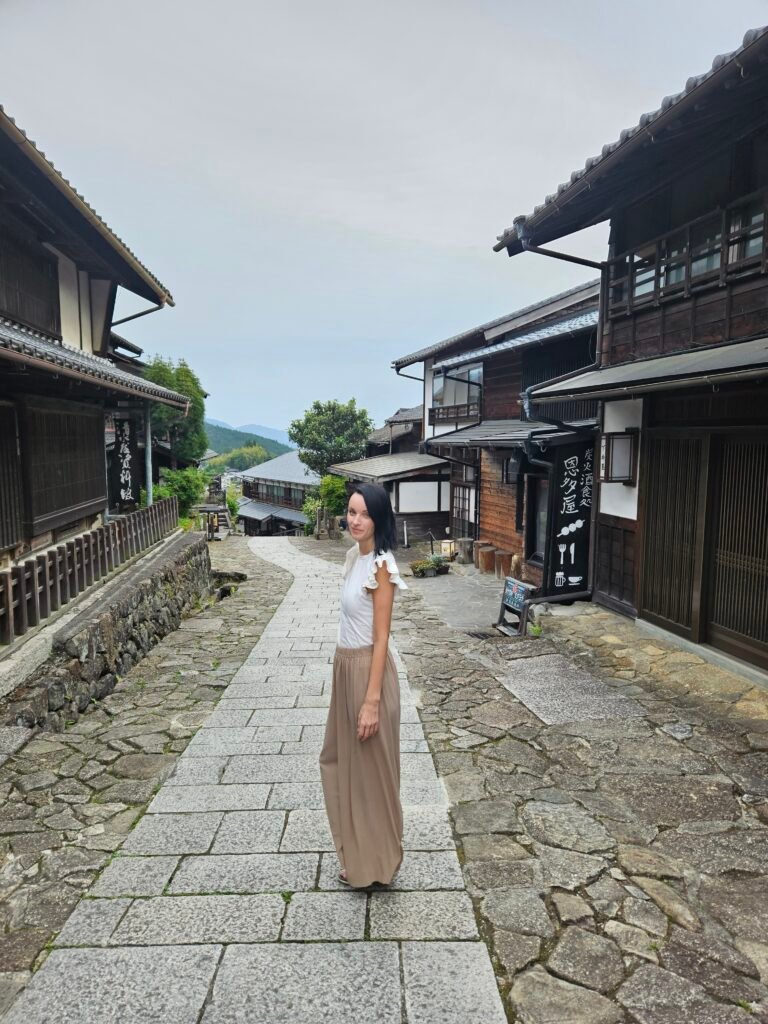
Magome sits on a steep hillside, with a stone-paved main street lined with wooden shops and inns. We arrived in the late afternoon, which was perfect timing. Tajimaya’s check-in runs from 3 PM to 6 PM, so we had time to settle in before dinner.
Food, Snacks and Toilets on the Trail
This is the practical tip I’d repeat to any family: bring plenty of food, water and snacks.
Both Tsumago and Magome have cafés and restaurants, but there’s very little to buy along the trail itself. The tea house serves free tea, not proper meals. We packed our own lunch and ate it at the tea house, which worked brilliantly. Pick up food before you leave the city, as there are no convenience stores on the trail.
Toilets were less of a worry than we expected. There are public toilets at points along the route and in both post towns. You’re walking past fields and houses for much of the way, not heading into remote wilderness.
Strollers, Carriers and What to Wear
Leave the stroller behind. Most of the route is easy walking, but the uneven forest paths and old stone paving would turn a buggy into a burden. If your child is too young to walk 8 km, a baby or toddler carrier is the realistic option. Our son walked the whole way, so we didn’t need one.
You don’t need serious hiking gear for this walk. Here’s what we’d pack:
- Comfortable walking shoes with good grip, as the stone paving gets slippery when wet
- A light rain jacket for everyone
- Layers you can take off for the climb
- Water bottles, a packed lunch and snacks
- Small daypacks, with an overnight bag if you’re staying in Magome or Tsumago
Staying at Tajimaya Ryokan in Magome
One of the main reasons we walked from Tsumago to Magome was to finish at Tajimaya Ryokan. I’m so glad we did. Tajimaya wasn’t just somewhere to sleep after the hike. It was part of the experience we’d come to Japan for.
The family room
We stayed in the family room, which was the only room type with its own toilet. Like the other rooms, it has tatami floors, and you sleep on futons laid out on the floor. I’d expected futons to look charming but feel less comfortable than a bed. I was wrong: we all slept really well.
The room also came with yukata, light cotton robes to wear around the ryokan. Changing out of hiking clothes and into yukata before dinner made the evening feel completely different from our hotel nights in Tokyo.
Dinner and breakfast
Dinner was a highlight. Instead of one main course, we sat down to lots of small, beautifully presented dishes: seasonal vegetables, pickles, tofu, sashimi, rice, soup and grilled fish. It all tasted amazing.
Our son skipped some pickled fish, but with so many little plates to choose from, he easily found plenty he liked. For families with fussy eaters, that variety is a real plus.
After dinner, there was a performance of Kiso-bushi, the traditional folk song of the Kiso region. Breakfast the next morning was another traditional Japanese spread.



The bath and bathroom
Tajimaya has a traditional shared bath (onsen) rather than showers in each room. Our family room had a private toilet but no shower, so we used the ryokan’s bath. The onsen had a shower too. You can book the bath for a set time, which gives your family complete privacy. After walking the Nakasendo all afternoon, it was exactly what we wanted.
Read the room descriptions carefully when you book. The standard rooms don’t have a private toilet, so the family room is the one to choose if that matters to you.
💰 What we paid: €152 (about $165) for one night for the three of us in 2023, including dinner and breakfast
🕘 Check-in: 3:00 to 6:00 PM
Check-out: 10:00 AM
Dinner: 6:00 PM
Breakfast: 7:30 AM
Our verdict
The food, the room and the atmosphere were all great, and we’d 100% stay at Tajimaya again. It’s not the cheapest option, though, and the family room often sells out, so book early. If it’s full or over budget, Magome Chaya is a simpler guesthouse in the centre of Magome with triple and quad rooms. Near Tsumago, Hotel Fuki no Mori has hot spring baths and triple rooms. It’s about 15 minutes’ drive from Tsumago and offers free pickup from Nagiso Station. If you base yourself there, start your walk in Magome and finish in Tsumago instead.

Getting On From Magome
The next morning, we caught the bus to Nakatsugawa just after breakfast, at about 10 AM. The Kitaena bus takes about 25 minutes and costs ¥800 (about $5). From Nakatsugawa, we took a JR train to Nagoya and then the Shinkansen to Kyoto, where our suitcases were waiting.
On the current timetable, buses from Magome to Nakatsugawa run daily at 9:45 and 10:30 AM, then roughly hourly until 6:15 PM. The Shinano to Nagoya takes about 50 minutes.
If you finish in Tsumago instead, take the Ontake Kotsu bus back to Nagiso Station (¥300, under 10 minutes) and pick up a JR train towards Nagoya. Check the bus and train times together, because a missed bus can mean a long wait.
Best Time to Hike the Nakasendo With Kids
We hiked in May, and we couldn’t have asked for better conditions. It was warm and dry, and the trail was quiet. Spring and autumn are the most comfortable seasons for walking with children.
- 🌸 Spring (late March to May): mild walking weather, and the luggage service is running. Avoid Golden Week, roughly 29 April to 5 May, when Japanese families travel too.
- ☀️ Summer (June to August): June and July bring the rainy season, and midsummer is hot and humid. Start early if you walk then.
- 🍁 Autumn (October to November): cooler days and autumn colours. The luggage service stops after 30 November.
- ❄️ Winter (December to February): snow and ice can make the trail slippery, and some guided hikes don’t run. We’d skip it with young kids.
Before you go: getting kids excited about Japan
Kids get so much more out of a samurai road when they already know a little about samurai, post towns and old Japan. We created a printable Japan Explorer Activity Book for children aged 7 to 11. It covers Japanese culture, geography, food and a few simple phrases, with origami, haiku and drawing activities. It also includes a treasure hunt with explorer missions to complete in Japan, which makes long train days far more fun. It’s an instant PDF download from our Etsy shop, so you can print it at home before you fly.
Nakasendo Trail FAQ
Can kids hike from Magome to Tsumago?
Yes. The 8 km trail is easy to moderate and well signposted, with one main climb to Magome Pass. School-age children who are used to walking can usually manage it. Our seven-year-old found it easy and loved it.
How long does the Magome to Tsumago hike take?
The walking itself takes about 2.5 to 3 hours. With children, allow three to four hours. It took us about four hours with a lunch stop, tea and lots of photos.
Is there Nakasendo luggage forwarding between Magome and Tsumago?
Yes. From 20 March to 30 November, the tourist information centres move bags between the towns for ¥1,000 per bag. Drop off between 8:30 and 11:30 AM, then collect from 1:00 to 5:00 PM in the other town.
How do you get to Magome from Tokyo?
Take the Shinkansen from Tokyo to Nagoya, then the Shinano limited express to Nakatsugawa. From Nakatsugawa Station, the Kitaena bus reaches Magome in about 25 minutes for ¥800. Allow around four hours in total.
Is Tajimaya ryokan in Magome good for families?
We think so. Book the family room, which has its own toilet, and reserve a private time for the shared bath. Dinner has lots of small dishes, so even picky eaters find something. We paid €152 (about $165) for the three of us in 2023, with dinner and breakfast included.
Are there bears on the Nakasendo Trail?
Asian black bears live in the Kiso Valley, and there are occasional sightings near the trail. Bells hang along the forest sections so walkers can make noise. Walk together, ring the bells and ask the tourist office about recent sightings.
Is the Nakasendo Worth It With Kids?
Absolutely. Walking from Tsumago to Magome with our son was one of our favourite days in Japan, and we wouldn’t change a thing. After five days in Tokyo, the forest, the waterfalls, the tea house and a night in a family-run ryokan felt like a different world.
If you’re planning a wider trip, see how the Nakasendo fits between Tokyo and Kyoto in our 12-day Japan itinerary with kids.