

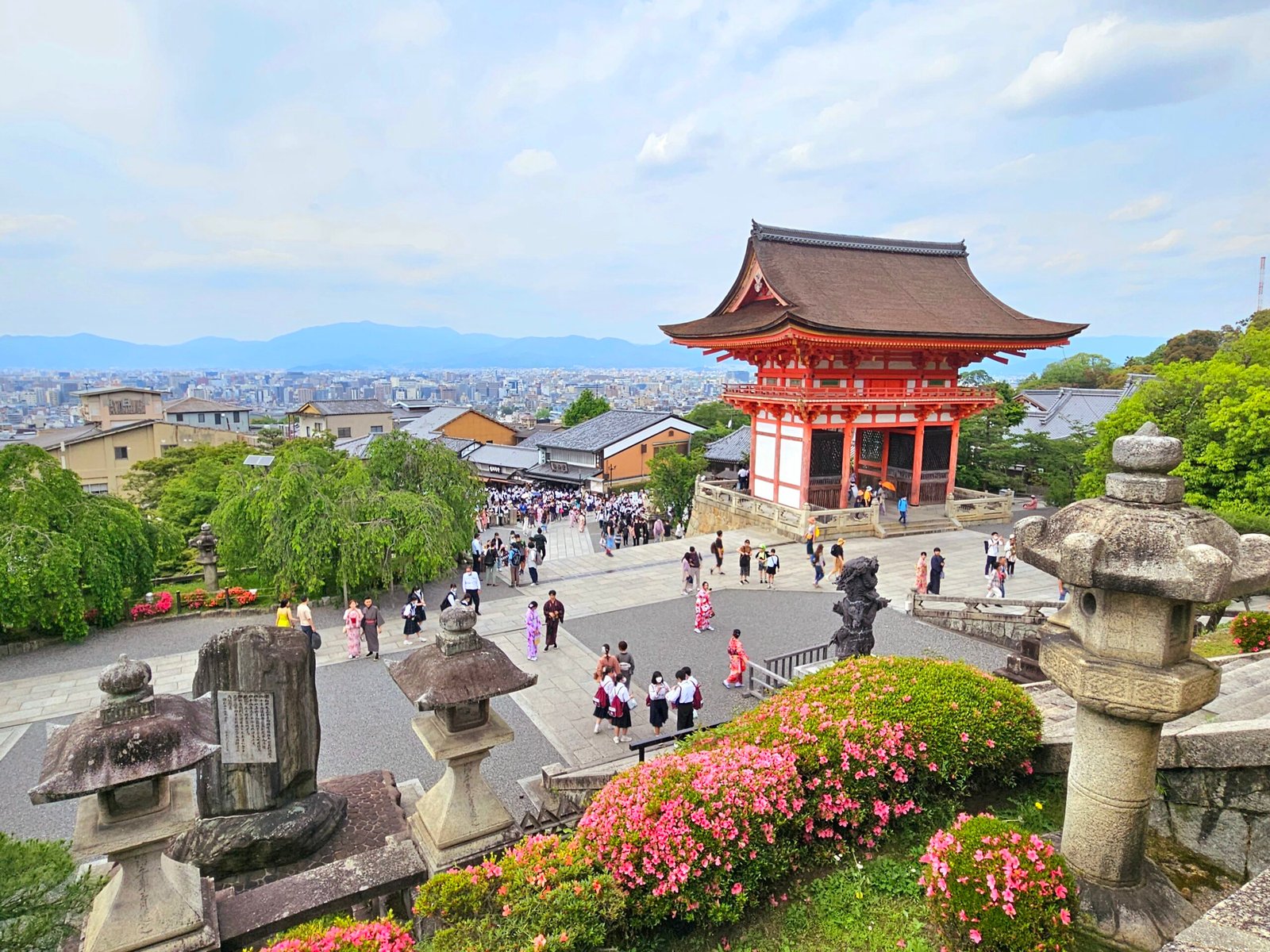
12 Days in Japan With a 7-Year-Old: Tokyo, the Nakasendo Trail & Kyoto
Japan had been on our list for many, many years. It was one of those countries we’d talked about visiting countless times, always imagining what it would be like to finally experience it together as a family. By the time we made it there, our son was seven, and we were excited to introduce him to a country that felt so different from anywhere we’d travelled before. This is exactly how we spent our 12 days in Japan, and what we’d tell any family with kids planning the same route.
There was a temptation, of course, to try to fit as much as possible into our 12 days. Japan has so many places we’d wanted to see that it would have been very easy to create an itinerary that had us changing hotels every couple of nights and ticking destinations off a list.
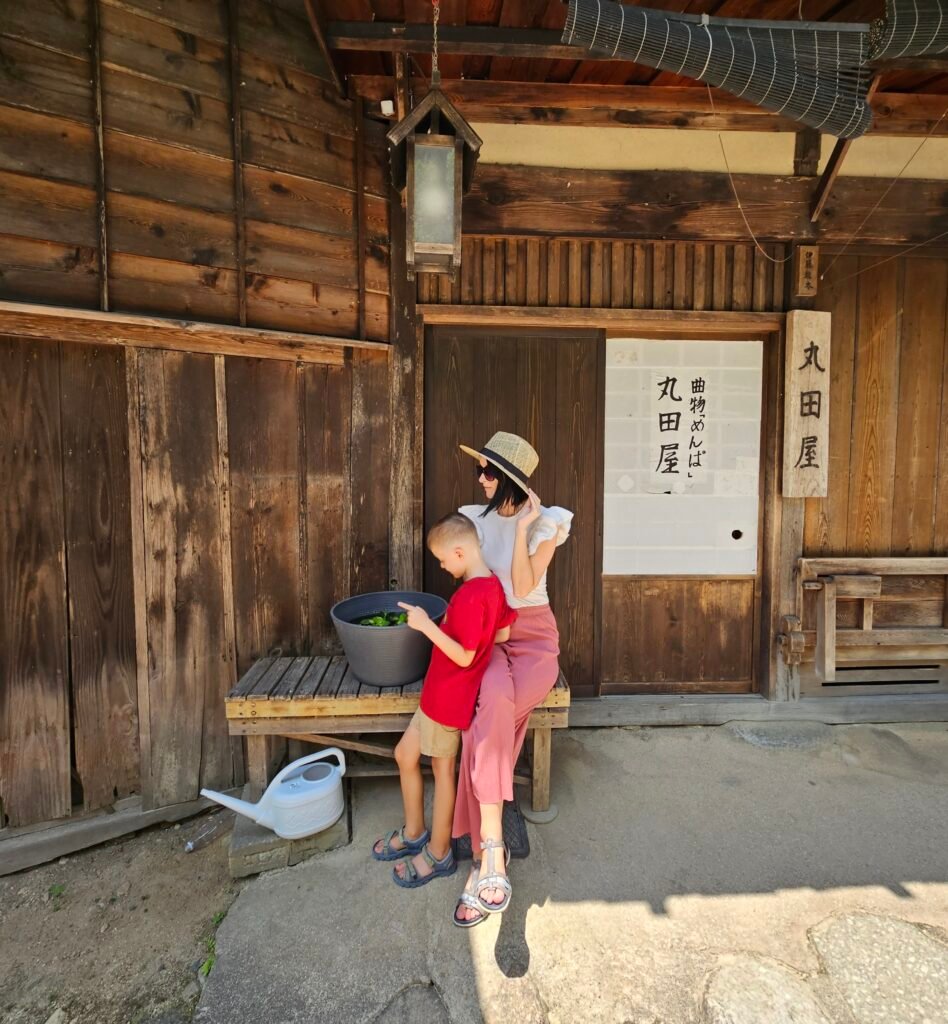
Instead, we decided to slow things down a little. We spent five days in Tokyo, headed into the Kiso Valley to walk part of the historic Nakasendo Trail, stayed overnight in the beautiful little post town of Magome, and then continued on to Kyoto, where we spent another five days.
Planning a Trip to Japan soon?
🏨 Hotels we recommend for this itinerary: Booking.com or Agoda.com
- JR Kyushu Hotel Blossom Shinjuku (Tokyo – Mid-Range) 👍 Top Pick
- Tajimaya Ryokan (Magome – Traditional Ryokan)
- Gion Misen Furumonzen (Kyoto – Boutique/Mid-Range)
🎎 Tours & Experiences: GetYourGuide and Viator
- Mt. Fuji & Lake Kawaguchi Small Group Tour (Tokyo, 10 hours) 🗻 Our Pick
- Kimono Rental + Tea Ceremony (Kyoto, approx. 1.5–3 hours) 👘
- Arashiyama, Nara and Fushimi Inari Tour (Kyoto, 10 hours) 🐒
- Samurai & Ninja Experience (Kyoto, guided + hands-on) ⚔️
📱 eSIM: Nomad or Airalo (compare them in our eSIM guide)
🏷️ Airalo discount: New customers get 15% off with code NEWTOAIRALO15 (valid until December 31, 2026)
🩺 Travel Insurance: Genki Traveler or SafetyWing Nomad Insurance (compare them in our insurance guide)
📚 For kids: Japan Explorer Activity Book (printable, ages 7–11)
Our 12-Day Japan Itinerary at a Glance
| Stop | Time | What we did |
|---|---|---|
| Tokyo | 5 days | teamLab, Senso-ji, Meiji Shrine, Kusama Museum, Harajuku, Ninja restaurant, Mount Fuji/Oshino Hakkai day trip |
| Kiso Valley / Nakasendo | 2 days | Tsumago, Nakasendo hike, Magome, Tajimaya Ryokan |
| Kyoto | 5 days | Temples, Gion, Fushimi Inari, Nijo Castle, Arashiyama, Nara, tea ceremony, kimono, museums |
| Departure | Day 12 | Shinkansen to Shin-Osaka, then the Haruka express to Kansai Airport |
The route gave us 12 days in Japan with kids using just three bases: one hotel in Tokyo, one night in a ryokan in Magome and one hotel in Kyoto.

Best Time to Visit Japan With Kids
We travelled in May, and it’s hard to beat for a trip like this. The weather was comfortable for long days of walking, which matters when your itinerary includes a mountain trail, hillside temples and a lot of time on foot in Tokyo and Kyoto.
Here’s how the seasons compare for a family trip:
🌸 Spring (March to May): Mild temperatures and cherry blossom season, which usually peaks in Tokyo and Kyoto from late March to early April. It’s beautiful, but it’s also the busiest and most expensive time of year, so book accommodation early. Avoid Golden Week (roughly 29 April to 5 May), when Japanese families travel too and trains and sights get very crowded.
☀️ Summer (June to August): June into July is the rainy season, and July and August are hot and very humid, which makes long walking days hard work with children. On the plus side, it lines up with most school holidays.
🍁 Autumn (September to November): A great alternative to spring. Temperatures ease off from October, and the autumn colours in Kyoto (usually mid to late November) are spectacular, though Kyoto gets very busy then. Early autumn can still bring typhoons.
❄️ Winter (December to February): Cold, but often dry and clear, and it’s the best season for Mount Fuji views. Crowds are lighter outside the New Year period. The Kiso Valley can get snow and ice, so the Nakasendo walk is less appealing in the depths of winter.
Our advice: if you’re planning 12 days in Japan with kids and can travel outside school holidays, aim for spring (avoiding peak blossom week and Golden Week) or October to November.
Before you go: getting kids excited about Japan
Kids get so much more out of temples, shrines and bullet trains when they already know a little about them. We’ve created a printable Japan Explorer Activity Book for children aged 7 to 11, covering Japanese culture, geography, food and a few simple phrases, with origami, haiku and drawing activities along the way. It also includes a treasure hunt with explorer missions to complete while you’re in Japan, which makes long train rides and temple visits a bit more interactive. It’s an instant PDF download from our Etsy shop, so you can print it at home before you fly.
5 Days in Tokyo With a 7-Year-Old
We based ourselves in Shinjuku, which worked well for us because Tokyo’s public transport network made it relatively straightforward to get around the city and take day trips.
Tokyo is enormous, and five days was barely enough to scratch the surface! We never felt as though we were struggling to fill the time.
In fact, having several days meant we could mix the big attractions with slower walks through neighbourhoods instead of trying to tick off five major sights every day.
Getting From the Airport to Shinjuku
We stayed in Shinjuku and chose a hotel within walking distance of Shinjuku Station, so we could take the train straight from the airport instead of paying $100 or more for a taxi. After a long flight with a tired seven-year-old and luggage, that small decision made a big difference.
Shinjuku Station is enormous, so check the exact exit and walking route when booking, rather than trusting a hotel that just says “near Shinjuku.”
From Narita Airport
Take the Narita Express (N’EX). Direct services run to Shinjuku, so there’s no need to change trains, and there’s dedicated luggage space on board.
🕘 Journey Time: About 80–90 minutes.
💰 Train Fare: ¥3,330 one way for adults; children aged 6–11 pay half. The N’EX TOKYO Round Trip Ticket (¥5,200 adults, ¥2,600 children) is better value if you’re flying home from Narita too.
From Haneda Airport
Haneda is much closer to the city. The cheapest and quickest option is the Keikyu Line to Shinagawa, then the JR Yamanote Line to Shinjuku. If you’d rather avoid changing trains with luggage and kids, the Airport Limousine Bus goes direct to Shinjuku Station and several Shinjuku hotels.
🕘 Journey Time: About 45 minutes by train; 45–80 minutes by bus, depending on traffic.
💰 Fare: About ¥590 per adult by train. The Limousine Bus is ¥1,400 for adults and ¥700 for children.
teamLab Planets
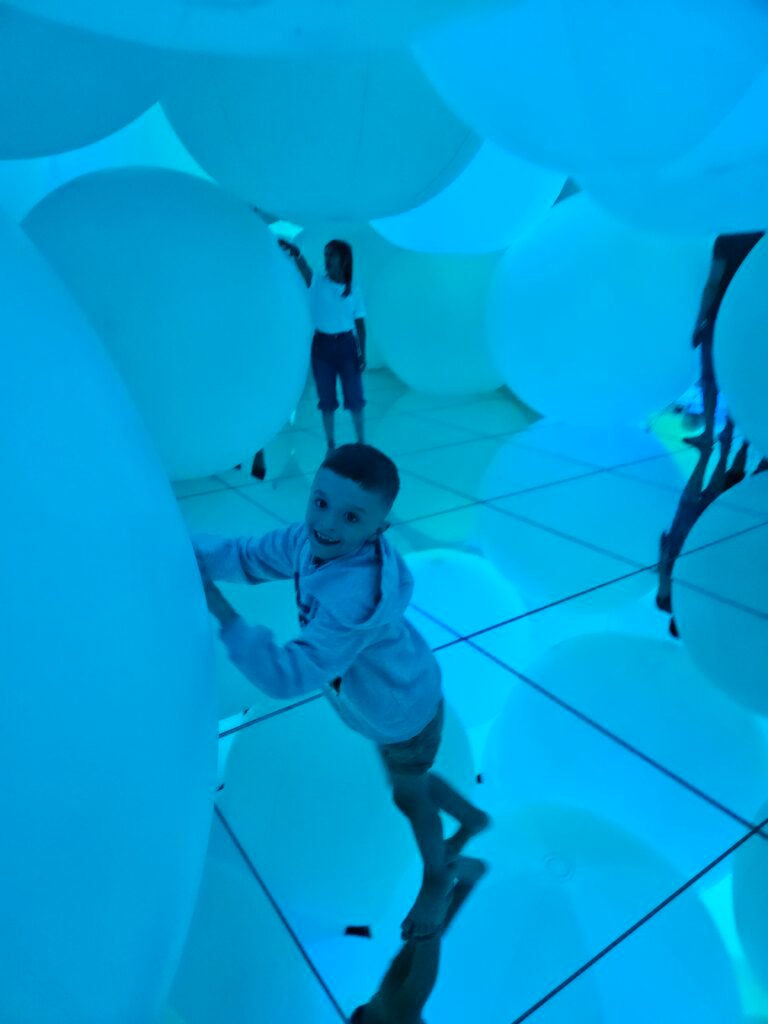
One of the absolute highlights of our time in Tokyo was teamLab Planets. We weren’t quite sure what to expect, but it turned out to be every bit as impressive as we’d hoped. Rather than simply looking at digital artwork, you actually move through the installations, surrounded by light, sound, projections and reflections.
Our favourite parts included the room where flowers seemed to fall all around you, constantly changing across the walls and floor, and the enormous glowing spheres that made the whole space feel wonderfully strange and otherworldly. Our seven-year-old loved exploring the different rooms and never seemed to get bored.
One thing to know before you go: you actually walk through shallow water in some parts of the exhibition, barefoot. The water can reach quite high (up to knee level for adults, and higher for younger kids), so wear clothes that can easily be rolled up and bring a change of clothes for children. Towels are provided at the site.
The individual installations can change over time, so some of what we saw may not be there when you visit. That’s worth keeping in mind when looking at older photos or reviews.
I’d allow at least two hours for the experience rather than trying to squeeze it into a quick visit.
🕘 Opening Hours: Hours vary by date; check the official calendar when booking.
💰 Entry Fee: Prices vary by date and ticket type. Advance timed tickets are required.
Getting there: teamLab Planets is in Toyosu, next to Shin-Toyosu Station on the Yurikamome Line.
For us, this was absolutely worth the money and one of the experiences we’d particularly recommend for families with school-age children.
🎟️ Book in advance: teamLab Planets tickets are sold for timed entry slots and they sell out fast, so reserve your date as soon as your Tokyo dates are fixed.


Senso-ji and Asakusa
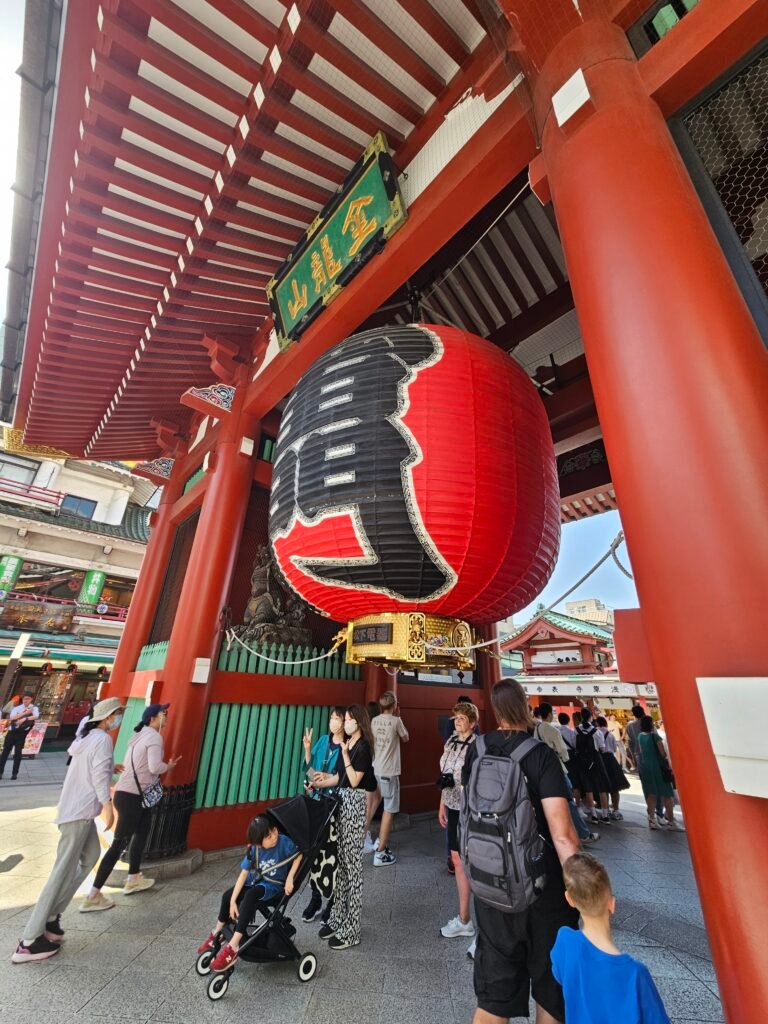
Senso-ji was one of those places where we knew we were going to encounter crowds, and we certainly did. Even so, we really enjoyed exploring Asakusa, partly because there is much more to the area than the temple itself.
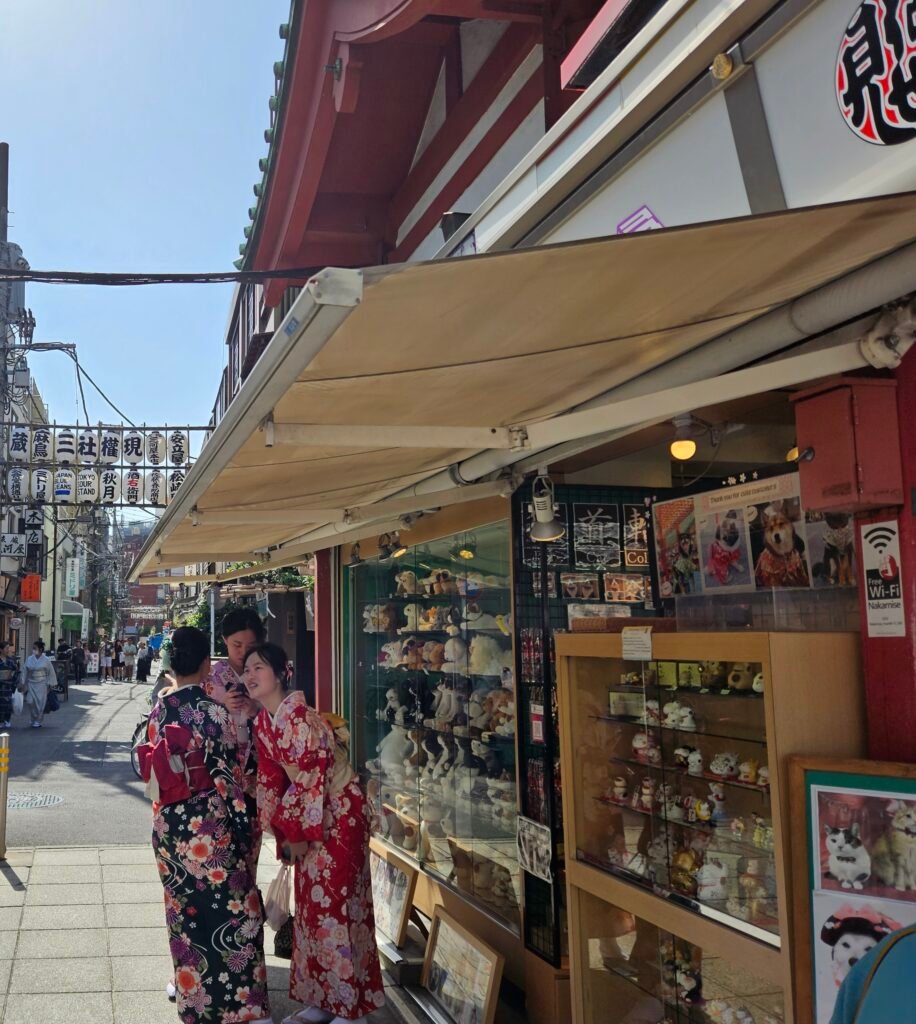
Senso-ji is Tokyo’s oldest temple, dating back to the 7th century, and the enormous red Kaminarimon (Thunder Gate) with its giant lantern has become one of the city’s most recognisable sights. From there, you walk along Nakamise-dori, a lively shopping street lined with traditional snacks, sweets, souvenirs and crafts, before reaching the main temple complex.
For us, Nakamise-dori was actually a big part of the fun with a child. There were plenty of things to look at and, naturally, plenty of opportunities for snacks! Beyond the main temple, there are also smaller halls, a five-storey pagoda and the purification fountain, where visitors traditionally cleanse themselves before praying.
It was very busy when we visited, so if you want to experience Senso-ji with fewer people around, I’d recommend going early.
🕘 Opening Hours: Main hall 6:00 AM–5:00 PM; from October to March, it opens at 6:30 AM.
💰 Entry Fee: Free.
Getting there: Senso-ji is about a five-minute walk from Asakusa Station on the Tokyo Metro Ginza Line, Toei Asakusa Line, Tobu Skytree Line or Tsukuba Express.
I’d allow at least 2–3 hours for Senso-ji and Asakusa, especially if you’re travelling with children and want time to browse the shops and try some of the food rather than rushing straight through the temple complex.

Meiji Shrine
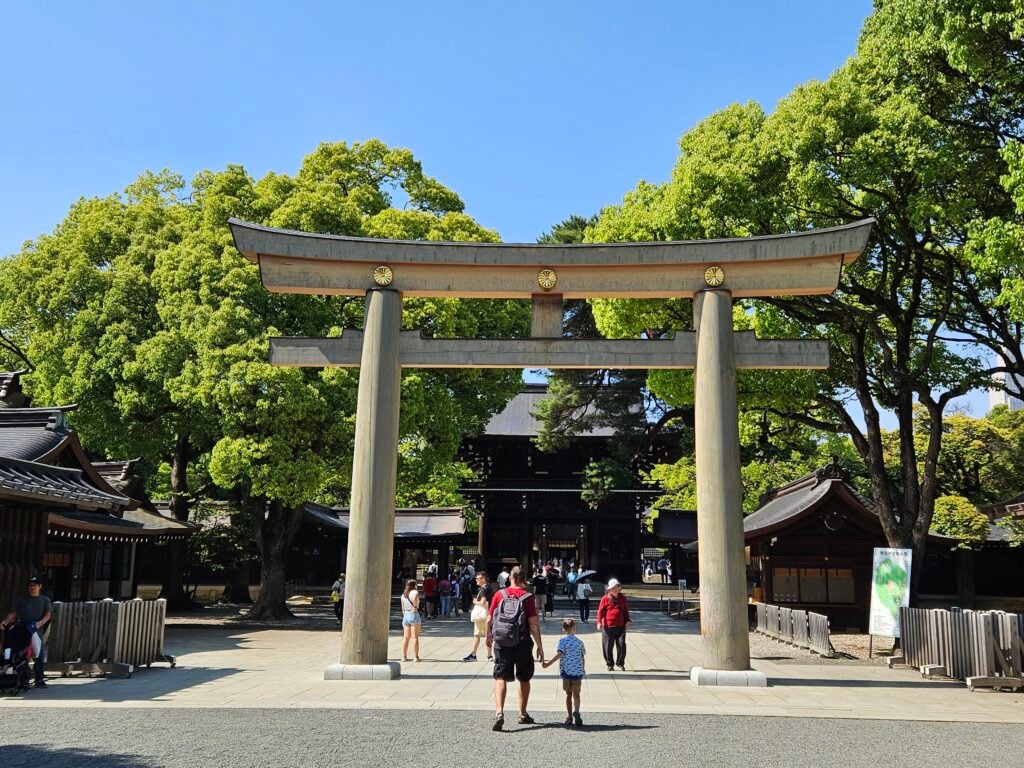
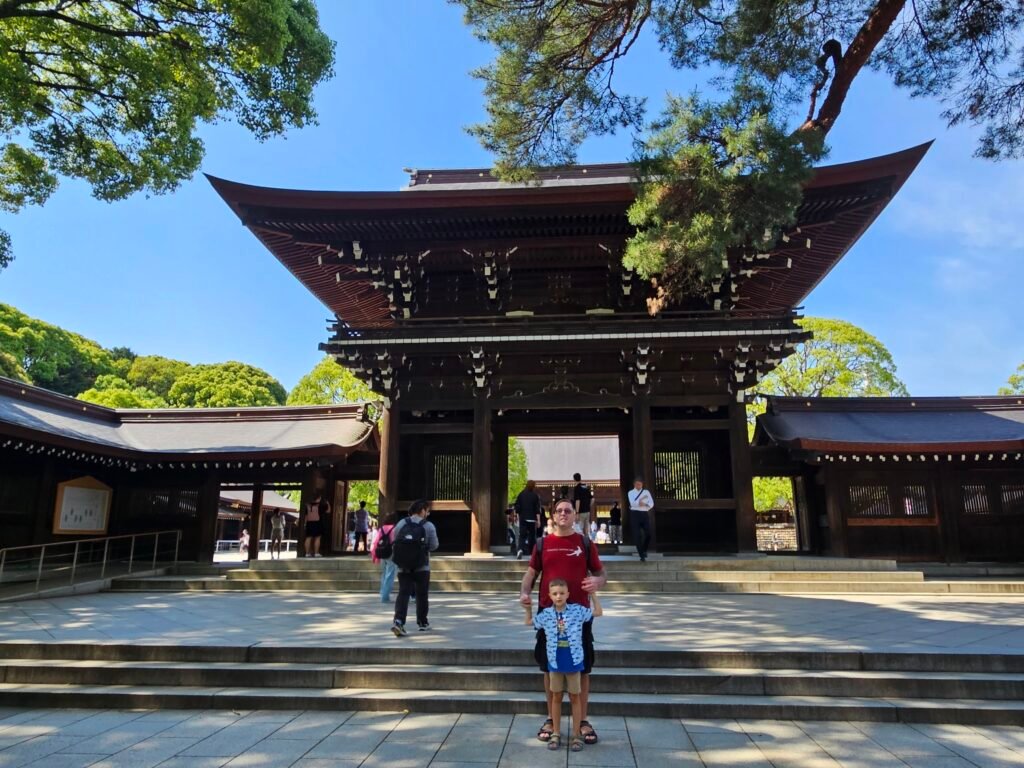
Meiji Shrine was one of the places in Tokyo where we really noticed how different the atmosphere could feel just a few minutes away from the city’s busy streets. Once you pass through the huge torii gate and start walking through the forest, Tokyo seems to disappear around you.
Here’s a fun fact for kids: this huge forest isn’t natural. Around 100,000 trees were donated from all over Japan and planted by hand about a century ago, when the shrine was built, and it has grown into a real forest in the middle of Tokyo.
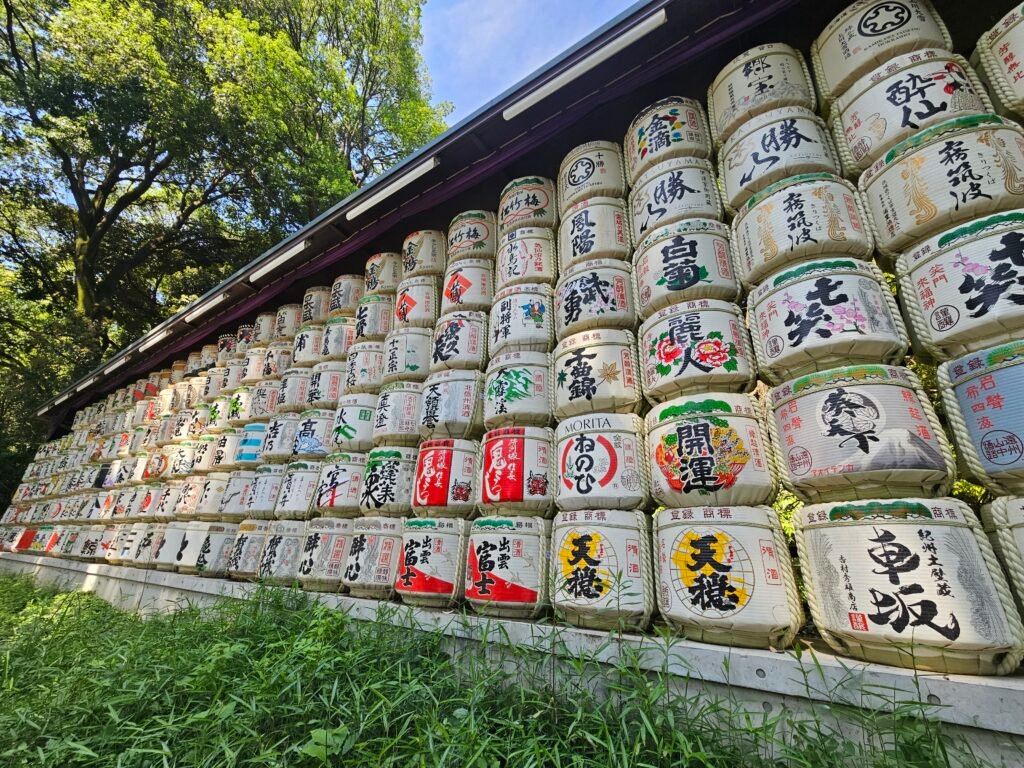
On the way to the shrine you’ll pass the rows of decorated sake barrels, with French wine barrels on the opposite side.
At the main shrine, children can write a wish on a small wooden ema tablet and hang it up with all the others.
🕘 Opening Hours: Meiji Shrine is open daily, with opening and closing times changing according to sunrise and sunset throughout the year.
💰 Entry Fee: Free.
Getting there: The shrine is easiest to reach from Harajuku Station or Meiji-jingumae Station. From the entrance, it’s around a 10-minute walk through the forest to the main shrine.
One thing I’d definitely recommend is combining Meiji Shrine with Harajuku, since they’re right next to each other. That gives you a lovely contrast between the quiet forest and shrine on one side and the colourful, energetic streets of Harajuku on the other.
Harajuku
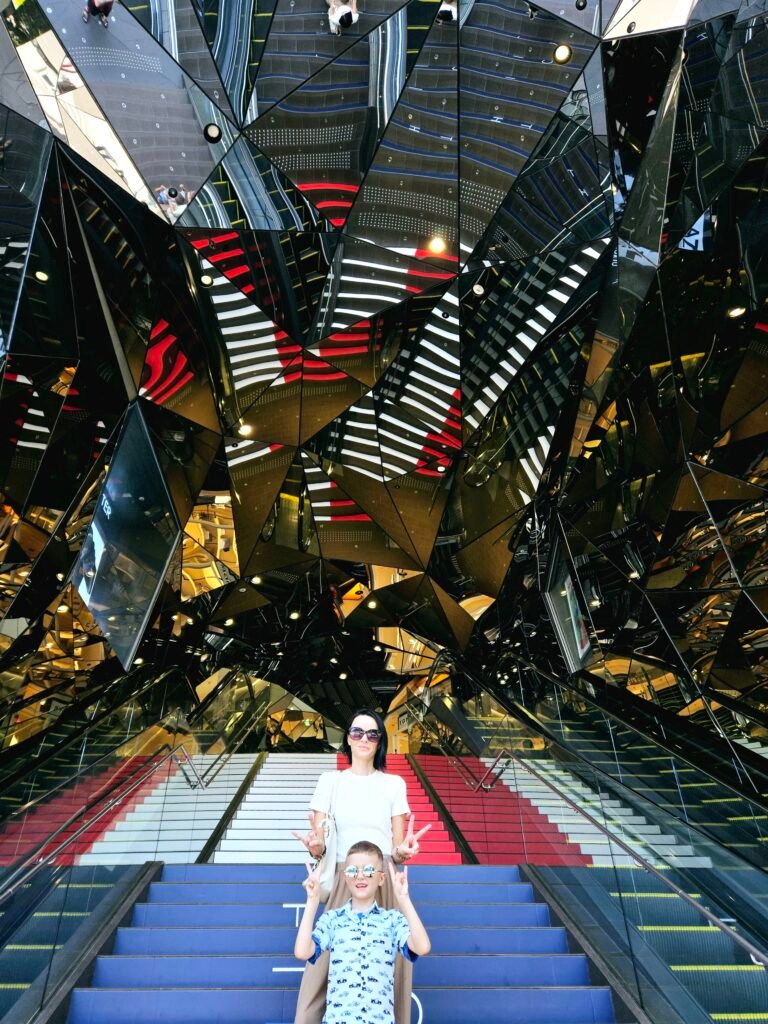
We spent some time exploring Harajuku, and it’s a fun area to visit with a child because everything feels a little more colourful and playful. Takeshita Street is the obvious place to start, with its quirky shops, Japanese sweets, enormous crepes and plenty of things that will catch a seven-year-old’s attention. It can get extremely crowded, though, so I’d recommend going earlier in the day.
If your child is into toys and Japanese characters, Kiddy Land is another easy stop, with several floors of toys, Sanrio, Snoopy and other character merchandise. And if you’ve had enough of the crowds, Yoyogi Park is right nearby and gives everyone a chance to slow down and run around a little.
We also stopped at CAFE REISSUE, which is famous for its incredibly detailed 2D and 3D latte art. We ordered cappuccinos and hot chocolate, and the drinks were decorated with little chocolate drawings on the foam. Our son loved it, although I’m not sure whether he was more impressed by the artwork or by getting to drink it afterwards!
🕘 Opening Hours: 10:00 AM–7:00 PM; irregular holidays.
💰 Entry Fee: Free; drinks and food are ordered separately.


The Yayoi Kusama Museum
The Kusama Museum was one of those places where our experience didn’t quite match our expectations.
It was quite small, and personally we found it somewhat disappointing, as we expected it to be a bit bigger and have more in terms of artwork.
That doesn’t mean you shouldn’t visit. Yayoi Kusama’s work is hugely popular and some visitors will absolutely love it. I’m simply including it because I think honest travel advice should include the things that didn’t live up to the hype for our family as well as the things we loved.
🕘 Opening Hours: Thursday–Sunday and national holidays, 11:00 AM–5:30 PM.
💰 Entry Fee: ¥1,100 adults; ¥600 for children aged 6–18. Children under six are free. Tickets must be bought online in advance for a timed 90-minute admission slot.
Getting there: The museum is in Bentencho, Shinjuku, and public transport is recommended.


A Ninja Restaurant in Tokyo
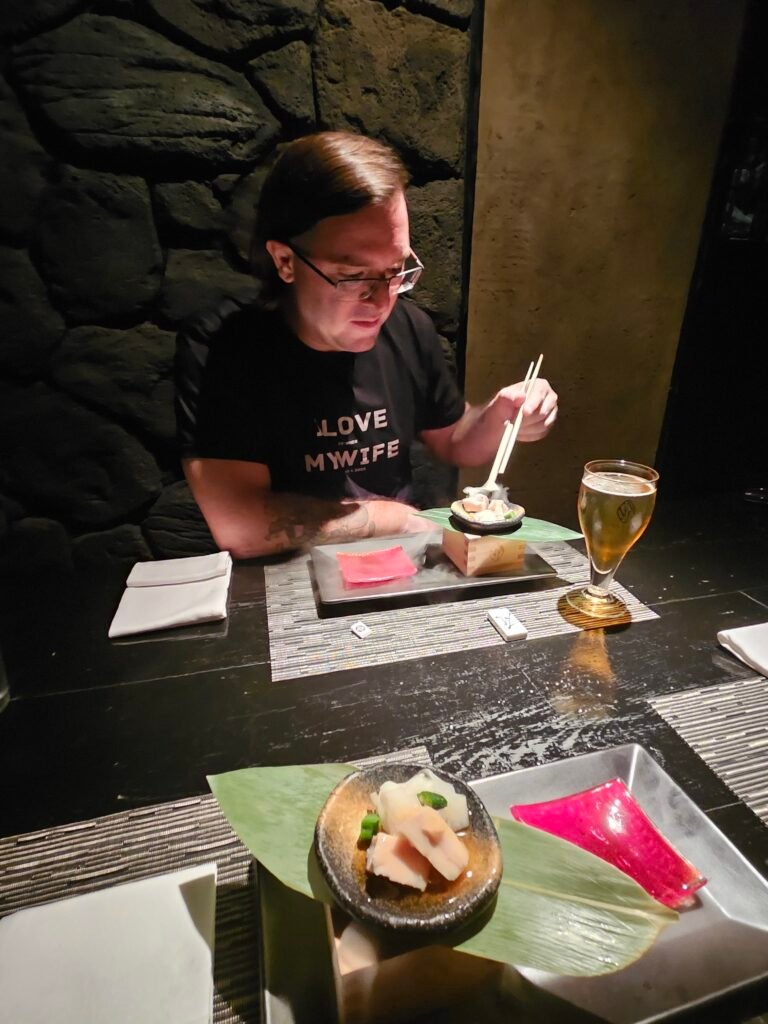
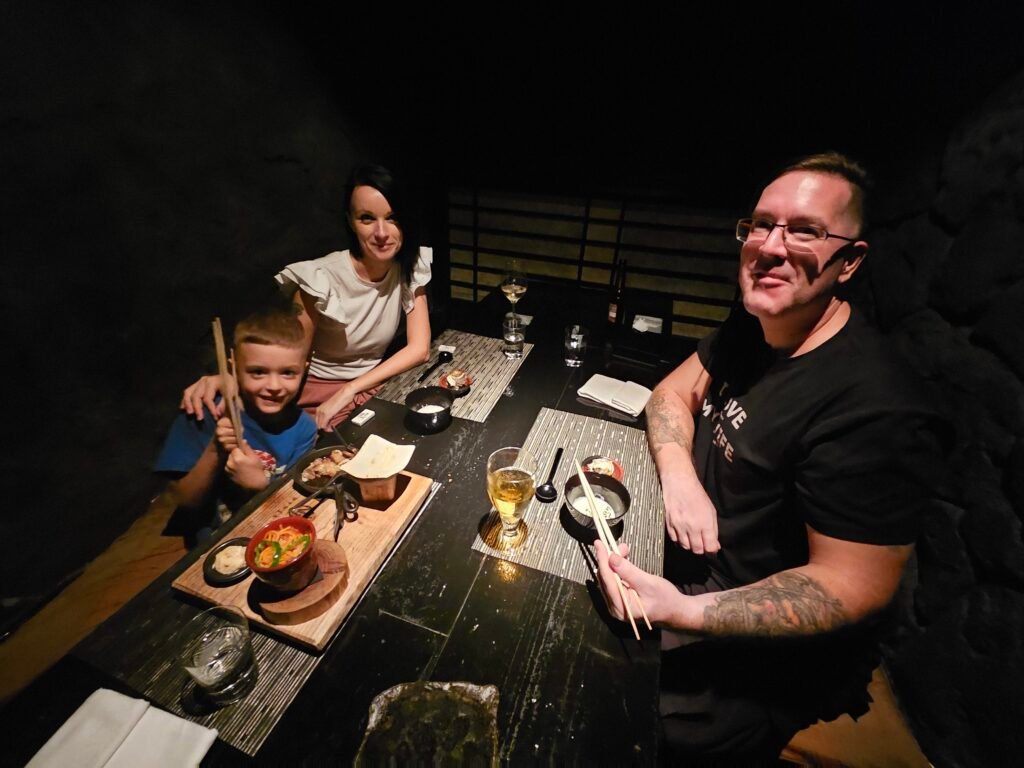
One of our favourite evenings in Tokyo was at the NINJA TOKYO restaurant. From the moment we arrived, it felt like we were stepping into a completely different world.
You don’t simply walk through the door. You have to ring a bell, and a ninja appears to greet you before leading you through the mysterious entrance to your private dining room. Inside, the decor is dark and atmospheric, with hidden corners and ninja-themed details that make you feel as though you’ve wandered into an actual ninja hideout.
The food was every bit as entertaining as the surroundings. Every dish came with its own little trick, surprise or dramatic presentation, so dinner became part meal and part show. It could easily have been one of those places where the gimmick is much better than the food, but surprisingly, the food itself was genuinely very good.
Yes, the whole thing is definitely a little gimmicky, that’s rather the point, but it was done so well that we didn’t mind at all. Our son absolutely loved it, and honestly, so did we. It was one of those experiences where the restaurant itself became part of the sightseeing rather than simply somewhere we went for dinner.
🕘 Opening Hours: Monday–Saturday, 11:30 AM–2:30 PM and 5:00 PM–10:00 PM. Closed Sundays and certain holidays.
💰 Prices: The restaurant operates with set courses. Current children’s and adult course prices vary depending on the menu.
Getting there: The current NINJA TOKYO location is in Otemachi and is directly accessible from Otemachi Station. I would definitely book ahead, particularly if you’re travelling with children.

Our Mount Fuji Day Trip
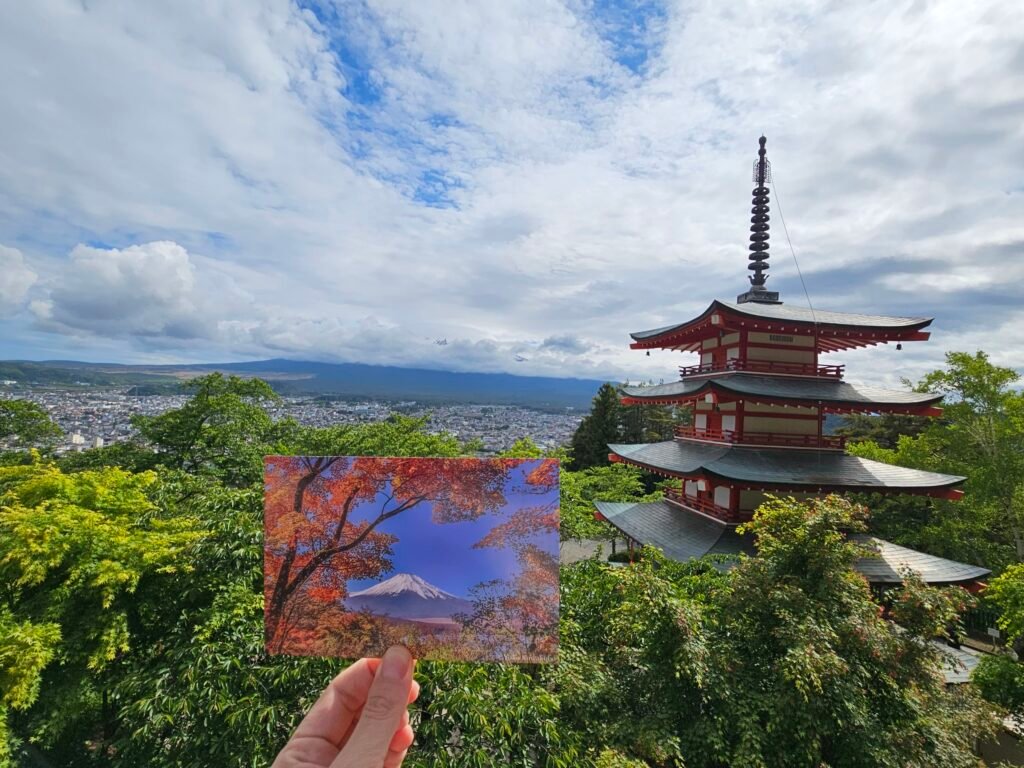
We had really been hoping for that classic Mount Fuji view, the kind of clear, postcard-perfect scene we’d imagined when we booked the day. Unfortunately, the weather had other plans. The mountain was hidden behind clouds for much of the day, so we never got the iconic view we’d been hoping for.
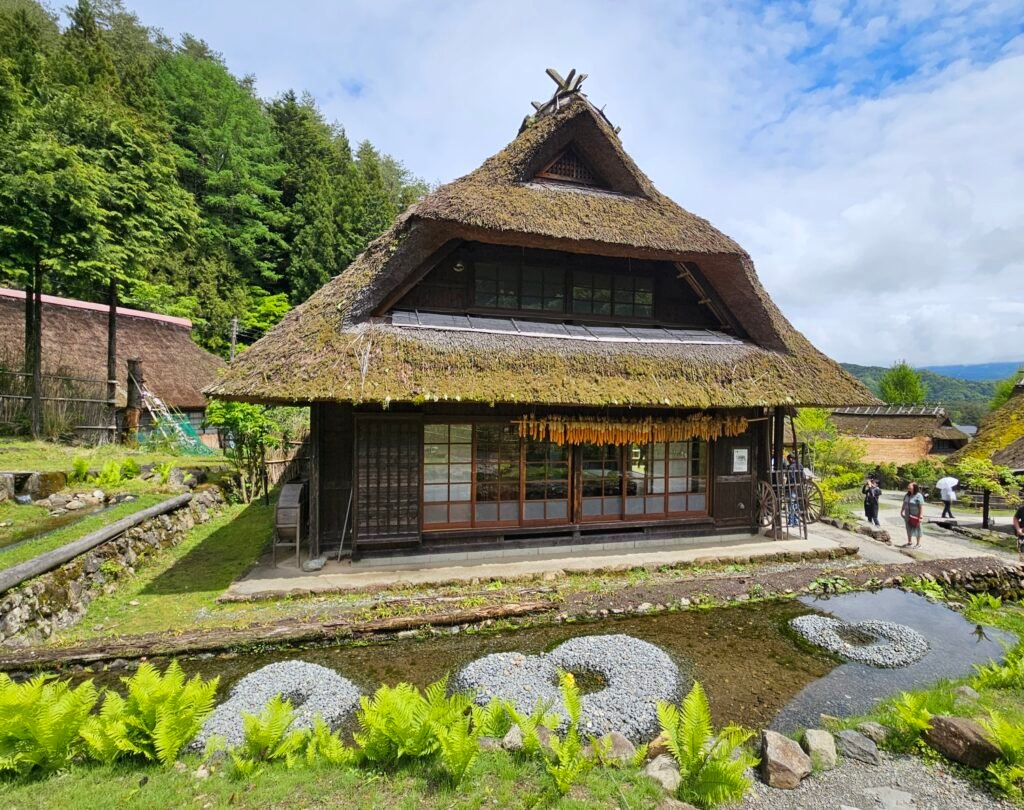
Even so, we really enjoyed the excursion. We booked a small-group tour that took us around the Fuji Five Lakes area, with stops including Chureito Pagoda, Oshino Hakkai and Lake Kawaguchi.
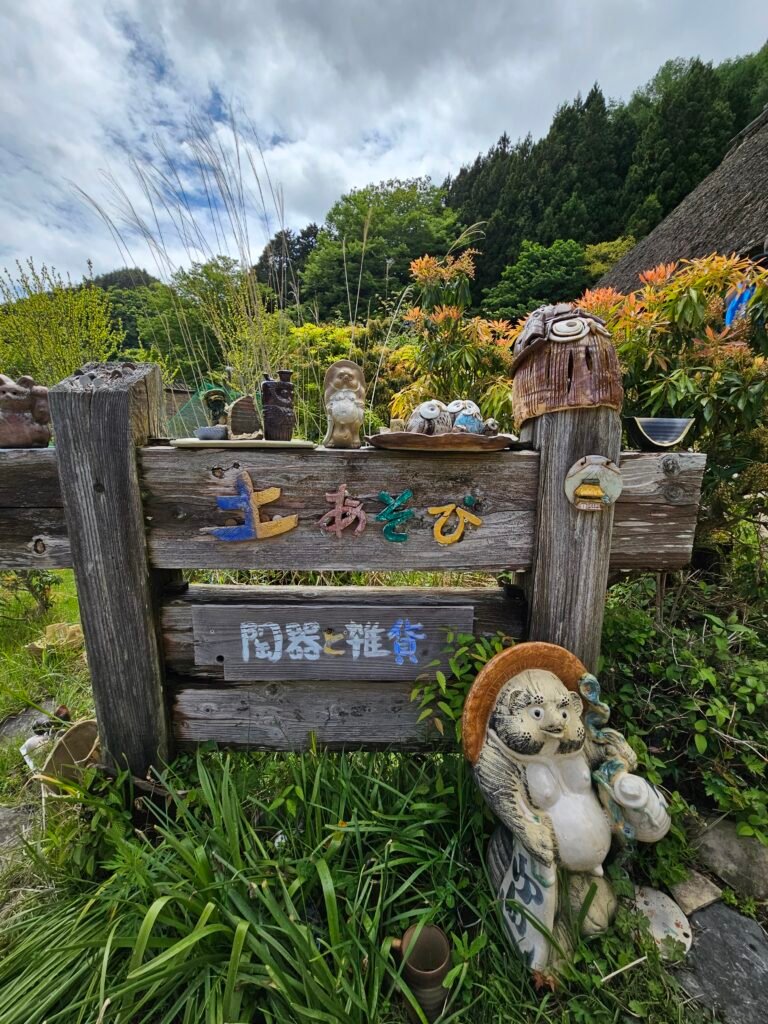
One of my favourite stops was Oshino Hakkai, a traditional village surrounded by eight beautiful spring-fed ponds. The ponds are supplied by snowmelt filtering down through the volcanic rock of Mount Fuji, and the area has traditional thatched buildings, little water wheels, shops and food stalls. It has a very different feel from Tokyo and was particularly nice to explore with our son.
We also visited Chureito Pagoda, which is famous for its spectacular view back towards Mount Fuji. Of course, on the day we visited, that famous view was hidden by clouds! Still, the pagoda itself was beautiful, and climbing the steps to reach it was part of the experience.
🕘 Tour Duration: Approximately 10 hours, including hotel pickup and multiple stops.
Hiking the Nakasendo Trail With Our 7-Year-Old
After five days in Tokyo, we left the enormous city behind and headed into the Kiso Valley. Looking back, this was one of the things we liked most about our itinerary. Japan suddenly felt completely different. The Nakasendo was an ancient highway linking Edo, now Tokyo, with Kyoto, and the 8 km stretch between Tsumago and Magome is one of its best-preserved sections.
We sent our suitcases ahead to Kyoto and travelled from Tokyo to Tsumago in a single morning. After a drink at a café on Tsumago’s main street, we set off just before midday and walked into Magome at around 4 PM. The weather was perfect, the trail was quiet, and our son managed it easily. There was some uphill walking on the climb to Magome Pass, but nothing he struggled with.
More than that, he loved it. He rang every bear bell we passed, stopped to look at the Odaki and Medaki waterfalls and chatted to other hikers along the way. Our favourite stop was the old Tateba rest house, where we drank free tea by the fire pit and ate our packed lunch.
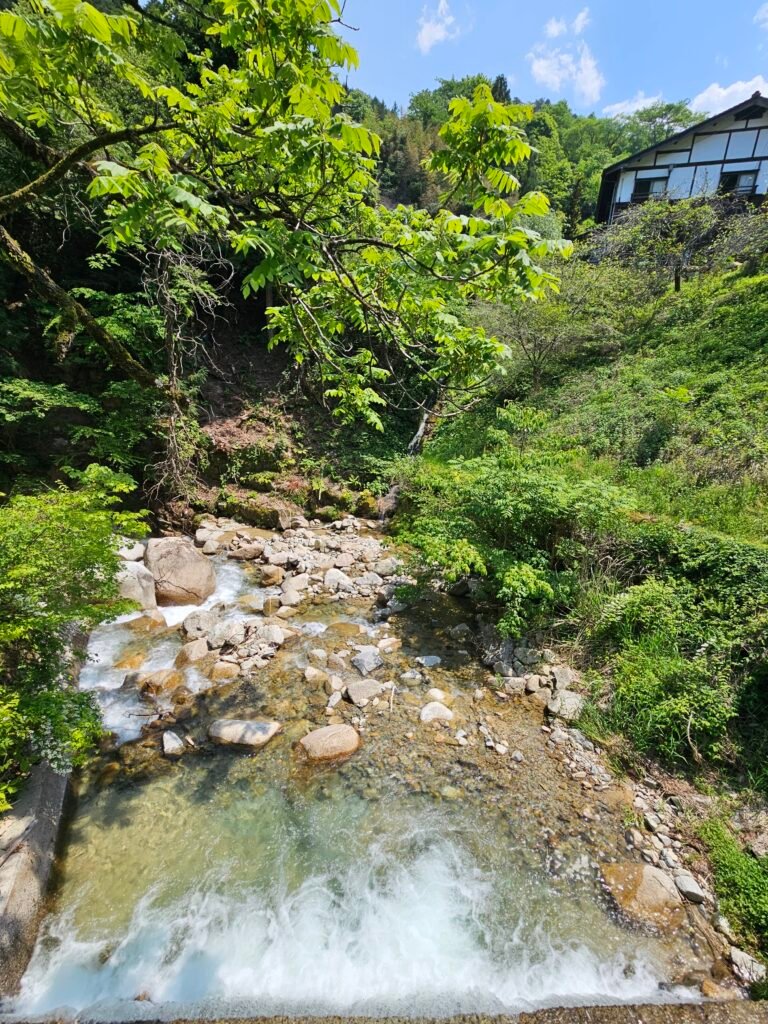
We ended the day at Tajimaya Ryokan in Magome, with futons, yukata, a traditional dinner and a Kiso folk song, and we’d happily stay there again.
👉 Read our full guide: Nakasendo Trail With Kids. It covers getting there from Tokyo step by step, luggage forwarding, food and toilets on the trail, bear bells, the bath setup at Tajimaya and what it cost us.
Travelling to Kyoto
Once we’d finished our Nakasendo experience, it was time to make our way west towards Kyoto. Getting out of the Kiso Valley takes a little more planning than travelling between Japan’s major cities, simply because the local buses and trains aren’t as frequent. It’s worth checking the connections in advance rather than just turning up and hoping the next bus lines up with the next train.
If you’re staying in Magome, as we did, the option is to take the bus from Magome to Nakatsugawa Station (about 25 minutes, ¥800), then the JR train to Nagoya before continuing by Shinkansen to Kyoto.
If you’re finishing in Tsumago, the most straightforward route is: Tsumago → Nagiso Station by local bus → Nagoya by JR → Kyoto by Shinkansen
The bus from Tsumago to Nagiso Station takes around 10 minutes, and from there you can take a JR train towards Nagoya. Depending on the timetable, this may be a direct Shinano Limited Express or a local train with a change at Nakatsugawa. From Nagoya, it’s a very easy final leg: the Tokaido Shinkansen takes roughly 35–45 minutes to Kyoto, depending on the service.
The important thing is to check the bus and train connections together, as the rural services don’t run anything like the frequency you’ll find in Tokyo or Kyoto. The Nagiso Tourism Association has current English-language bus and JR timetables, including the Tsumago–Nagiso and Magome–Nagiso routes, which is a really useful resource when planning this part of the journey.
Nagiso Tourism Association – bus and train timetables
For the final leg, the JR Central Shinkansen information is useful for checking current services between Nagoya and Kyoto.
JR Central – Shinkansen information
For us, the combination of buses, local trains and then the Shinkansen made the journey feel like another part of the adventure rather than simply a transfer between destinations. After the quiet mountain villages of the Nakasendo, arriving back into the scale and energy of Kyoto was quite a contrast.
5 Days in Kyoto With a 7-Year-Old
Kyoto was our longest stop after Tokyo, and five days gave us enough time to see a lot. Kyoto was our favourite city in Japan, and we did wish that we had more time there! We did a mixture of cultural experiences, temples, museums and day trips.
We dressed in kimono, attended a tea ceremony, visited a samurai museum, explored Gion and Fushimi Inari, visited Kiyomizu-dera and Nijo Castle, spent time in Arashiyama, visited Nara and took our son to the Kyoto Railway Museum.
That sounds like a lot, but we spread it across several days.
Wearing Kimono in Kyoto
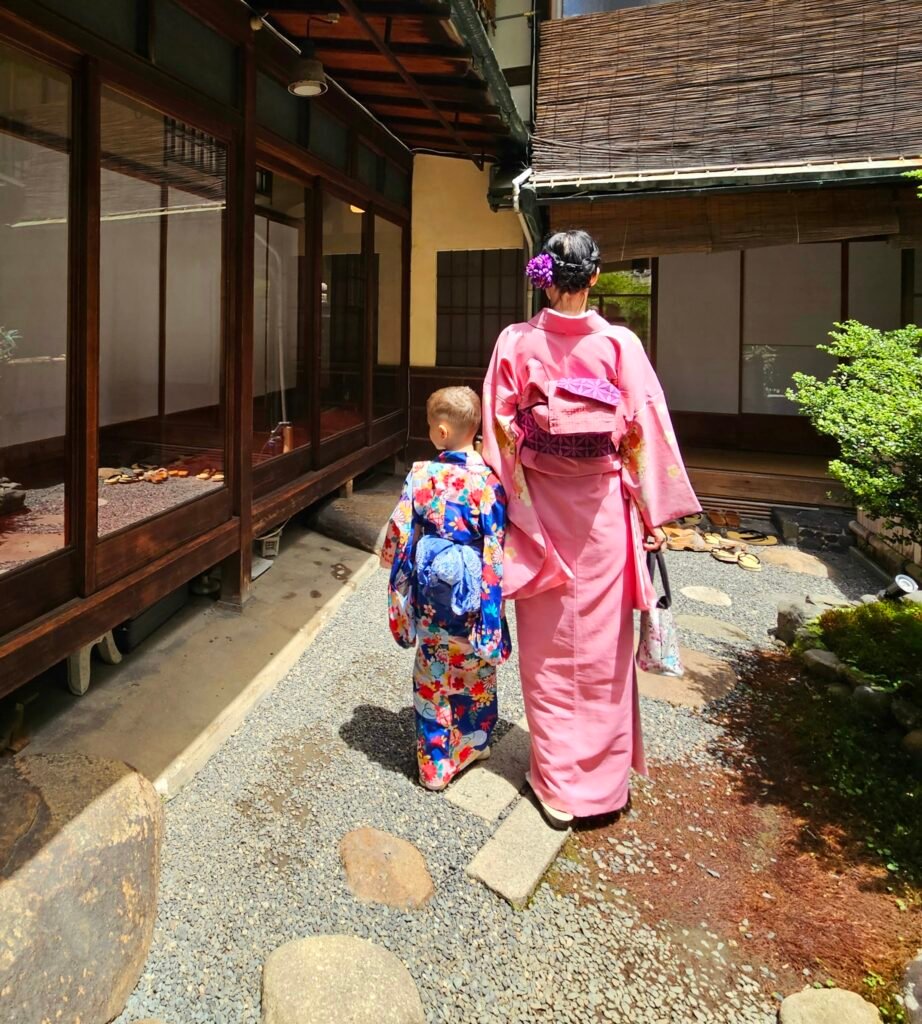
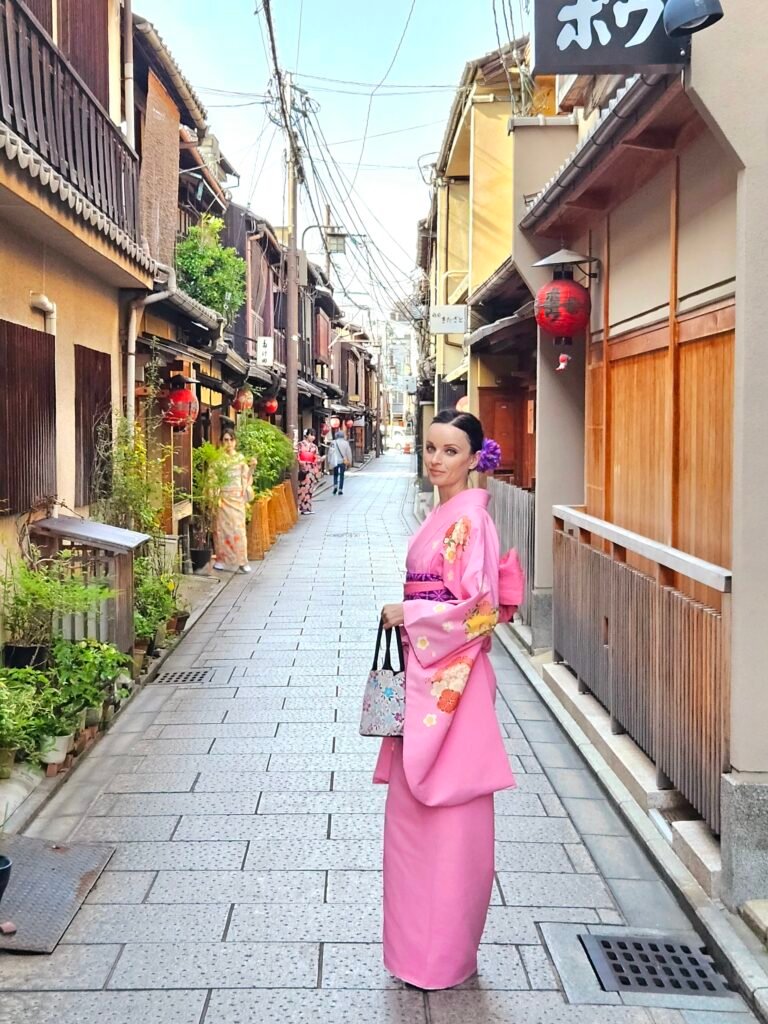
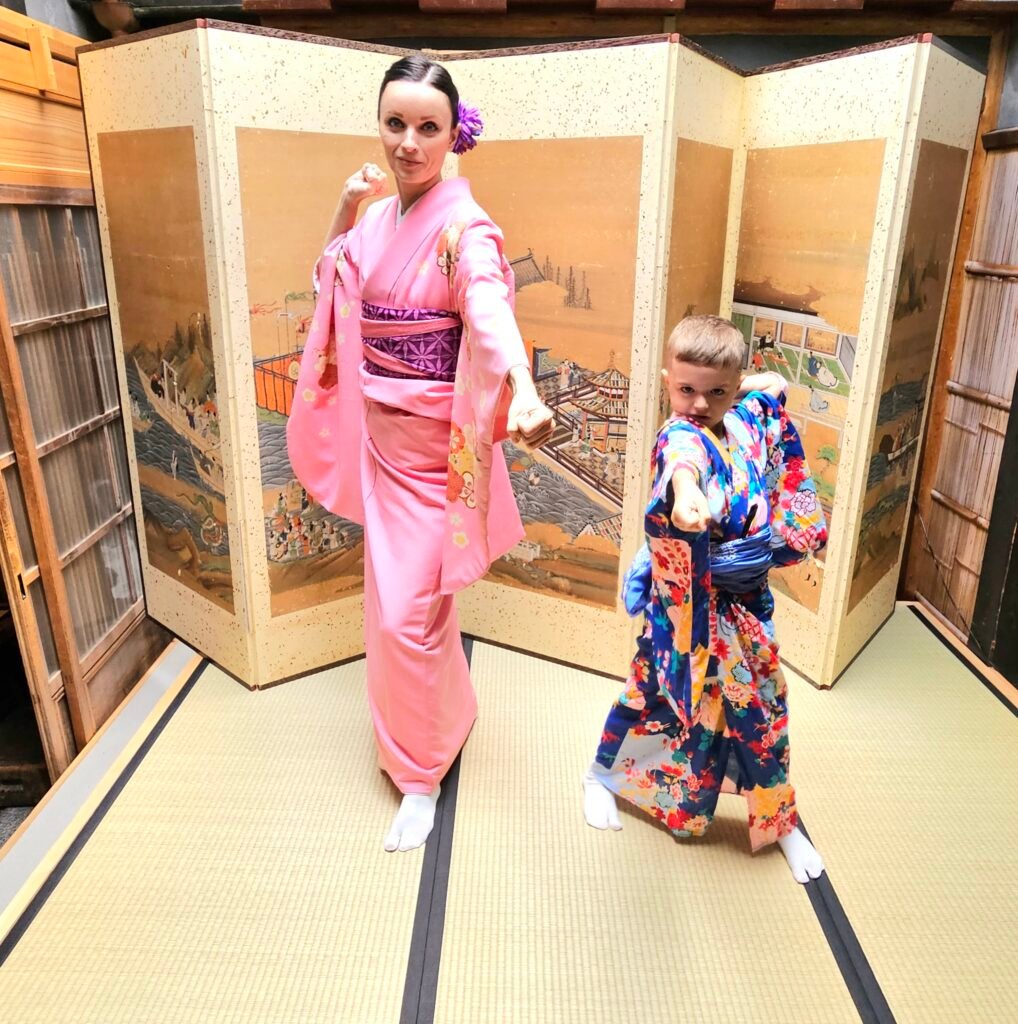
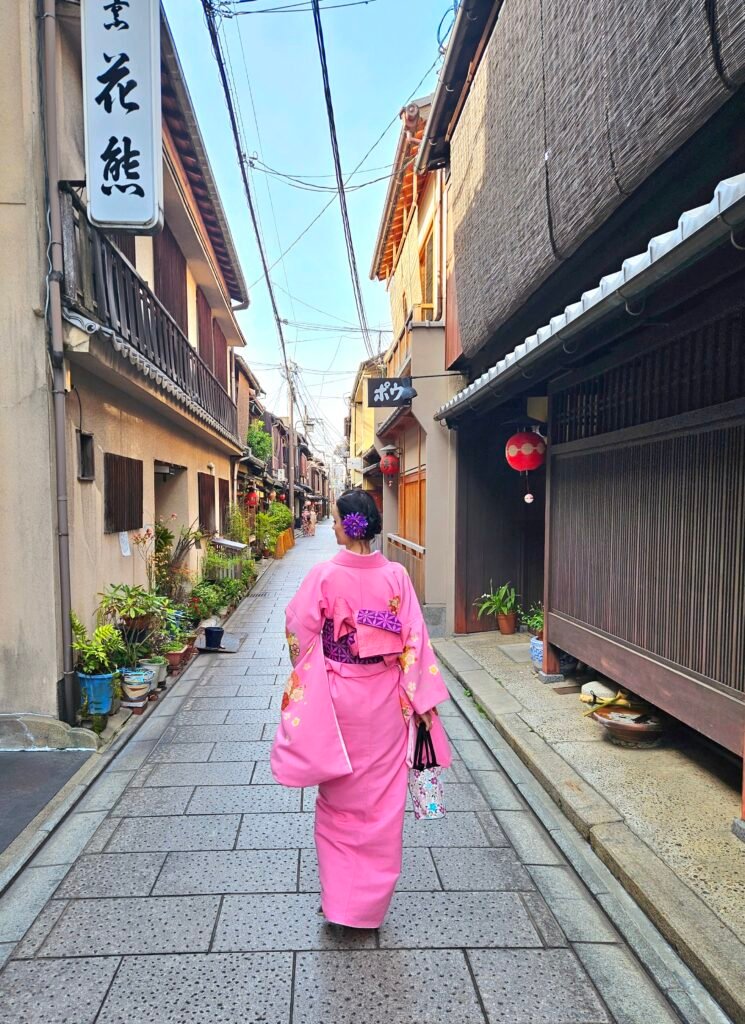
One of our favourite experiences in Kyoto was getting dressed in traditional kimono and then actually going out to explore the city in them. There were kimonos for women, men and children, with lots of colours and patterns to choose from, along with obi belts, bags, sandals and tabi socks (note that the socks need to be purchased, and they are yours to keep). The women can also have their hair styled, complete with beautiful traditional hair accessories, and the ladies there do an amazing job.
As a current example, Kimono Rental Okamoto has several locations around Kiyomizu-dera and Gion. Their standard plans start at around ¥2,980–¥4,980, with men’s and children’s options from around ¥3,980, and hair styling from ¥500.
The great thing is that you don’t just put the kimono on for a photo and take it straight off. You can keep it for several hours and walk around Kyoto, visit temples and shrines and stop for photos along the way.
🕘 Opening Hours: Varies by shop.
💰 Approx. Price: ¥3,000–¥5,000+ for a standard rental, with hair styling usually extra.

A Traditional Tea Ceremony
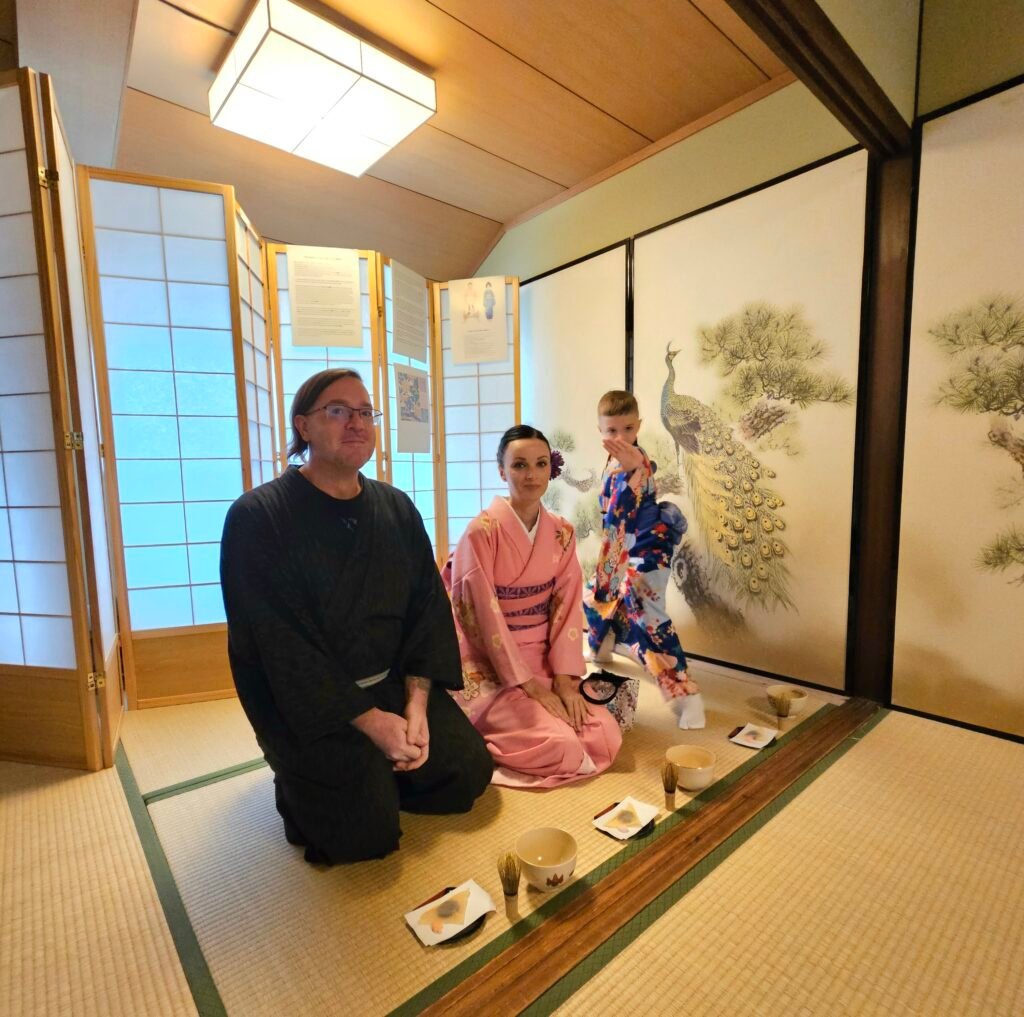
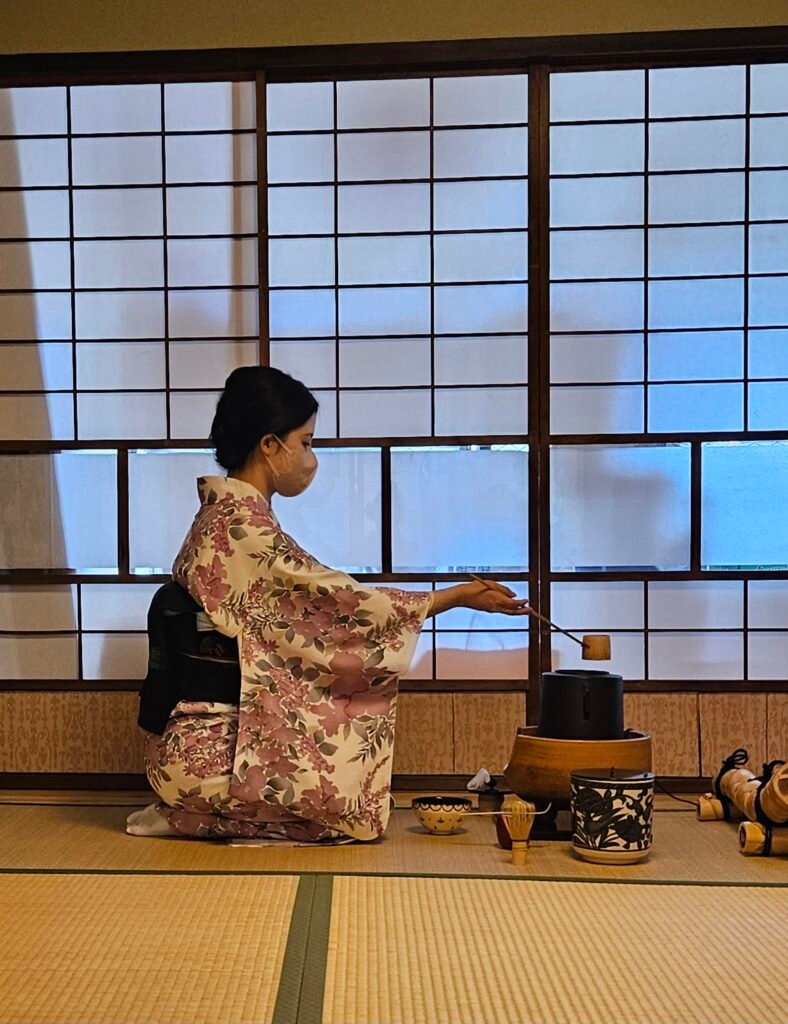
We also took part in a traditional Japanese tea ceremony, led by a tea apprentice who had already been studying the craft for around 10 years. What surprised me was that she was still considered an apprentice after all that time. Becoming a teacher or master of tea is a long process, and the practice itself is often described as a lifelong pursuit.
She explained the traditions and meaning behind the ceremony in detail before preparing the matcha for us. We got to taste the tea ourselves, and even our seven-year-old tried a little sip, and actually liked it!
It was a lovely experience because we weren’t simply watching a performance. We had the chance to understand why the ceremony is done the way it is, and to participate in a small part of it ourselves.
If you’d like to try the same experience for yourself, there are kimono rental and tea ceremony experiences in Kyoto that combine the two, making it easy to book them together rather than arranging everything separately. You can choose your kimono, have your hair styled, explore Kyoto dressed in traditional clothing, and then take part in a tea ceremony and enjoy freshly prepared matcha.

Samurai & Ninja Museum
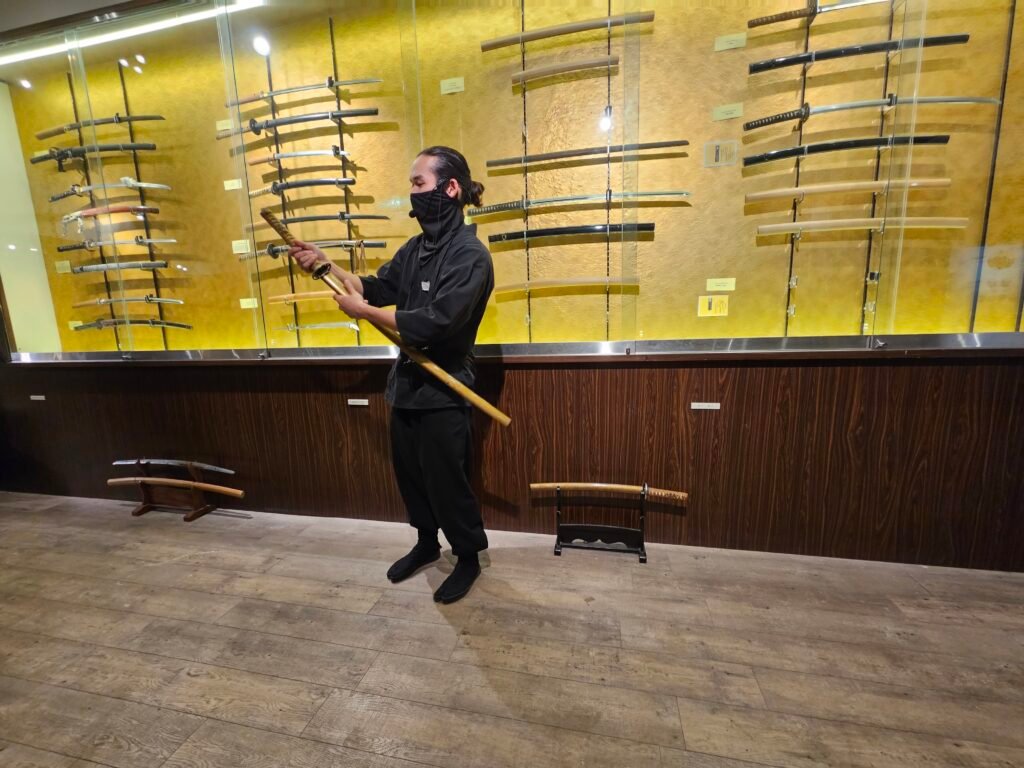
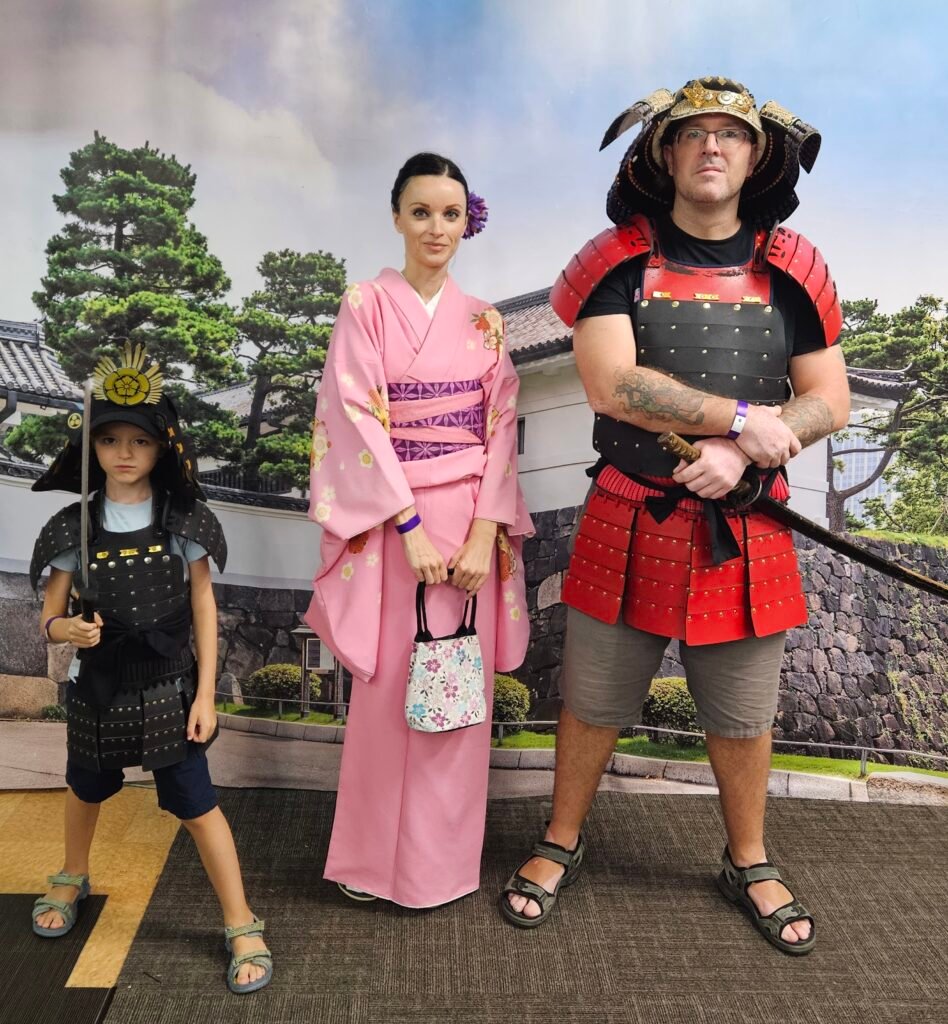
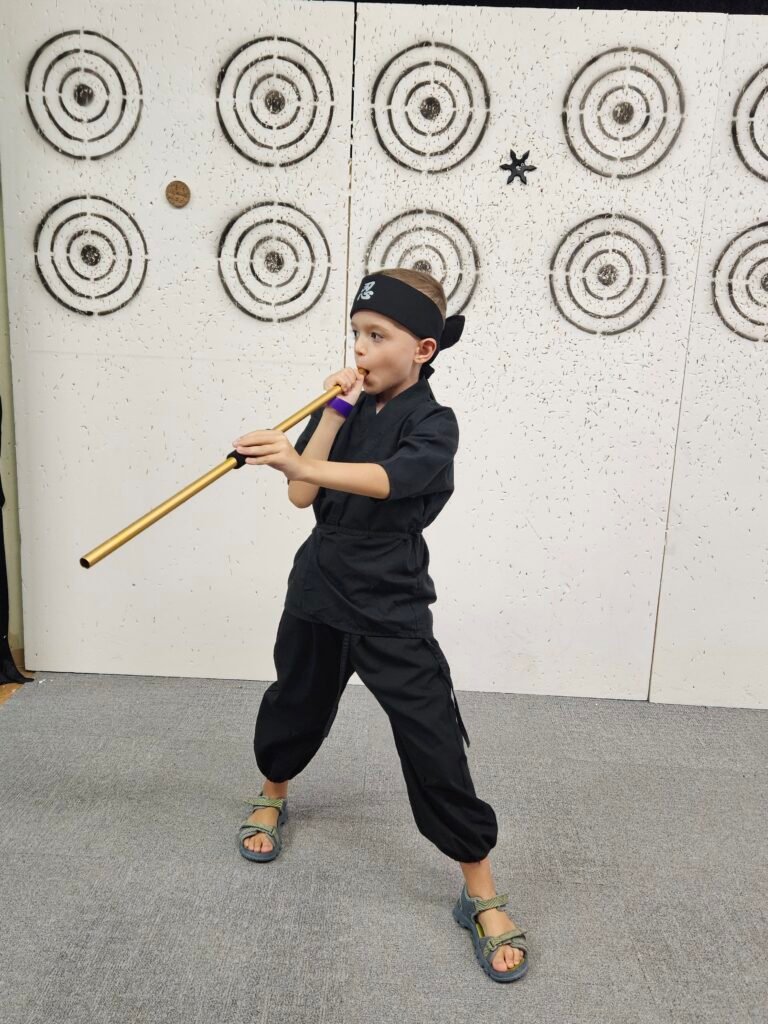
Our son was seven at the time, so a visit to the SAMURAI NINJA MUSEUM KYOTO was an easy choice. It isn’t just a museum where you walk around looking at swords and armour! The visit includes a guided tour, with the guide explaining samurai history, their culture, traditions and code, as well as the role of the ninja. The museum is designed to be interactive, which made it particularly engaging for children.
There are also hands-on activities. Depending on the experience booked, you can dress in samurai armour, try holding a sword, dress as a ninja and throw shuriken (ninja stars), with some experiences also including blowgun practice.
The museum is in central Kyoto, close to Nishiki Market, so it’s easy to combine with a day exploring this part of the city.
🕘 Opening Hours: around 9:30am–7:30pm, although individual experience times vary and advance booking is recommended.
📍 Address: 109 Horinouechō, Nakagyo Ward, Kyoto 604-8117, Japan.
💰 Approx. Price: Around ¥3,500 per person for the basic guided museum tour and experience; more extensive samurai/ninja experiences cost more. Current prices vary by package.
🚶 Getting There: It’s about a 7-minute walk from Hankyu Kyoto-Kawaramachi Station or 7 minutes from Karasuma-Oike Station, and around 4 minutes from Nishiki Market.
For kids who are fascinated by samurai and ninja, this is a much more interactive way to learn about that part of Japanese history than simply visiting a traditional museum. It’s exactly the kind of hands-on learning we look for when worldschooling, and you’ll find more ideas in our worldschooling resources guide.
You can buy your tickets for the Samurai and Ninja Museum guided tour here
If your kids love this kind of hands-on learning, our Japan Explorer Activity Book has more samurai, ninja and culture activities to try.
Gion
We spent some time exploring Gion, Kyoto’s famous traditional district, known for its wooden machiya houses, narrow lanes, traditional tea houses and geisha culture. The area is particularly atmospheric around Hanamikoji Street, where you can see some of Kyoto’s beautifully preserved traditional architecture.
It was very busy when we visited, but that didn’t stop us from enjoying it. There are quieter streets away from the main areas, and I think the experience would be even nicer if you arrive early in the morning, before the crowds build up.
Gion is also very easy to combine with a visit to Kiyomizu-dera. You can walk between the two, passing through some of the traditional streets around Higashiyama along the way, making it a natural combination for a half or full day of exploring.

Kiyomizu-dera
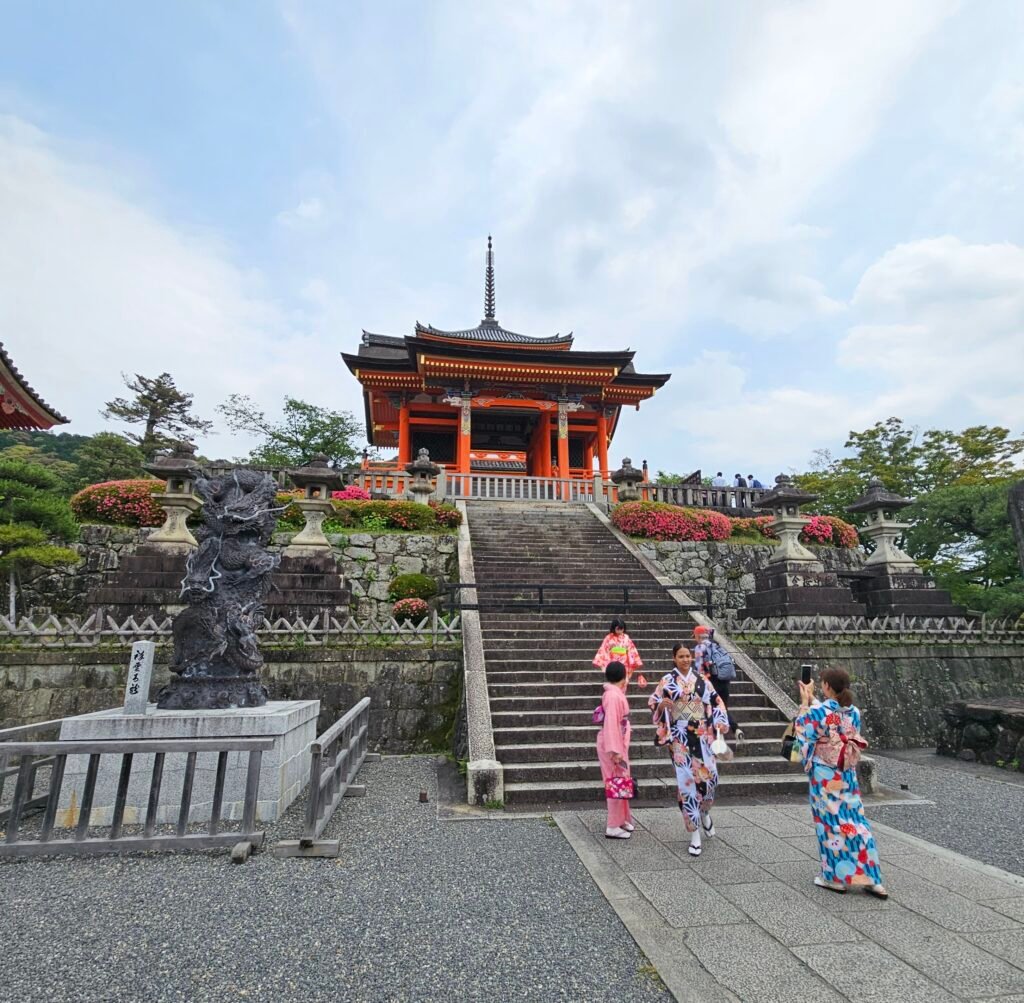
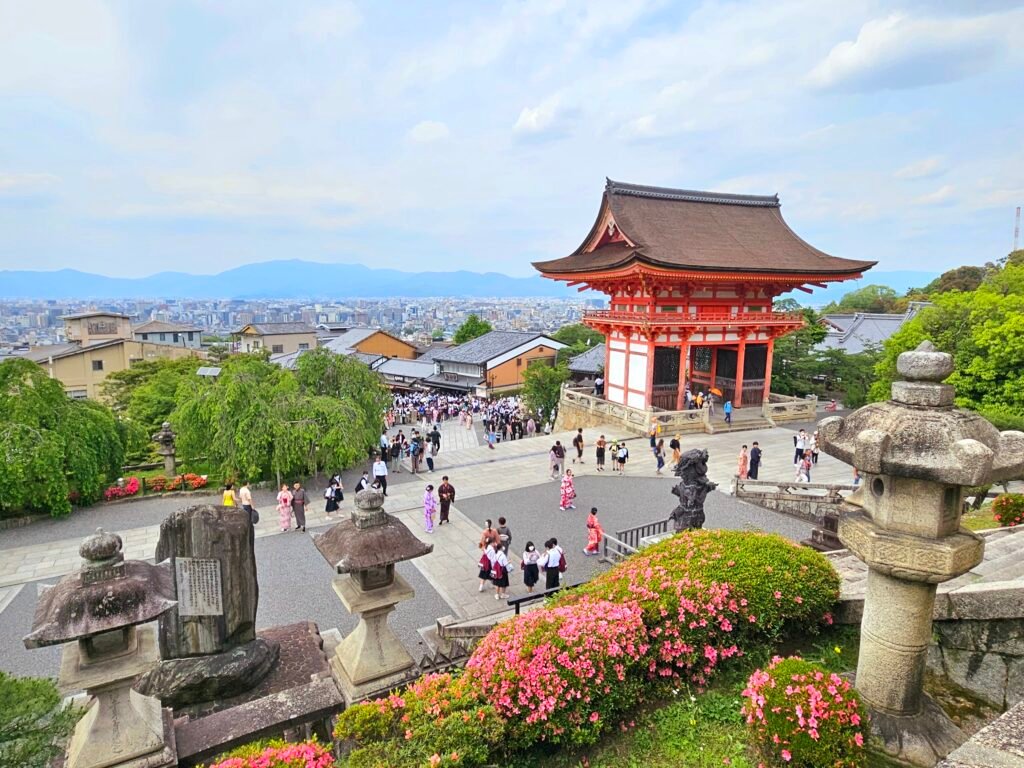
Kiyomizu-dera was another major Kyoto highlight for us. The complex sits on a hillside and includes the famous wooden Main Hall with its huge stage, smaller halls, views over Kyoto and the Otowa Waterfall, where visitors drink from three streams said to bring different blessings.
A fun one for kids: the stage is so famous that Japanese people say “jump off the stage at Kiyomizu” when they mean taking a big leap and making a bold decision.
It’s also a fairly substantial visit. There are stairs, slopes and plenty to explore, so I wouldn’t treat it as a quick stop for the famous photo from the Main Hall. We found it much more enjoyable to take our time and wander through the complex rather than rushing from one viewpoint to the next.
It’s also perfectly positioned to combine with Gion and the traditional streets of Higashiyama. You can spend the morning around Kiyomizu-dera, then walk downhill through the old streets towards Gion.
🕘 Opening Hours: Opens at 6:00 AM. Closing time varies by season. In 2026 it is generally 6:00 PM, with some summer periods extending to 6:30 PM and special evening openings until 9:30 PM.
💰 Entry Fee: ¥500 for adults and ¥200 for elementary/junior-high students for the regular temple visit. Special exhibitions or evening events may have separate admission.
📍 Getting There: From Kyoto Station, take city bus 100 or 206 to Gojozaka, then walk about 10 minutes uphill. From Gion-Shijo or Kawaramachi, bus 207 to Kiyomizu-michi is another option, followed by a roughly 10-minute walk.
Tip: Go early if you can. Kiyomizu-dera is one of Kyoto’s busiest sights, and arriving early makes a noticeable difference.

Kennin-ji
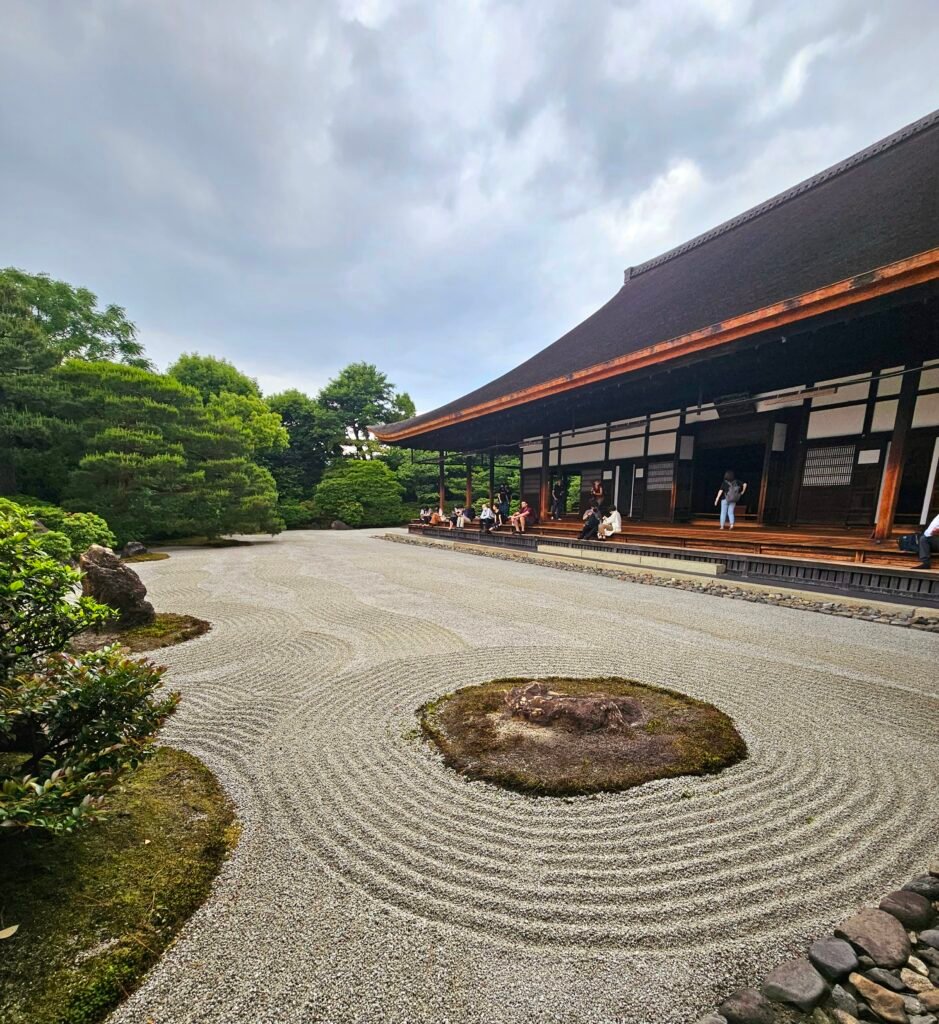
Kennin-ji was another temple we really enjoyed visiting in Kyoto. Tucked away in the Gion area, it felt much more peaceful than some of the city’s larger and busier attractions, and it was a lovely place to slow down for a while.
It’s Kyoto’s oldest Zen temple, but the thing that will grab a child’s attention is on the ceiling. Look up in the Dharma Hall to see the Twin Dragons, a huge painting of two dragons twisting around each other, covering the whole ceiling.
The Zen gardens were probably the highlight for us. It’s the kind of place where you can sit for a while and take in the surroundings rather than rushing on to the next sight.
It’s also very easy to combine with Gion, since it’s only a few minutes’ walk from the main Gion area.
🕘 Opening Hours: 10:00 AM–5:00 PM, with admission ending at 4:30 PM. There are a few annual closure dates, so check before visiting.
💰 Entry Fee: ¥800 for adults and ¥500 for students. Children under elementary-school age are free.
📍 Address: 584 Komatsu-cho, Higashiyama Ward, Kyoto.
🚶 Getting There: Around 7 minutes on foot from Gion-Shijo Station on the Keihan Line, or about 10 minutes from Kyoto-Kawaramachi Station.


Nijo Castle
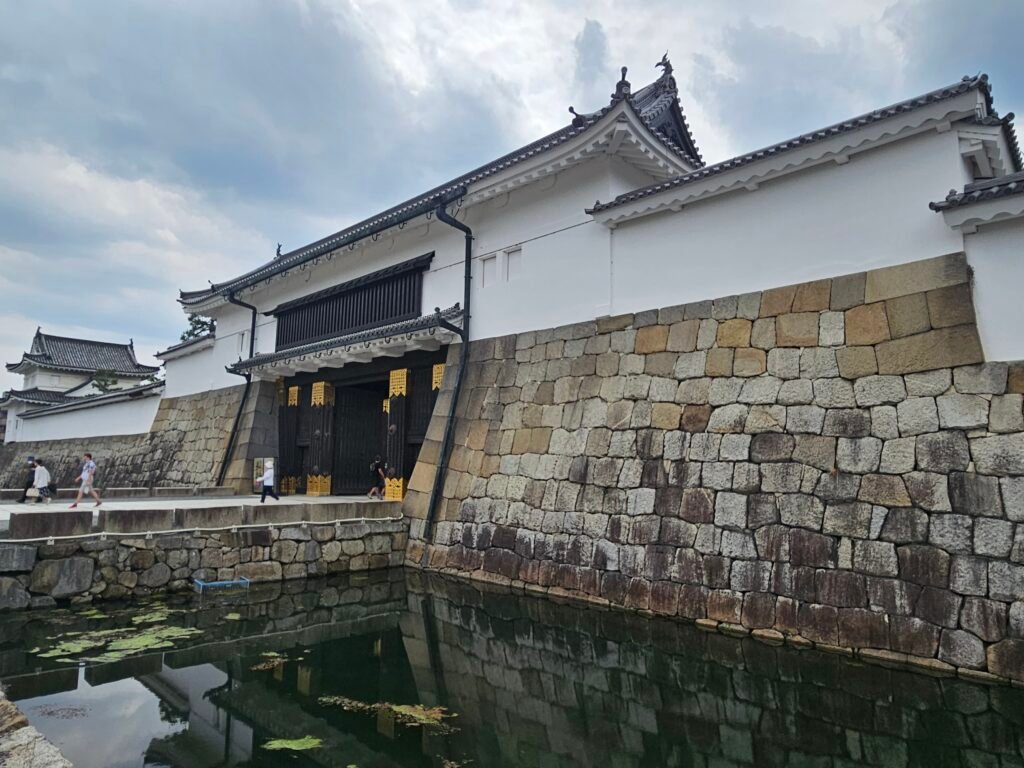
Nijo Castle gave us another completely different perspective on Japanese history. Built in 1603 by Tokugawa Ieyasu, the founder of the Tokugawa shogunate, it was used as a residence for the shoguns when they were in Kyoto. Unlike the temples and shrines we had been visiting, this was a chance to learn more about the political and military history of Japan and the people who actually governed the country during the Edo period.
The highlight is Ninomaru Palace, where you can walk through the beautifully decorated rooms and see the spaces where the shogun would meet with feudal lords and officials. One of the details our son found particularly interesting was the famous “nightingale floors.” The wooden floorboards deliberately squeak as you walk across them, traditionally thought to have helped alert occupants to anyone moving through the corridors.
Outside, the castle grounds are just as worth exploring, with extensive gardens, ponds, stone walls and moats. It makes for a fairly substantial visit rather than something you can see in half an hour, so we’d allow a couple of hours to properly explore.
🕘 Opening Hours: 8:45 AM–5:00 PM, with last admission at 4:00 PM.
💰 Entry Fee: Castle admission is ¥800 for adults and ¥300 for elementary-school children. Admission including Ninomaru Palace is ¥1,300 for adults and ¥300 for elementary-school children.
🚇 Getting There: From Kyoto Station, take the Karasuma Subway Line to Karasuma Oike, change to the Tozai Line and get off at Nijojo-mae Station. The castle entrance is just outside the station.
Kyoto Railway Museum: A Huge Hit With Our Son
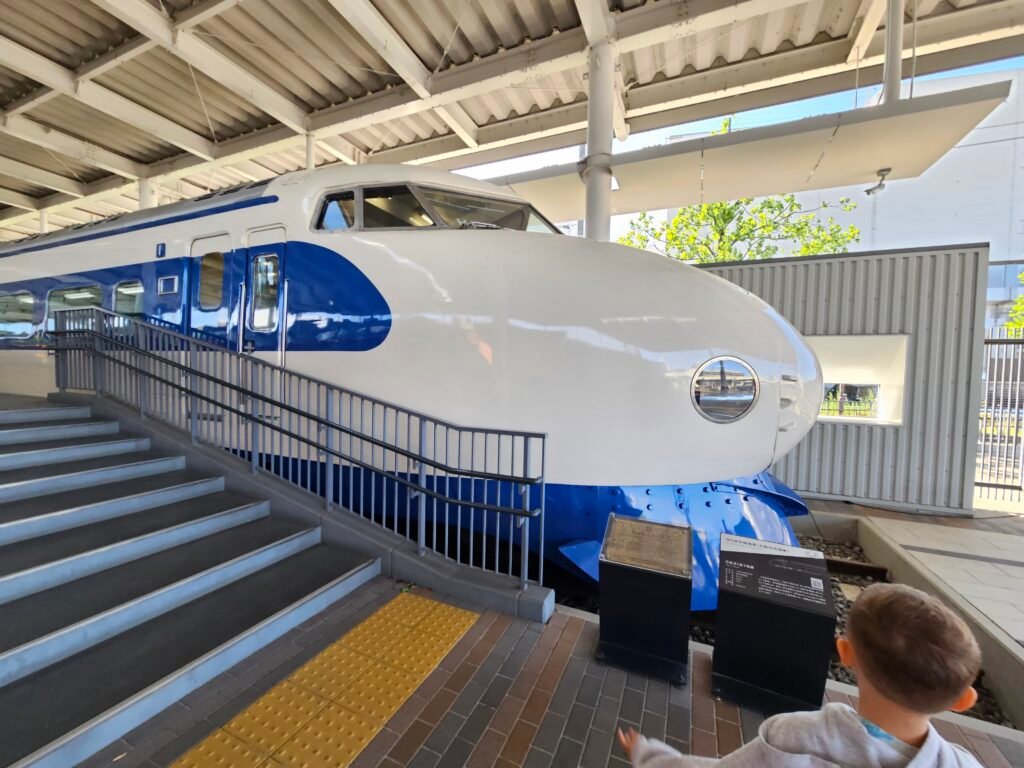
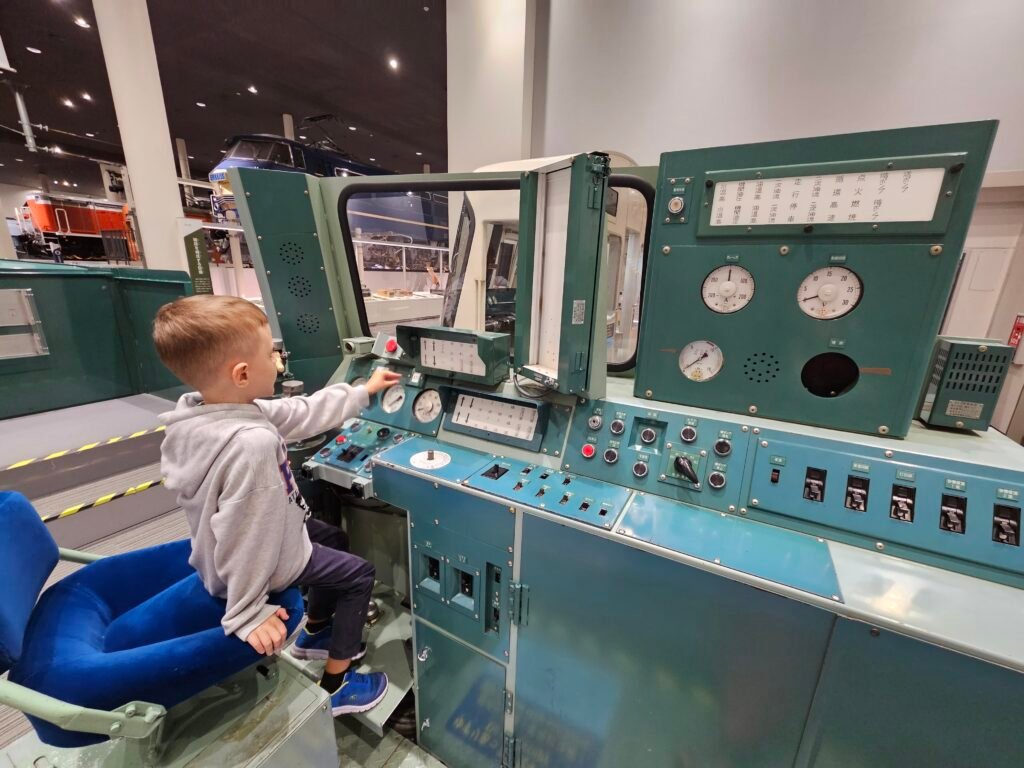
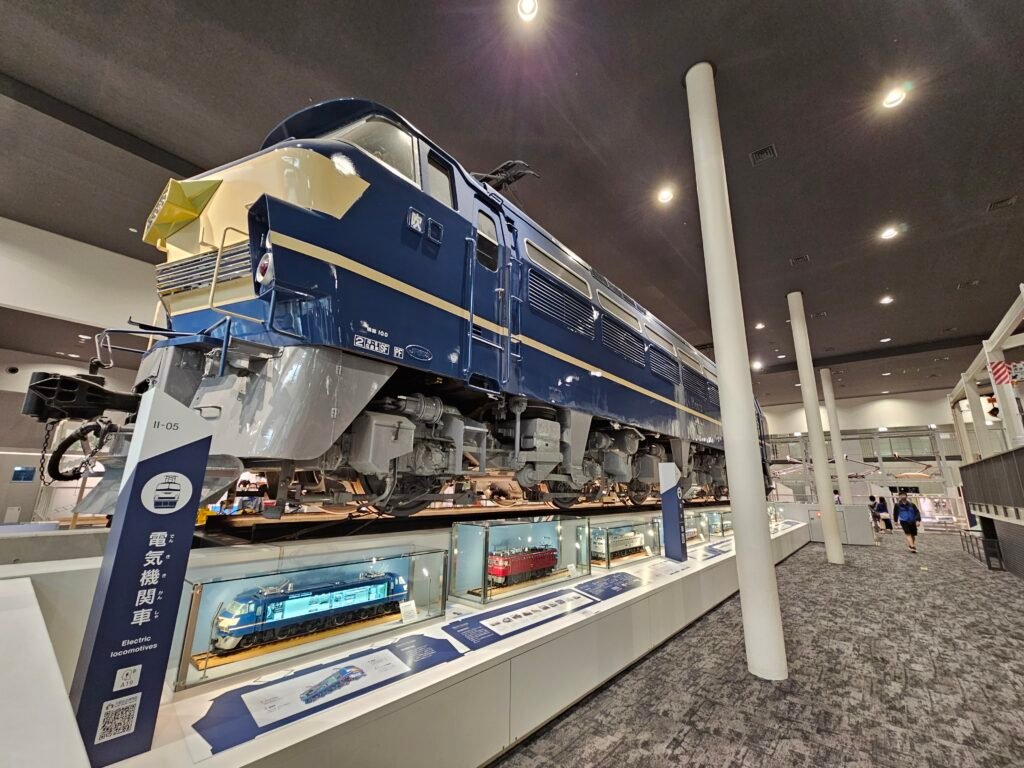
If there was one Kyoto attraction that our seven-year-old absolutely did not want to leave, it was the Kyoto Railway Museum. He loved it!
Japan’s trains are already fascinating for children, and this museum goes far beyond looking at a few old locomotives. There are Shinkansen, steam trains, railway displays, simulators and interactive exhibits. The museum has more than 50 railway vehicles on display.
🕘 Opening Hours: 10:00 AM–5:00 PM; last admission 4:30 PM.
💰 Entry Fee: ¥1,500 adults; ¥500 for junior-high/elementary-school students; ¥200 for children aged 3 and over. Closed Wednesdays and during the year-end/New Year period, with additional calendar exceptions.
Getting there: From Kyoto Station, take the JR Sagano Line to Umekoji-Kyotonishi Station, which is about a two-minute walk from the museum. You can also walk from Kyoto Station in around 20 minutes.
For families, I’d go earlier rather than later. The museum closes earlier than many major Kyoto attractions, and there is enough here to occupy kids for several hours (especially if they are train obsessed like ours!)
Fushimi Inari
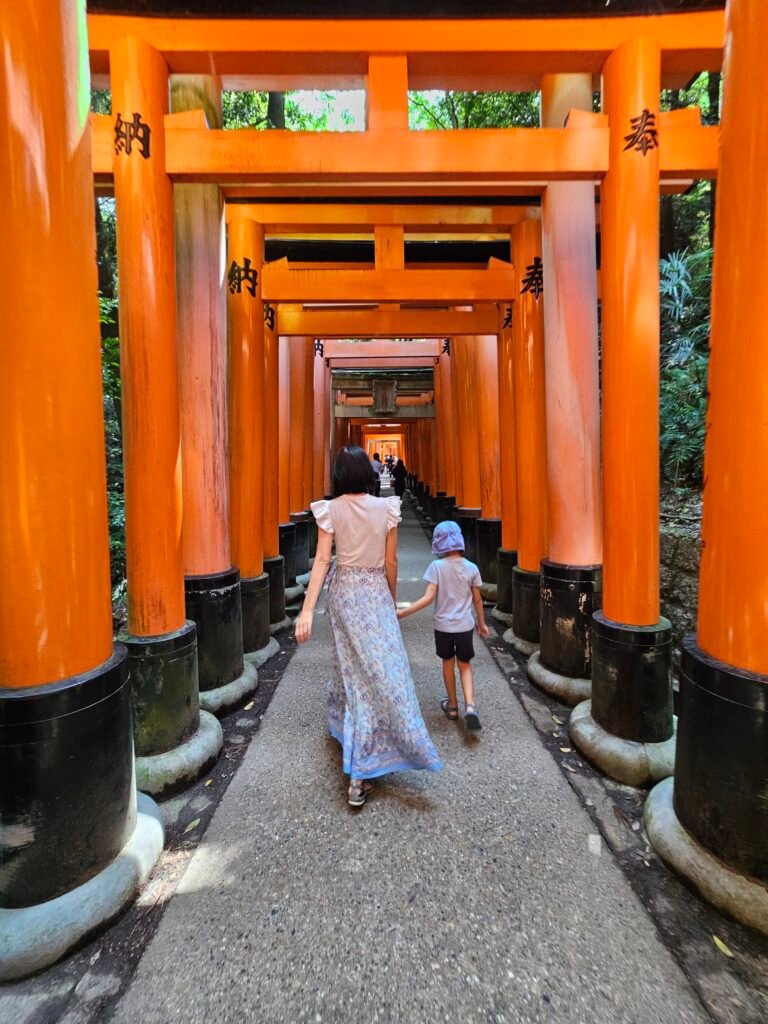
Fushimi Inari Taisha was another Kyoto highlight, and photographs really don’t capture the scale of it. It’s the head shrine for the thousands of Inari shrines across Japan, and it’s famous for its seemingly endless rows of bright orange torii gates winding up Mount Inari, many donated by businesses hoping for good luck.
Get your kids to look out for the fox statues. Foxes are the messengers of Inari, and some of them carry a key in their mouth: the key to the rice storehouse.
You don’t have to hike all the way to the top of the mountain to experience Fushimi Inari. The lower shrine and the first sections of the torii gates are already impressive, while continuing further up turns it into a proper uphill hike. With a child, you can simply decide how far you want to go rather than treating reaching the summit as the goal.
One of the easiest things about visiting is the transport. JR Inari Station is directly beside the shrine, and it’s only about five minutes from Kyoto Station on the JR Nara Line. The Keihan Line’s Fushimi-Inari Station is another option, around a five-minute walk away. I’d definitely use the train rather than a bus.
🕘 Opening Hours: The shrine grounds are accessible 24 hours a day, although individual facilities have their own hours.
💰 Entry Fee: Free.
📍 Address: 68 Yabunouchi-cho, Fukakusa, Fushimi-ku, Kyoto.

Day Trips From Kyoto
We also took two easy day trips from Kyoto, all independently using public transport: Nara and Arashiyama. Japan’s train system can look a little intimidating at first, especially when you’re used to travelling somewhere where transport isn’t quite so organised, but we found it surprisingly easy to figure out.
Once we understood which station and train line we needed, we could simply follow the signs, check the departure boards and get on our way.
Nara as a Day Trip From Kyoto
Nara was one of the easiest day trips we did from Kyoto, and it was well worth adding to our itinerary. We travelled there independently by train and spent the day exploring on foot, without needing to book a tour.
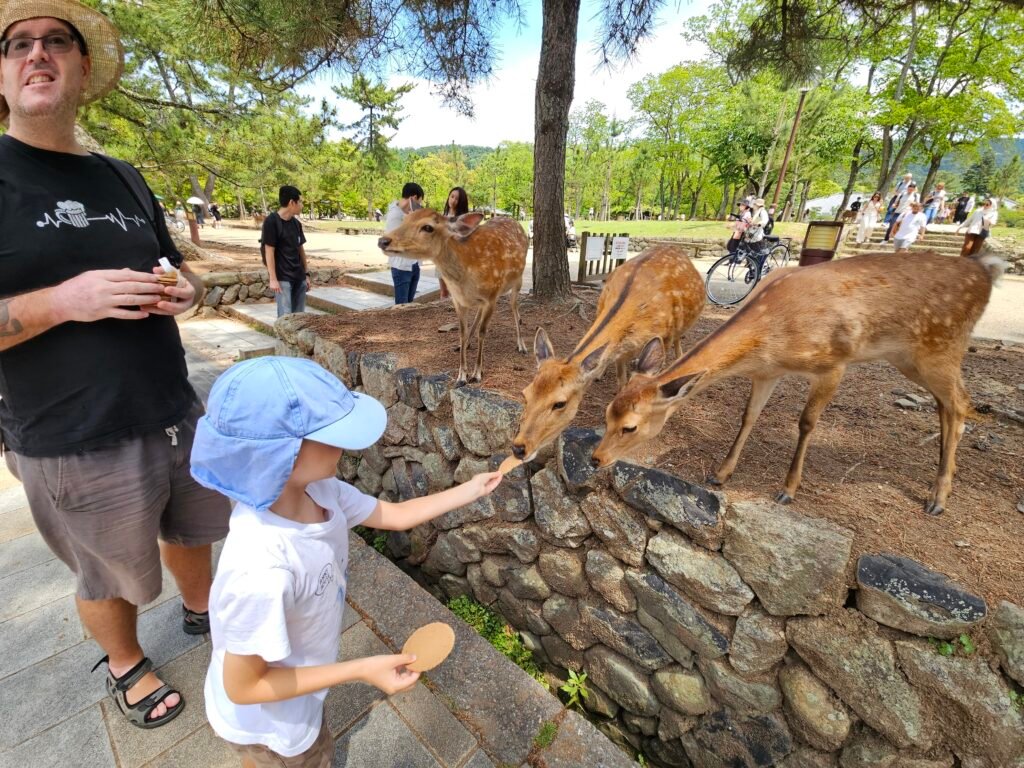
The biggest attraction for our son, unsurprisingly, was the deer. Hundreds of them roam freely around Nara Park, and you can buy special shika senbei (deer crackers) to feed them. They are used to people and can be very friendly, although some become very enthusiastic when they realise you have food! A few will nudge, tug at your clothes or even give you a little nip if they think you’re hiding crackers from them. The official Nara tourism advice is to show them your empty hands once you’ve run out so they know there’s no more food.
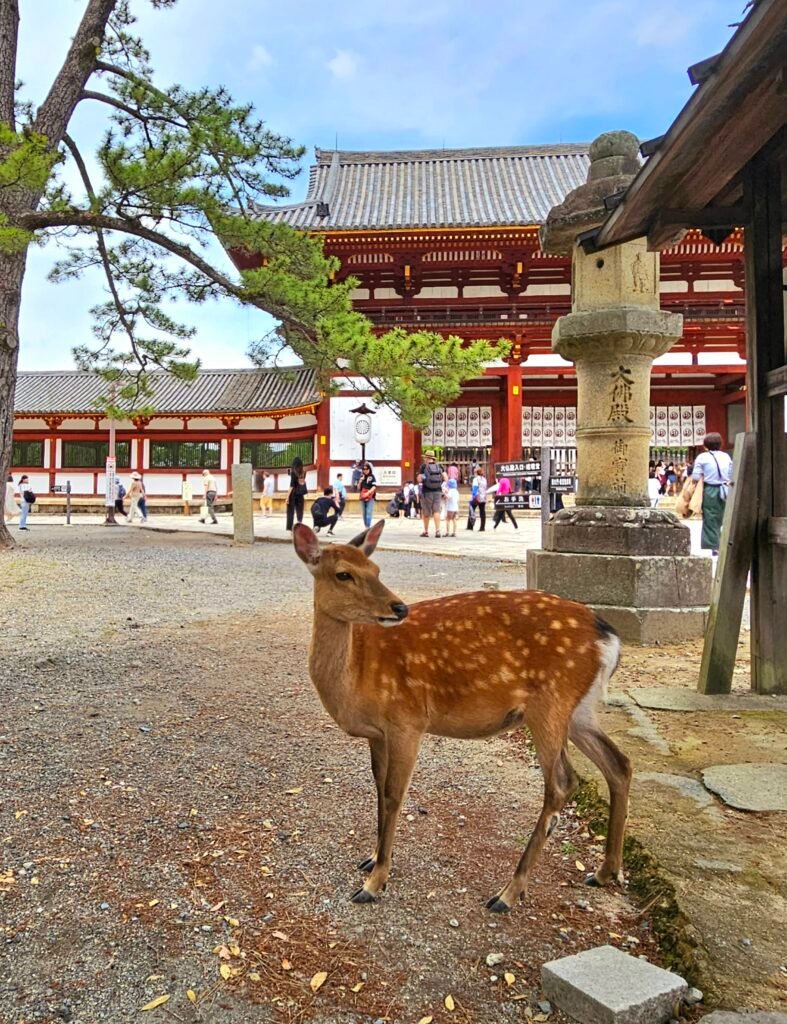
Beyond the deer, there is plenty to see. We visited Tōdai-ji, home to the enormous Great Buddha and the huge wooden Great Buddha Hall. The scale of the building and statue is impressive even for adults, and it’s a particularly memorable place to introduce children to Japan’s Buddhist history.
We also enjoyed walking along Sanjo-dori, the main shopping street leading towards Nara Park. It’s lined with shops, restaurants and Japanese sweets, and eventually takes you towards the park and the historic areas of Nara. One of the fun stops along the way is Nakatanido, famous for its dramatic high-speed mochi pounding and freshly made yomogi mochi.
Nara’s Naramachi district is another lovely area to wander through, with narrow streets, traditional merchant houses, small shops, cafés and craft stores. It’s compact enough to explore on foot and makes a nice change from the major temple sites.

Getting to Nara from Kyoto
The journey is straightforward by public transport. From Kyoto Station, JR trains take around 45 minutes to JR Nara Station, while the Kintetsu route takes you directly to Kintetsu-Nara Station, which is particularly convenient because it’s closer to Nara Park. Once you’re there, much of the main sightseeing area can be explored on foot.
You can also take this half day tour if you don’t feel like figuring out the transportation.
Nara could easily fill more than a day, but for our itinerary, a day trip worked perfectly and meant we could experience another completely different side of Japan without packing up our bags and changing hotels again.
Arashiyama
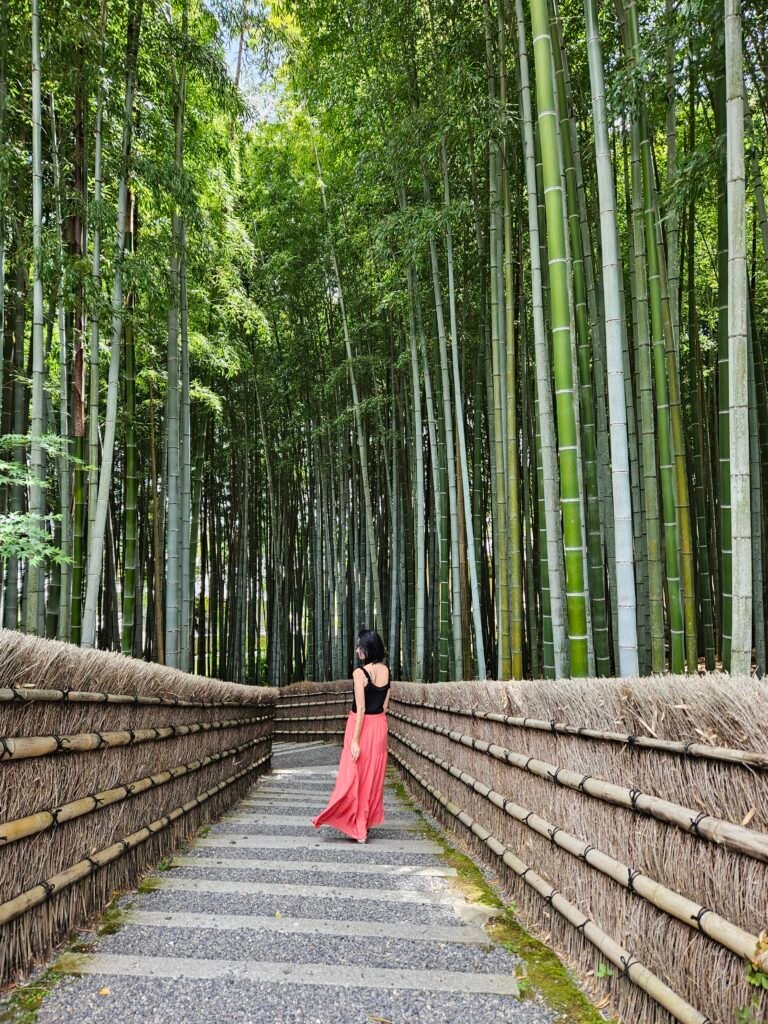
One of the things I’d definitely recommend when visiting Arashiyama is allowing much more time than you think you’ll need. The famous bamboo grove is only one small part of the area, and we found ourselves doing a lot of walking because there was so much more to see.
We wandered through the Arashiyama Bamboo Grove, around Togetsukyo Bridge, and further into the surrounding area, including Otagi Nenbutsu-ji, which was one of our favourite stops. There are also temples, gardens, traditional streets, shops and restaurants spread throughout the wider Saga-Arashiyama area. Tenryu-ji, one of Kyoto’s most important Zen temples, is another major attraction here.
We travelled to Arashiyama independently from Kyoto. From Kyoto Station, the easiest option is the JR Sagano Line to Saga-Arashiyama Station, which takes around 11 minutes on a rapid train, followed by a walk into the main sightseeing area. Kyoto’s official tourism site recommends the train over the bus, as buses can be slow and crowded. Alternatively, you can book this tour taking you to all the main sites so you don’t have to worry about the logistics.
There’s also the Sagano Romantic Train, a scenic railway that runs along the Hozu River through the Hozukyo Gorge. We didn’t take it ourselves, but it’s a popular option if you’d like to make the journey part of the experience. The train takes around 25 minutes, and advance reservations are recommended, particularly during busy periods.
For us, Arashiyama ended up being much more of a walking and exploring day than a quick visit to the bamboo forest. If you want to see some of the quieter temples and areas beyond the main tourist streets, I’d definitely give yourself most of the day.
🕘 Opening Hours: Arashiyama itself is an open district; individual temples and attractions have their own opening hours.
💰 Entry Fee: Free to explore the area and bamboo grove; individual attractions charge their own admission.
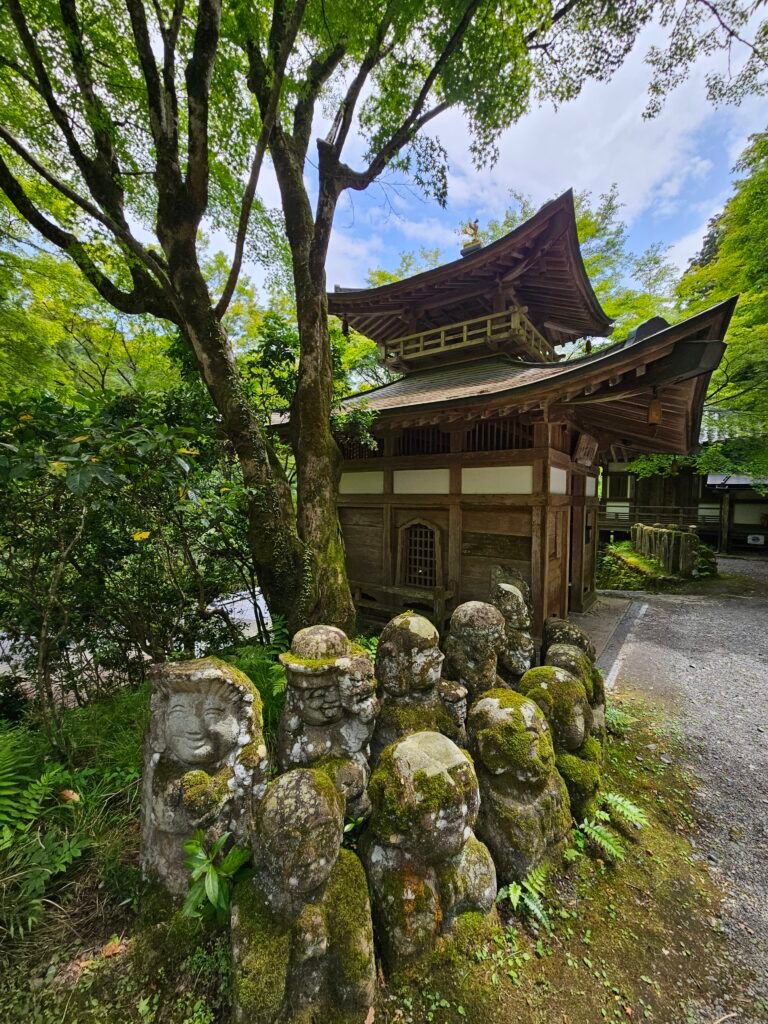
Otagi Nenbutsu-ji
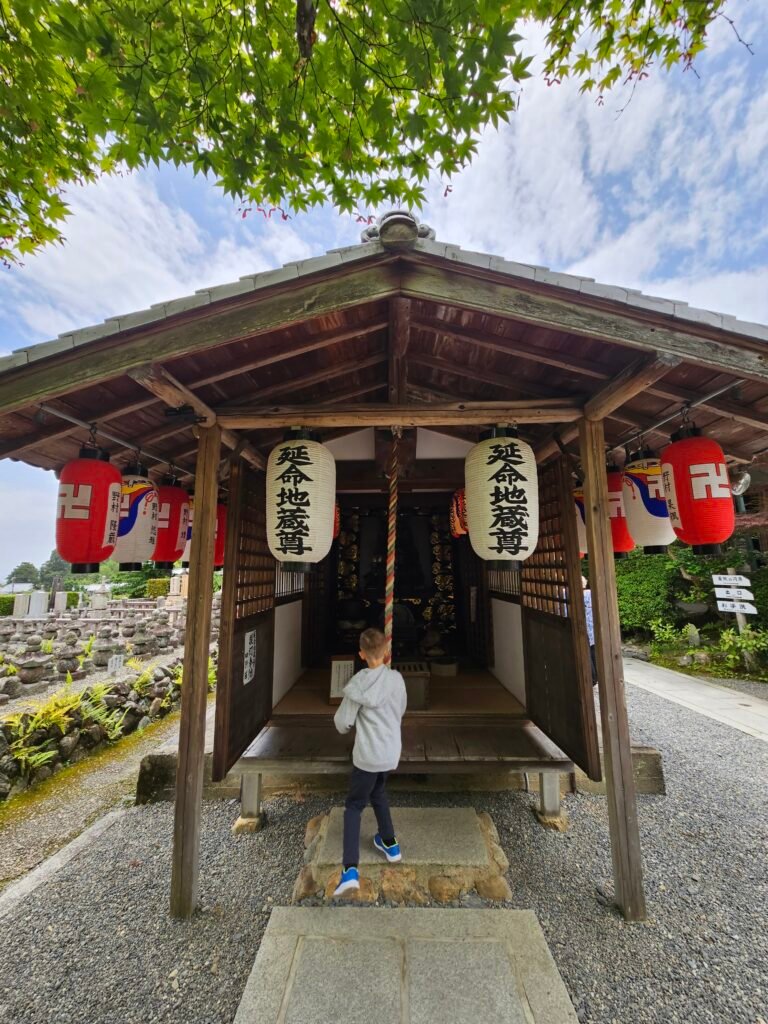
Otagi Nenbutsu-ji was one of those places our family thought was really cool. The hillside around the temple is covered with around 1,200 small stone Rakan figures (disciples of the Buddha), and every single one has a different face.
They were carved in the 1980s and 1990s by ordinary visitors, not professional sculptors, and it shows in the best way. Some look serious, but plenty are grinning, laughing or pulling funny faces, and some hold objects linked to the hobbies of whoever carved them. Hunting for the silliest face is a great game for kids.
Getting to Otagi Nenbutsu-ji
We’d actually recommend making this the starting point for your Arashiyama day. The temple is at the northern end of the area, so you can visit it first and then gradually walk downhill through Saga-Toriimoto’s preserved traditional streets, towards the bamboo grove, Togetsukyo Bridge and central Arashiyama. The temple itself recommends this route.
From JR Saga-Arashiyama Station, the easiest option is a taxi: about 5 minutes and around ¥1,500. Alternatively, take Kyoto Bus #94 (towards Kiyotaki) to the Otagi-dera-mae stop. Walking from the station takes about an hour, mostly uphill.
🕘 Opening Hours: 9:00 AM–4:00 PM. Closed every Wednesday and Saturday, so plan your Arashiyama day around this.
💰 Entry Fee: ¥1,000; children aged 10 and under are free.

Leaving Japan: Kyoto to Kansai Airport
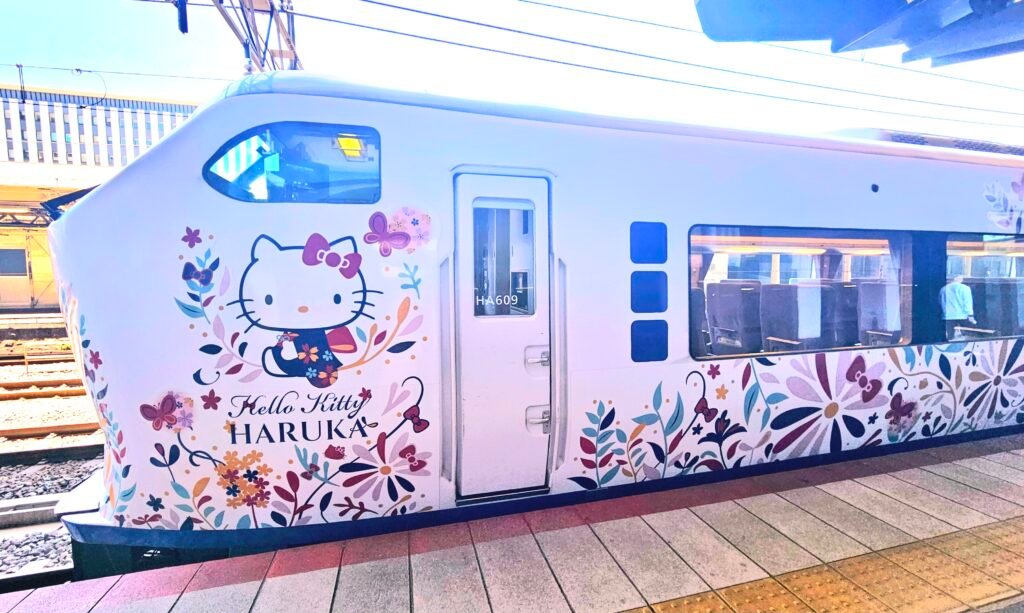
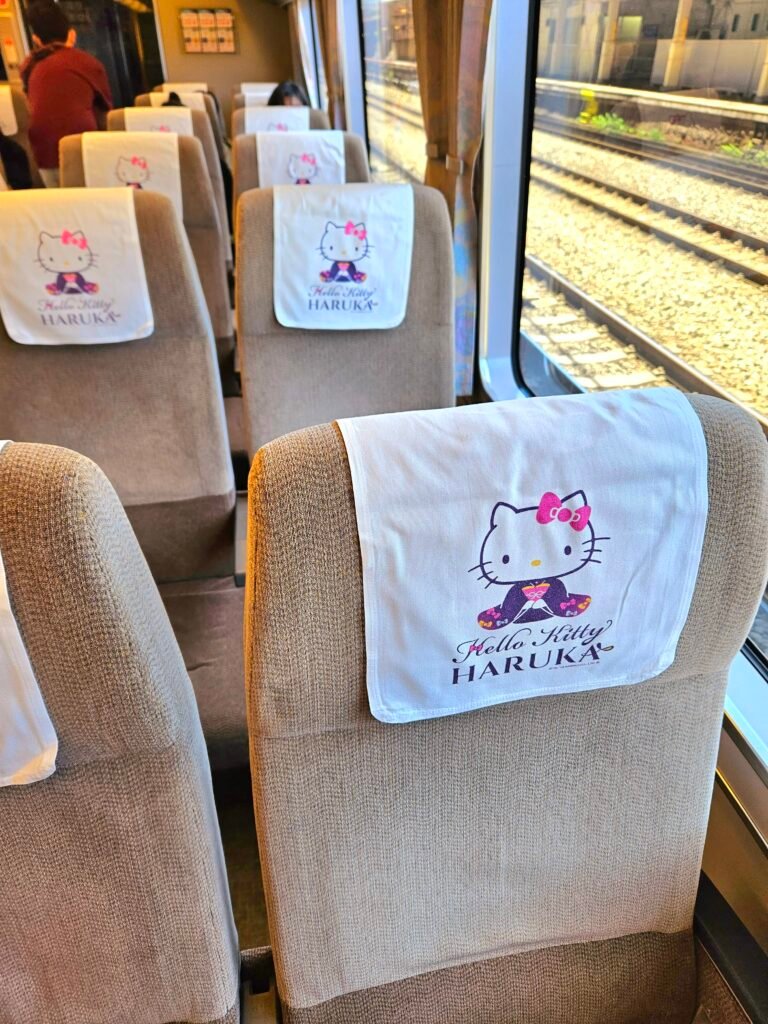
To leave Japan, we took the Shinkansen from Kyoto to Shin-Osaka, then the Haruka limited express from Shin-Osaka to Kansai International Airport. We didn’t spend any time in Osaka, so for us this was simply the last leg of the trip.
The Shinkansen part was a highlight in itself: our train was decorated with Hello Kitty, which made it a particularly fun way to finish our time in Japan.
🕘 Journey Time: About 15 minutes from Kyoto to Shin-Osaka by Shinkansen, then about 50 minutes on the Haruka to Kansai Airport.
💰 Haruka Fare: The discounted HARUKA One-way Ticket for overseas visitors is ¥1,800 for adults and ¥900 for children from Shin-Osaka.
Tip: the Haruka also runs directly from Kyoto Station to Kansai Airport in around 70–80 minutes (¥2,200 adults, ¥1,100 children with the same ticket), with no change of train. It’s worth considering if you aren’t set on one last Shinkansen ride.
Booking Shinkansen Tickets
For the Tokaido Shinkansen (Tokyo, Nagoya, Kyoto, Shin-Osaka), the easiest way to book is the official Smart EX service. You can book from outside Japan, choose your seats from a seating map and board with a QR code. One booking covers up to six passengers, adults and children together, so it’s easy to make sure the family sits together.
For the longer Tokyo to Nagoya leg, look at the early-booking Hayatoku fares, including the EX Family Hayatoku 7, which can save money if you book at least seven days ahead. Seats are limited, so book once your plans are fixed.
What We Ate: Food in Japan With a 7-Year-Old
We’d wondered whether food might be tricky with a seven-year-old, and it turned out to be one of the easiest parts of our 12 days in Japan with kids. Our son happily ate his way around Japan, and these were our family’s go-tos:
Konbini (Convenience Stores)
Japan’s convenience stores, like 7-Eleven, FamilyMart and Lawson, are nothing like the ones at home. They’re perfect for quick breakfasts, train snacks and picnic supplies: onigiri (rice balls with fillings, wrapped in seaweed), egg sandwiches, fried chicken, yoghurt, fruit and drinks. They’re also ideal for putting together a packed lunch for the Nakasendo.
Conveyor-Belt Sushi
Kaiten-zushi was a huge hit with our son. Plates come past on the belt or are ordered from a touchscreen and whizz up to your table, which makes the meal part of the entertainment. It’s also good value, and the big chains have plenty of non-fish options for children, plus desserts.
Ramen, Udon and Tempura
Noodle shops were an easy win for all of us. Many ramen and udon restaurants use a ticket machine at the entrance: you choose your meal, pay, and hand the ticket to the staff. Udon is mild and filling, and tempura (lightly battered, fried vegetables and prawns) tends to go down well with children.
Street Snacks and Traditional Sweets
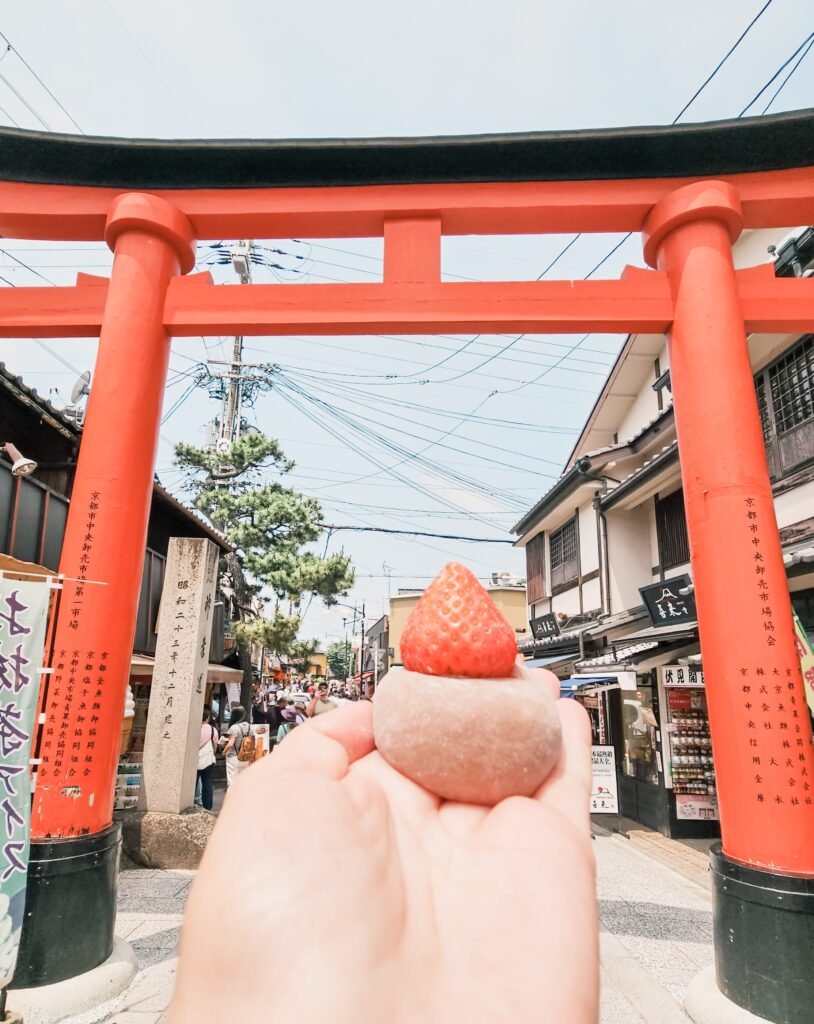
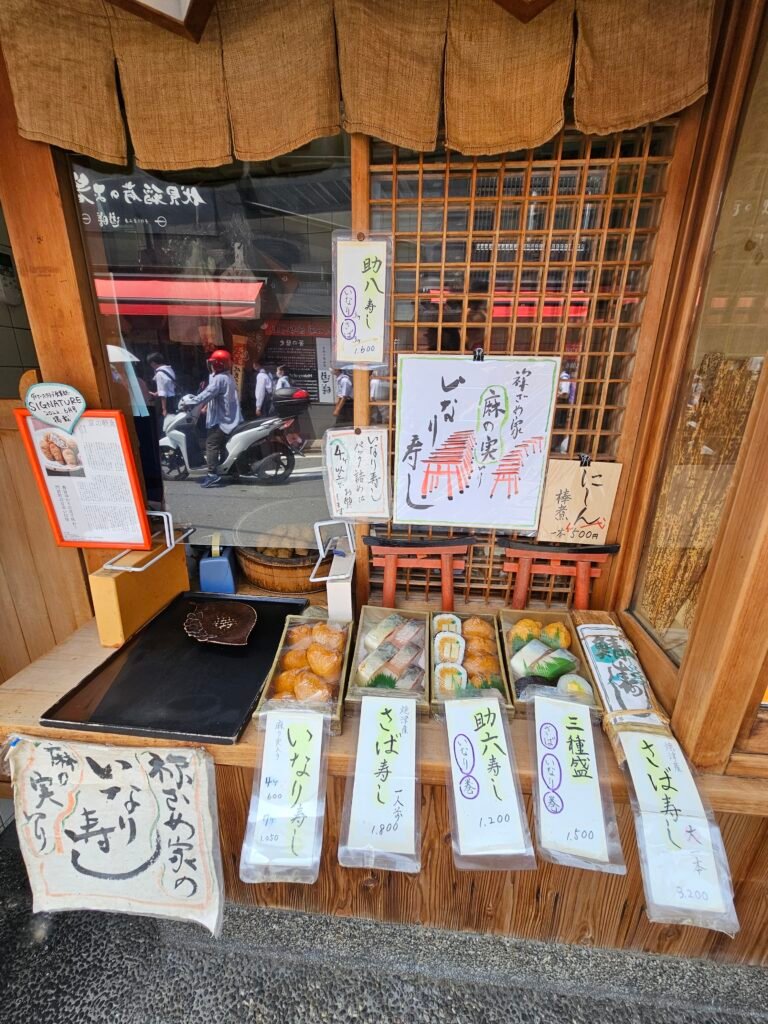
Snacking was a big part of the fun, especially along Nakamise-dori in Asakusa, Takeshita Street in Harajuku and Sanjo-dori in Nara. Look out for taiyaki (fish-shaped cakes filled with sweet red bean or custard), dango (rice dumplings on a stick), freshly pounded mochi and matcha soft-serve ice cream.
In Kyoto, don’t miss yatsuhashi, the city’s most famous sweet. The soft version, nama yatsuhashi, is a thin, almost paper-like sheet of rice-flour dough folded into a triangle around sweet red bean paste, and it’s usually flavoured with cinnamon or matcha. You’ll find it in shops all over Kyoto, including around Kiyomizu-dera and Nishiki Market, and the boxes make great souvenirs.

How Much Did 12 Days in Japan With Kids Cost?
Here’s exactly what our family of three (two adults and our seven-year-old) spent on our 12 days in Japan with kids in May 2023. These figures don’t include flights.
| Category | What it covered | Cost (USD) |
|---|---|---|
| Accommodation | 5 nights in Tokyo (room only), 1 night at Tajimaya Ryokan (dinner and breakfast included), 5 nights in Kyoto (breakfast included) | $1,364 |
| Food and drinks | Mid-range restaurants, konbini lunches, snacks and treats, including one dinner at NINJA TOKYO (about $300) | ~$1,000 |
| Transport | Airport train, Shinkansen, local trains, metro and buses | $620 |
| Activities | teamLab Planets, museums and temple tickets, Mount Fuji tour, kimono rental and tea ceremony, Samurai & Ninja Museum | $550 |
| Souvenirs | High-quality matcha to take home and small gifts for our son | $100 |
| Luggage forwarding | Two large suitcases and one small suitcase, Tokyo to Kyoto | $55 |
| eSIM | Two phones, 10 GB each for 12 days | $36 |
| Total | Family of three, 12 days, not including flights | $3,725 |
That works out to about $310 a day for the three of us, or roughly $104 per person per day. A note on prices: these are our 2023 costs, and prices in Japan have gone up since then, so treat them as a guide and build in a buffer.
If you’re curious how Japan compares with the rest of our travels, here’s what we spent in a full year of family travel where we break down our full year of travel in 2023 and 2024, as a worldschooling family of three.
Is 12 Days in Japan With Kids Enough?
Twelve days obviously isn’t enough to see everything Japan has to offer. But 12 days in Japan with kids is enough to get a really good taste of the country, and, if anything, leave you wanting to come back for more.
Our route gave us three very different sides of Japan without constantly packing and unpacking:
Tokyo introduced us to the energy of modern Japan, with its technology, food, neighbourhoods, museums and seemingly endless things to discover.
The Nakasendo was a complete change of pace, with forest trails, historic post towns, mountain scenery and a traditional ryokan experience.
Kyoto brought us temples, shrines, Japanese history and culture, traditional experiences and easy day trips into the surrounding area.
That is a huge amount of variety for 12 days, and it never felt as though we were simply racing from one destination to the next.
Of course, there is still so much we didn’t see. And I think that’s actually a good thing. Japan is somewhere I’d happily return to, knowing there are still entire regions, cities and experiences waiting for us.
Rather than trying to squeeze the whole country into one trip, 12 days can give you enough time to experience a few places properly, get a feel for Japan, and leave with a very good reason to start planning the next visit.
If you’re planning more of Asia with kids, you might also like our guides to Mongolia with kids, Uzbekistan with kids, Kyrgyzstan with kids and Da Nang with kids.
FAQ: 12 Days in Japan With Kids
Yes, for a first trip. Twelve days is enough for Tokyo, a night on the Nakasendo Trail and Kyoto, with day trips to Nara and Arashiyama, without rushing. Keep the number of bases low: we used just three.
Our family of three spent about $3,725 USD in May 2023, not including flights. That’s roughly $310 a day, or about $104 per person per day. Accommodation ($1,364) and food (about $1,000) were the biggest costs. Prices have risen since, so add a buffer.
Yes. The Tsumago to Magome section is about 8 km and easy to moderate. Our seven-year-old walked it in about four hours, including stops for lunch and tea. Children who are used to walking will manage it, but a stroller isn’t practical.
Magome to Tsumago has less uphill walking, which is why it’s usually recommended. We walked Tsumago to Magome because we were staying the night in Magome. Choose the direction that ends at your accommodation.
Take the Shinkansen to Nagoya, then the JR Chuo Line to Nagiso (for Tsumago) or Nakatsugawa (for Magome), and a local bus from there. Allow about four hours from central Tokyo.
Probably not. From 1 October 2026 a 7-day adult pass costs ¥53,000, and individual tickets for a Tokyo, Nakasendo and Kyoto route like ours add up to well under that. Book the Shinkansen legs on Smart EX instead.
Spring (avoiding peak cherry blossom week and Golden Week) or October to November. We travelled in May, and the weather was ideal for long walking days.
Forward it. We sent our suitcases from Tokyo to our Kyoto hotel with a luggage-forwarding service and carried only a small overnight bag. Send it at least two days before check-in and confirm your hotel will accept it.

One Comment