
Long-Haul Flights With Kids Aged 6 to 10 (and the Headphones That Actually Work)
Some of the links below are affiliate links. If you buy through them we may earn a small commission at no extra cost to you. We’ve clearly marked which products we use ourselves and which we’ve only researched.
Long-haul flights with kids aged 6 to 10 are much easier than most parents fear. At this age the problem isn’t naps or nappies. It’s boredom. What makes the biggest difference for us is a pair of volume-limited headphones, hours of downloaded music and audiobooks, a small bag of screen-free activities, plenty of snacks, and seats booked well in advance.
We started travelling with our son when he was almost four. Since then we’ve visited more than 90 countries as a family, including four years of full-time family travel, before making Tbilisi our home base. He’s 10 now, and long flights are a normal part of his life. Most guides to flying long haul with kids are about babies and toddlers. This one is for parents of school-age children, written by a family that flies with one constantly.
Our long-haul flight bag for a 6 to 10-year-old
This is what goes into our son’s bag for a long flight. Everything on this list is something we actually pack.
- Volume-limited headphones: his JBL Junior headphones, fully charged.
- A tablet: our Samsung Galaxy tablet, loaded with downloads before we leave.
- Downloaded audio: a long music playlist and a couple of audiobooks from Audible.
- E-books: books downloaded in the Kindle app, so he never runs out of reading.
- A drawing kit: paper, pencils and markers, like this set.
- Small games: a couple of compact card games from our list of travel games we actually take.
- A small chess set: a travel chess set for games together on the tray table.
- Snacks: more than you think you’ll need.
- Natural gummies: something to chew during take-off and landing. We love Bob Snail brand or other natural gummies with no added sugar.
For everything else we carry, see the family travel gear we actually use and how we pack for long-term family travel.
Before the flight: booking, seats, meals and downloads
Compare airlines, not just prices
We usually search for flights on Kayak, because it compares lots of airlines in one place. On a long-haul flight, the airline matters as much as the fare. Extra legroom, decent food and a working entertainment system can change the whole day.
Compare long-haul fares, airlines and cabins in one search.
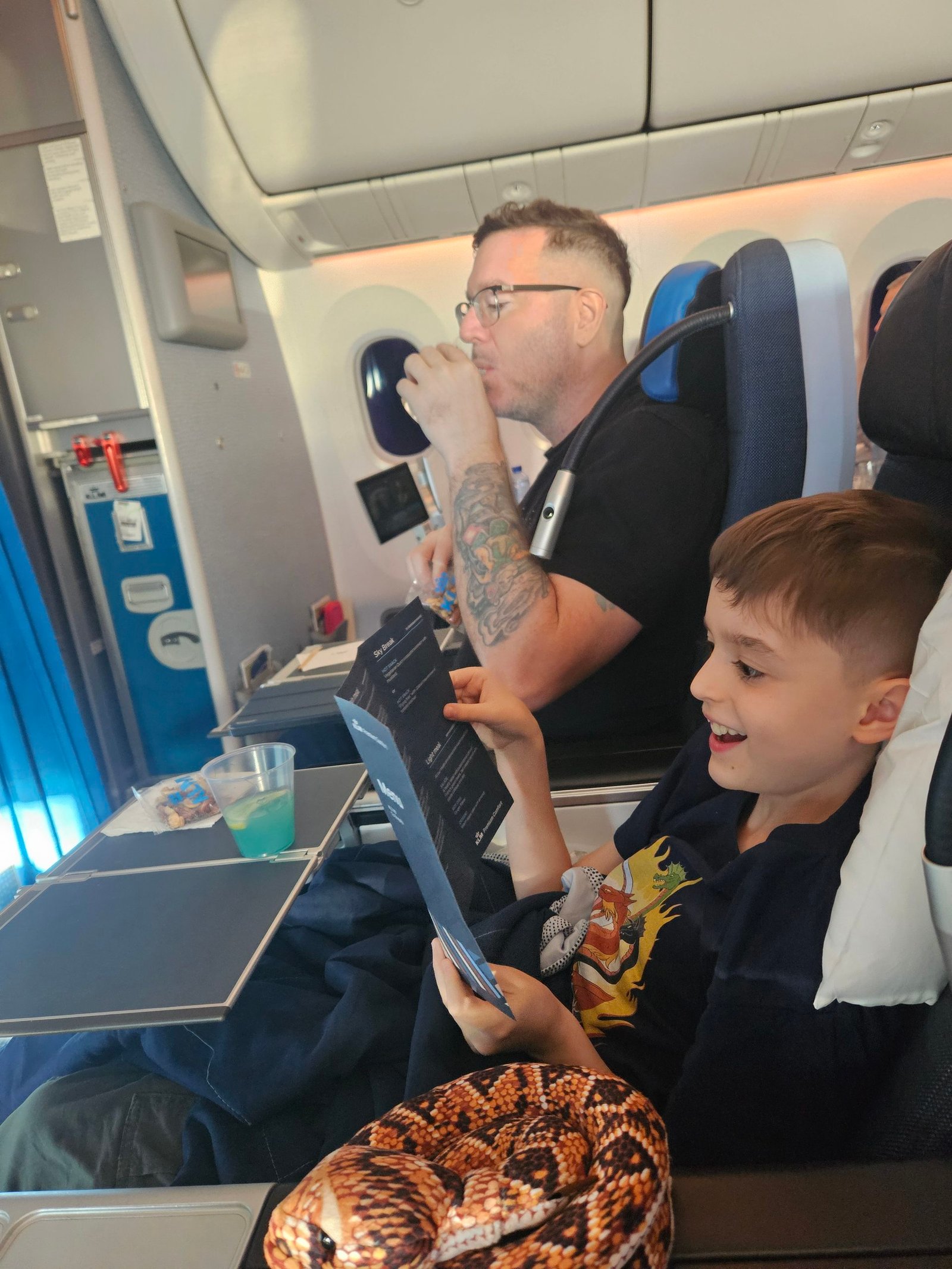
Our longest flights with our son were Amsterdam to Bogotá with KLM and Cancún to Amsterdam with TUI fly, each around ten hours. We flew premium economy both times, and both flights were genuinely comfortable. The extra legroom made a real difference to all three of us. He still got bored at times, of course. That’s normal, and it’s what the rest of this guide is about. (You can read about that trip in our week in Colombia.)
Airlines we’d recommend, and the kind we avoid
KLM is our favourite for long flights with our son. The service in its premium economy cabin, which KLM calls Premium Comfort, is excellent and the food is good. We’d also happily fly Qatar Airways, Emirates or TUI fly with a child. Our TUI fly premium economy flight home from Cancún was a good one.

What we avoid on long haul is ultra-low-cost airlines such as Scoot. Our one Scoot flight was only around five hours, and even that was uncomfortable, with very little legroom. Meals aren’t included in Scoot’s basic fare either, even on its long-haul routes. Once you add seats, meals and bags for a whole family, the cheap fare stops looking cheap.
Always pay for seats
We always pay for seat selection on all flights. We don’t want to take any chances on being split up, especially with a child. Rules on seating families together differ between airlines and countries, so check your airline’s policy when you book. For us, the extra cost is worth the peace of mind.
Pre-order the kids’ meal
We pre-order a child meal whenever the airline offers one. Most airlines need the request in advance, so add it when you book or in “manage booking” well before you fly.
Pro tip: Here’s a tip we’ve picked up along the way. In our experience, special meals, such as child, gluten-free or diabetic meals, arrive before the main meal service. With a hungry child, getting food first is very handy. Only choose a dietary or medical meal if it genuinely suits your child, though.
Download everything before you leave
Don’t rely on the plane’s Wi-Fi or entertainment system. Download films, games, music, audiobooks and e-books at home, then open each one offline to check it works. Power sockets and USB ports vary from plane to plane too, so charge everything fully the night before.
The headphones that actually work on long-haul flights with kids
If we could only take one thing on a long flight with our son, it would be his headphones. Luckily, he loves music and is happy to listen to his favourite songs for hours. That gives him something to do that isn’t a screen, and it gives everyone a calmer flight. We didn’t want him on a screen or playing games the whole time, and music solves that.
Our pick: JBL Junior headphones (used by us)
We did a lot of research before settling on JBL Junior. They’re Bluetooth, so there’s no cable to tangle around an armrest. The volume is capped, so he can’t turn them past a safe level, even in a noisy cabin. The battery lasts a really long time, and he finds them comfortable enough to wear for hours.
The current Bluetooth model in the range is the JBL Junior 320BT. According to JBL, it never goes above 85 dB and lasts up to 50 hours on a charge. Parents can also set a lower volume limit and a daily listening time in the JBL Headphones app. The headband adjusts as your child grows, and the headphones fold flat for a backpack.
One thing to know: the Junior 320BT has no headphone socket, so it can’t plug into a seat-back screen. That’s fine for anything on a tablet. For the airline’s own films, you’ll need the airline’s headphones, a wired pair, or a small Bluetooth transmitter such as the Avantree Relay (researched, not used by us), which plugs into the seat socket.
See JBL Junior headphones on Amazon
What to look for in kids’ headphones for flying
- Volume limiting. Most kids’ headphones cap volume at 85 dB. Treat that as a ceiling, not a target. The WHO-ITU safe listening standard uses a lower reference for children: 75 dB for 40 hours a week. A parental app that sets a lower limit is a real bonus.
- Battery life. Aim for at least 20 hours, so a long flight plus a layover won’t run them flat.
- A wired backup. A 3.5 mm cable lets your child keep listening when the battery dies, and plug into a seat-back screen. Check whether the volume limit still works when wired. Some brands only promise it in Bluetooth mode.
- An airline adapter. Some planes still use a two-pin audio socket. A small two-pin airline adapter lets a normal 3.5 mm plug fit.
- Fit and comfort. A padded, adjustable headband and soft cushions matter on a ten-hour flight. Get your child to wear them at home for an hour first.
- Noise cancelling. Active noise cancelling cuts engine noise, so children are less tempted to turn the volume up. It costs more and uses more battery.
- Durability. They’ll get squashed in bags and dropped on airport floors. A folding design and a case help.

Kids’ headphones for flying, compared
Here’s how our JBL Junior headphones compare with four well-reviewed alternatives for ages 6 to 10. We’ve only used the JBL pair. The others are researched from each maker’s published specs. Prices are a rough US guide and change often.
| Headphones | Used by us? | Volume limit | Battery | Wired and airline use | Noise cancelling | Approx. price |
|---|---|---|---|---|---|---|
| JBL Junior 320BT | Yes, our pick | 85 dB, lower limit in app | Up to 50 hours | Bluetooth only, no socket | No | $45 |
| JBL Junior 470NC | No, researched | 85 dB, lower limit in app | Up to 50 hours with noise cancelling off | 3.5 mm cable included | Yes | $65 |
| Puro Sound Labs BT2200s Plus | No, researched | 85 dB | 20 hours | 3.5 mm cable included | No (noise isolating) | $99 |
| Belkin SoundForm Mini | No, researched | 85 dB in Bluetooth mode | Up to 30 hours | 3.5 mm cable included | No | $33 |
| iClever Cat Ear BTH13 | No, researched | 74 or 85 dB settings | Up to 50 hours with lights off | 3.5 mm cable included | No | $27 |
A few notes on the alternatives. The JBL Junior 470NC is the one we’d look at if you want noise cancelling plus a cable for seat-back screens. Belkin’s SoundForm Mini is the budget choice, but Belkin only states its 85 dB cap for Bluetooth mode. The iClever Cat Ear BTH13 headphones are the fun pick, with light-up cat ears that many kids love. They have a quiet 74 dB setting and an 85 dB setting, rated 4.7 out of 5 from nearly 12,000 Amazon reviews. Switch the lights off on long flights to save battery. Independent tests sometimes measure kids’ headphones a little above their stated cap, so a limit helps but doesn’t replace keeping an eye on listening time.
Entertainment that isn’t just screens
On long-haul flights we let our son use the in-flight entertainment, usually for games or a film. We keep it to a couple of hours at most. The rest of the time he reads, listens to music or an audiobook, draws, or plays games with us (or sleeps, if it’s an overnight flight).
Audible and the Kindle app do a lot of the work. Audiobooks are especially good on a plane, because he can close his eyes and still be entertained. We’ve used Audible for years on long car journeys too, where screens aren’t ideal for anyone prone to motion sickness.
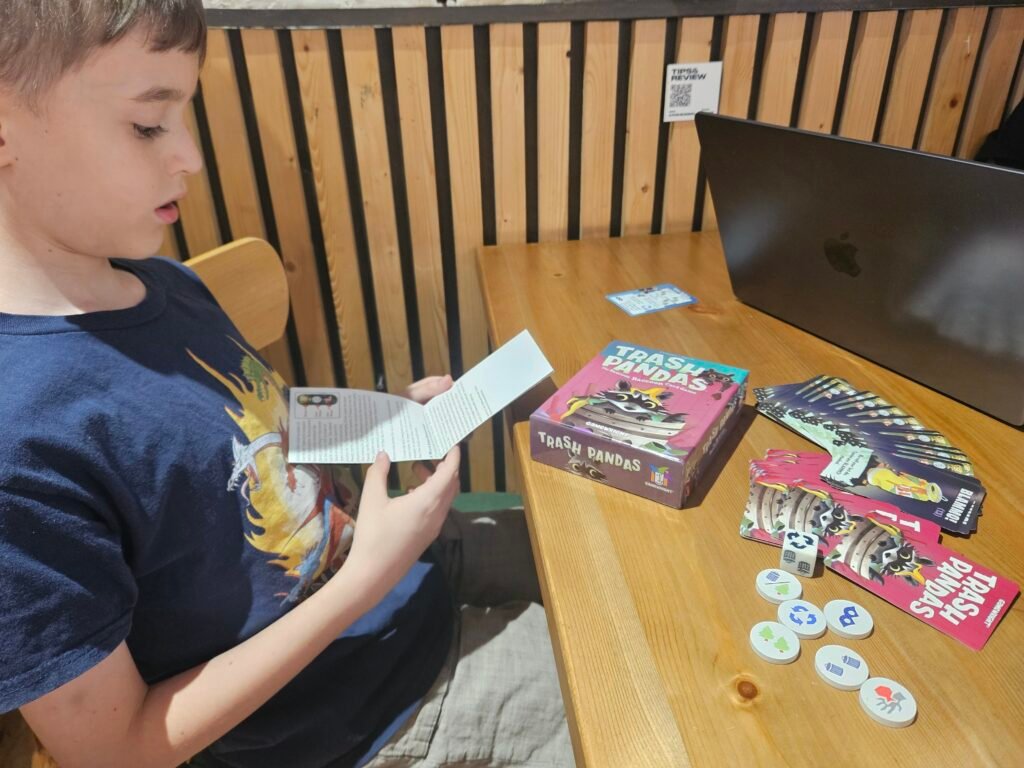
Small card games and his chess set are our favourite way to pass time together. A tray table is small, so choose games with few pieces and no board. Our best travel games for kids post covers the ones that pack smallest.
If your child likes writing or drawing, a travel journal is another good screen-free option. Our free kids travel journal prints at home and slips into a backpack.
Our son’s own tip
We asked our son what he’d tell other kids before a long flight. His advice:
“Bring headphones and have something long downloaded that you can listen to, like a music playlist or a book.”
Snacks and food on board
We always carry our own snacks, even when meals are included. Meal times on a plane rarely match a child’s hunger, and a delay can push the next meal back by hours. Pack dry, non-messy snacks and buy water after security. Remember that liquid limits apply at security, and some countries restrict bringing fresh food in when you land.
Combine your snacks with a pre-ordered child meal and you rarely end up with a hungry, grumpy child. On airlines with decent food, like KLM, the meals become part of the fun.
Sleep, jet lag and time zones
We’re lucky here. When it’s time to sleep, our son sleeps anywhere, including on planes. Not every child does, so give them the best chance: a window seat to lean against, a layer for the cold cabin, and audio instead of a bright screen.
For jet lag, the American Academy of Pediatrics suggests shifting your child’s sleep schedule two to three days before you leave. After you arrive, get them active outside or in bright places during daylight. The CDC notes that losing sleep while travelling makes jet lag worse, and that caffeine can disrupt in-flight sleep. If you’re thinking about melatonin or any sleep aid for a child, ask your doctor first.
Ear pain, motion sickness and staying healthy
This is general information, not medical advice. Speak to your child’s doctor about their own health and any medication.
Ear pain on take-off and landing
Our solution is simple: we buy natural gummies and our son chews them during take-off and landing. Chewing and swallowing help the ears adjust to the change in cabin pressure. The AAP suggests chewing gum or drinking through a straw for older children. It also advises talking to your paediatrician if you’re flying within two weeks of an ear infection.
KidsHealth adds two useful tips. Encourage plenty of water during the flight, and keep children awake for take-off and landing if you can, because we swallow less while asleep.
Motion sickness
The NHS recommends looking at a fixed point, such as the horizon, and avoiding reading or screens if you feel unwell. A seat over the wing can feel steadier too. On a plane, that’s another reason to have audiobooks downloaded. A pharmacist can suggest remedies suitable for children, so ask before you travel rather than on the day.
Travel insurance for the whole family
We never fly long haul without travel insurance. We use SafetyWing for trips. On its Essential plan, one child under 10 per adult is covered free, up to two per family. Genki has a higher medical limit but charges for every child. Our guide to the best travel insurance for digital nomad families compares them in detail.
Long layovers with kids
We use airport lounges whenever we can on long layovers. A quiet seat, a proper meal, clean toilets and somewhere to charge devices make a long wait far easier with a child. Our lounge access comes with our bank accounts at TBC Bank in Georgia, so check whether your own bank or credit card includes it. If not, it’s worth pricing up day passes or a lounge membership such as Priority Pass before you go.
Layovers are also the best time to recharge headphones and tablets. Treat a long layover as a break: walk, stretch and eat before the next flight, so your child boards fed and a bit tired.
When you land, set up mobile data before you leave the airport. We use Airalo and Nomad eSIMs, so we can book a taxi or message our host straight away. Our best eSIMs for international travel guide compares the options.
What we’d do differently, and what we’ve learned
- Headphones come first. Volume-limited headphones and a long playlist do more for a calm flight than anything else we pack.
- Screens need limits, not bans. A couple of hours of films or games, mixed with reading, music, drawing and games together, works well for us.
- Pay for seats. It’s a small cost for knowing you’ll sit together.
- The airline matters. The only thing we’d change is our one budget flight. Even five hours on Scoot was uncomfortable, so on anything long we now choose a full-service airline.
- Premium economy is worth pricing up. The extra legroom made our longest flights genuinely comfortable.
If you’re planning more than one trip, our guide to long-term travel with kids covers how to keep the pace manageable for everyone.
Long-haul flights with kids: FAQ
Plan for boredom. Pack volume-limited headphones, downloaded music, audiobooks and films, a few screen-free activities and plenty of snacks. Book seats together in advance, pre-order a child meal, and mix short bursts of screen time with reading, drawing and games.
Our son’s bag holds headphones, a tablet with downloads, audiobooks and e-books, a drawing kit, small card games, a travel chess set, snacks and something to chew for take-off and landing.
Most kids’ headphones cap volume at 85 dB. The WHO-ITU safe listening standard uses a lower reference for children of 75 dB for 40 hours a week, so treat 85 dB as a maximum and keep an eye on listening time.
Usually not on their own, because most seat-back screens only have a wired headphone socket. Use headphones with a 3.5 mm cable, or plug a small Bluetooth transmitter into the seat socket. Some planes need a two-pin airline adapter.
Encourage chewing, swallowing and drinking during take-off and landing, and keep your child awake for both if you can. Talk to your doctor before flying within two weeks of an ear infection.
That’s up to each family. We allow a couple of hours of in-flight films or games on long-haul flights, then switch to reading, music, audiobooks, drawing and games together.
On long flights, we think it often is. Our longest flights with our son were in premium economy, and the extra legroom made them genuinely comfortable for all three of us.
Final thoughts
Long-haul flights with kids aged 6 to 10 are mostly about filling hours well. Get the basics right: seats together, a pre-ordered meal, snacks, and downloads that work offline. Then add the one thing that changed flying for us, a comfortable pair of volume-limited headphones with something long to listen to. Your child might even start looking forward to the flight.
Free kids travel journal
Looking for something screen-free for the flight? Our free printable travel journal has 10 pages for your child to fill in on the trip. Print it at home and pack it with a few pencils.